Paul Kupperberg on September 11th, 2009


Have I mentioned that I’ll be at the Brooklyn Book Festival this Sunday, September 13 at the Moonstone Publishing booth, starting at around noon? And that I’ll be signing copies of Captain Action and anything else you care to shove under my pen? I’m just being rhetorical, of course; I know I haven’t. But now I have, so if you’re in the Borough Hall area and like books, I hope you’ll come around and say hello. As one Brooklynite to another, you know what I mean?

Tags: ,

Paul Kupperberg on September 9th, 2009


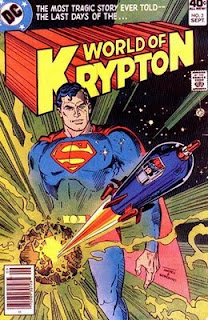
An introduction I wrote last year for DC’s Superman: The World of Krypton trade paperback:

© 2008 DC Comics

Whenever I’m asked about Krypton, the first question I ask is, “Which Krypton?”

There have been a lot of them over the years, one for practically every artist who ever drew Superman. The default image of Krypton for me will always be Wayne Boring’s, the lead artist on Superman for most of the 1950s, the decade in which Krypton received a lot of play in the developing Superman mythology.

Boring’s art had a distinctive and, even for its time, dated look, a very old school, 1930s pulp illustration sensibility. His people were stiff and posed; his Earth-bound cities heavy, buildings looking like they were carved from great slabs of granite that could withstand Superman lifting them by their corners to move out of harm’s way. His Krypton, on the other hand, was sleek and delicate, boasting gleaming, graceful minarets towering over spotless streets filled with streamlined art deco vehicles.

To me, Boring’s art represents the very essence of Krypton, that world of supermen that spawned my favorite comic book character.

But that’s just me.

As I mentioned, every artist brought their own interpretation to the page, particularly Curt Swan, Boring’s 1960s successor as lead Superman artist. And that’s not to forget the contributions of Al Plastino, George Papp, John Forte, and the rest. And, after 1978, film designer John Barry’s Krypton in Superman: The Movie added yet another version to the popular imagination. As did John Byrne’s 1986 Man of Steel miniseries.

I’ve even had the opportunity to put my 2¢ into the ongoing development of Krypton. In fact, my very first assignment for DC Comics in 1975 was writing a ten-page “World of Krypton” story for Superman Family.

I was following in some big footsteps with my little ten-pager, as the stories in this volume illustrate. Since the early 1970s, then-new Superman editor Julie Schwartz had been presenting the semi-regular tales of “The Fabulous World of Krypton: Untold Stories of Superman’s Native Planet” as a back-up feature in Superman. Julie packed “The Fabulous World of Krypton” stories with such luminaries as Dennis O’Neil, Dick Giordano, Cary Bates, Gray Morrow, Gil Kane, Michael Kaluta, Marv Wolfman, Martin Pasko, Dave Cockrum, Dick Dillin, and many others.

Each short, six or eight pages long, took on some aspect of Kryptonian history or culture from the very beginning, as in “A Name Is Born” (Superman #238, June 1972) with the meeting of the aliens Kryp and Tonn – and thank goodness for the future of the universe that two genetically compatible humanoid aliens of the opposite sex just happened to get stranded together on this uninhabited paradise of a planet – to the very end, “The Greatest Green Lantern of All” (Superman #257, October 1972), in which we learn that Green Lantern Tomar-Re used his power ring to keep Krypton from exploding long enough for Jor-El to finish his rocket and send Kal-El, whose destiny the Guardians of the Universe had sensed, to safety.

In between, other stories told ecological or political parables, such as “The Doomsayer” (Superman #236, April 1971) and “And Not A Drop To Drink” (Superman #367, January 1982) or set up small tales that brought Kryptonian history into line with other events in the DC Universe, like “The Last Scoop on Krypton” (Superman #375, September 1982).

The latter was a specialty of E. Nelson Bridwell, Julie Schwartz’s assistant editor and DC’s reigning king of continuity. Nelson liked nothing better than taking a whole heap of events, bits of business and facts from stories and tying them all together into a nice, neat package. Nelson’s knowledge of DC history and continuity – not to mention the Bible and the works of Shakespeare, but that’s neither here nor there – was encyclopedic and he wanted everything to go with everything else.

That first story of mine, “The Stranger,” was notable mostly for being some of the earliest DC work of the late Marshall Rogers (Marshall and I would “team up” for one more story, also Krytpton-related, in the Nightwing and Flamebird feature – the superhero duo of the bottled city of Kandor – I wrote for subsequent issues of Superman Family). My real immersion in the world of Krypton – and the world of Nelson Bridwell – came about two years later when I was asked to script a three-issue run of Showcase, a try-out comic that showcased (get it?!) features to determine if a feature sold well enough to warrant a title of their own. In its day, Showcase had introduced such features as the Flash, Challengers of the Unknown, the Atom, Green Lantern, Adam Strange, and others, running for 93 issues, from 1956 to 1970, before being revived in 1977 for eleven more issues. I wrote the revival’s first three-issue story arc (The New Doom Patrol), followed by a co-writing credit on the epic 100th issue, and then, beginning with Showcase #105, I wrote the next three issue arc, showcasing “The World Of Krypton.”

Unfortunately, the Showcase revival was cut short with #104.

Fortunately, this happened in 1978, the year of Superman: The Movie.

Due to legal entanglements over the Mario Puzo written screenplay, DC could not publish any comics based on the film…but there was nothing stopping them from putting out Superman product based on their own versions of the character. And with that in mind, the Powers-That-Were turned to my left-over and nowhere-to-be-published issues of “World of Krypton,” the life story of Superman’s father (played in the movie by superstar Marlon Brando) all written and drawn (penciled by Howard Chaykin and inked by Murphy Anderson on #1-2 and Frank Chiarmonte on #3), ready and waiting to go.

And that, boys and girls, is how World of Krypton became the very first comic book miniseries.

“My” Krypton was straight out of the stories of the 1950s and 1960s, complete with the fun and goofy elements like the Crystal Mountains, the Flame Forest and, at Nelson’s insistence, such Superman kin as sadistic cousin Cru-El. (Really.) It had all Nelson’s trademark editorial touches, including his adding obscure references, such as Kryptonian words and expressions, to the dialogue that required the addition of footnotes to explain them. But that miniseries, which was kept in print for many years as a black and white paperback compilation published by Tor Books, became, for the time being, the accepted version of Krypton.

One, I’ve been told over the years, many readers considered to be their definitive version as well, just as Wayne Boring’s was mine.

In 1986, John Byrne was handed the task of revitalizing Superman, revamping the character from square one. John opened the landmark Man of Steel miniseries with Krypton’s last moments, offering readers of the new Superman a tantalizing glimpse of a Krypton quite different than what they were used to seeing. His interpretation was a mix of old school comic book science fiction and the frozen wasteland it was portrayed as in Superman: The Movie, taking the cold, sterile Kryptonian environment and extrapolating from that architectural sensibility that a people living in such an environment would themselves be cold and emotionless.

That glimpse brought demands for a deeper look, leading to the second World of Krypton miniseries (1987), scripted by Byrne, with art by Mike Mignola, Rick Bryant and Carlos Garzon. In it, we learn how the deep emotions aroused over human rights for clones once lead Krypton to the brink of civil war and a nuclear blast that destroyed Kandor, causing Kryptonians to turn away from emotion and embrace cold, hard logic so as to avoid a repeat of that great tragedy. And yet, it is ultimately an act of love and personal sacrifice that saves the life of Kal-El, destined to be Krypton’s greatest legacy.

And to readers of that miniseries, the Byrne/Mignola vision was Krypton.

So, what’s yours?

But before you answer, check out the stories in this volume. One of them may contain a vision of Krypton that you never considered before.

Tags:

Paul Kupperberg on September 7th, 2009

A shout out to Jerry on his 43th annual show!

Tags: , , ,

Paul Kupperberg on August 30th, 2009


Out this week: Captain Action #5 from Moonstone Comics. In addition to featuring the continuing saga of current-day CA and an episode of Action Boy written by my pal Vito Delsante, it also contains a 6-page story starring the “classic,” 1960s CA, “Captain Action Classified: The Missile of October,” written by myself and illustrated by John Hebert.

Me, Lady Action, Ed Catto, Sean Ahearn, Joe Ahearn, Vito Delsante and a table full’o merch!

I did an appearance at the fabulous Jim Hanley’s Universe, one of New York’s premiere comic shops on 33rd Street across from the Empire State Building, last Friday to sign that issue (and anything else people wanted to bring for me to sign…and believe me, some folks dug deep and found some ancient comics for me to scrawl all over). Signing with me was the aforementioned Vito Delsante, as well as CA Enterprises muckety-mucks, Joe Ahearn and Ed Catto…and the lovely and ever-dangerous Lady Action (aka Nicky).

Me, Lady Action, and the equally dangerous Vito Delsante

A great time was had by all and a lot of Captain Action fans passed through to pick up copies of the new issue, some oh-so-cool CA merchandise (I got a Cap cap!!!), including the new coffee table book, and spend some time talking. A few old friends came by to say hello, some on purpose, others who just happened to be there on their regular weekly visit.

Team Action will be appearing next at the Brooklyn Book Festival on September 13…I’m hoping to be there with them ’cause I hate to pass up a chance to visit the old neighborhood, meet some new friends, and be surrounded by books and book lovers!

Tags: , , , , , , , ,

Paul Kupperberg on August 13th, 2009

The Kid Who Saved Superman is a kids chapter book I wrote for a series of DC Superhero chapter books published by Stone Arch Books. I’ve written six books featuring Superman, Batman or Wonder Woman for this series, but this particular one has been getting some press because it involves a contest the publisher held for grade school kids to have themselves written into the story. On Tuesday, I made a trip in to DC Comics to meet the winner on his tour of the company, a little adventure I wrote up for the Stone Arch blog:

My Day at DC With the Kid Who Saved Superman
and Seven of His Friends, Plus Stanley

I tell lies for a living. Locked away in my office, day after day, I sit behind this desk and make up stories to (hopefully) entertain people. I’ve told some whoppers in my time, great big lies about the fate of mankind and the history of the world…I’ve even come close to destroying the universe on more than one occasion. But that’s only because the lies I tell are about some of the most powerful fictional heroes in the world, including Superman, Batman, Wonder Woman, Spider-Man, the Phantom, and Dr. Who. Of course, not every bit of prevarication can be so epic, so sometimes I turn my attention to more fanciful lies with friends like Bart Simpson, Scooby Doo, Wishbone or the Powerpuff Girls.

So it’s rare that I get to incorporate as big a chunk of “reality” into my lies as I did when I wrote The Kid Who Saved Superman, one of the books in Stone Arch’s DC Super Heroes line. Stone Arch held a contest for students to write an essay about a real hero at their school. The winner would receive a starring role in the book, along with his/her hero and school.

As you know by now, the winner was 13-year old Hakeem Bennett, an eighth grader at P.S. 36K, The Nathanael Greene School, in Brooklyn, New York. (Yo, Brooklyn! My home town!!) Hakeem wrote about Matthew Brown, his visually impaired teacher who, with his sidekick, Stanley the guide dog, takes public transportation to school every day and teaches his students, among many other things, the very big difference between a “disability” and a “handicap.”

Yesterday, I finally got a chance to crawl out of my cave, take the train from Connecticut to the DC Comics offices in New York, to meet the true heroes of The Kid Who Saved Superman, Hakeem and Mr. Brown. And Stanley.

I arrived at 11:00 a.m. and was greeted by DC Licensed Publishing Editor Ben Harper, and his boss, Group Editor Steve Korte. They introduced me to the gang from Stone Arch Books who were in town from Minnesota to join us on the tour: Capstone Publishing President, Fiction Joan Berge, Editorial Director Michael Dahl, and Bob Coughlan.

Next, Mr. Brown and Stanley arrived, followed shortly thereafter by Hakeem and his sister. After all the introductions were made and the troops organized, Steve began the tour by taking us to the very top. Well, top floor of DC at any rate, which is home to the office of company President and Publisher, Paul Levitz. Paul’s office isn’t quite what you would expect of a corporate big shot, lined as it is with bookshelves full of comics and graphic novels and decorated with hundreds – I don’t exaggerate – of action figures, toys and statues of DC’s line of superheroes.

DC Comics President and Publisher Paul Levitz and
Hakeem discuss the writer’s craft in Paul’s toy filled office.

Hakeem with author Paul Kupperberg and the original
manuscript of The Kid Who Saved Superman.

Hakeem and his box full of kryptonite.

Paul spent some time talking with Hakeem and Mr. Brown about the contest, comics, Brooklyn (like me, Paul’s a native) and their school before we presented Hakeem with a few mementos of his visit, including the seriously cool JLA Trophy Room: Multi-Colored Kryptonite Replica Display, (seriously, I want one, too) and a copy of the original manuscript of The Kid Who Saved Superman. Hakeem was a little disconcerted to discover that the book, which had to be written before the contest winner was chosen so it could be published on time, featured not “Hakeem Bennett” in the starring role, but…Judy Porter?! I had just made up a name, which happened to be a girl’s name, and wrote the story with her taking Hakeem’s place. She was then replaced (along with “Ms. Shiner,” who served as the stand-in for Mr. Brown and P.S. 36K’s principal, Ms. Schneider, who was, unfortunately, unable to join us on the tour) by Hakeem and company by my editor at Stone Arch, Donnie Lemke.

Hakeem revealed his desire to one day be a writer and asked the old pros in the room for some advice. Paul, who on his way to becoming DC’s head honcho, has written a few hundred comic book stories of his own, Michael Dahl, who in addition to his editorial job is author of several DC Super Hero and other books, and myself, were happy to provide the young author with the fruits of our many years of accumulated wisdom…all to the accompaniment of a smiling and nodding Mr. Brown saying, “Does any of this sound familiar, Hakeem? Heard any of this before?”

We had to get moving on as Paul had real work to get back to (remember, kids: With a great office comes great responsibilities!), so we moved on to DC’s incredible 7th floor lobby. When the elevator doors open, visitors are greeted by a wall-sized mural of the Metropolis skyline. As if that weren’t impressive enough, a turn to the reception desk to your right brings you up short at the sight of a line of telephone booths…and the figure of Superman landing in front of them!

Hakeem, Kal-El, and Kupperberg.

That’s Hakeem on the right…Mr. Brown and Stanley on
the left…but who’s the guy in the middle?

Now, I’m no stranger to DC Comics (heck, my picture is even up on the wall…if you know where to look it), having worked there as a writer and editor for…oh, a long, long (LONG) time. But every time I tag along on one of these tours, it’s like I’m seeing this crazy fun factory for the first time, through their experiences. Its walls are covered by framed copies of everything from famous comic book covers and posters to advertisements and sketches and character designs and theme park blueprints of all the ways DC’s great superheroes have been used over the decades. There are little surprise touches everywhere. Is that Clark Kent sitting in that chair in the conference room? Hey…that’s a real piece of green kryptonite in that display case! Wow, is that really one of the costumes Christian Bales wore in the Batman movies? The answers are: Yes. It is. Uh-huh, we have one costume from each film on display. Check out the photos.

Hakeem meets the press.

The Green K is kept here to prevent Superman hanging out
in the lobby and bugging the receptionist.

Michael Dahl and Batman! Watch out, Robin…someone’s
angling for your job!

Speaking of Batman, DC’s third floor reception area is modeled to look like the rooftops of Gotham City, complete with the Bat-signal shining on the wall and a water tower in the middle of the lobby. It actually hides the office kitchen…Joan asked if she could get one for Stone Arch’s office, but she’ll have to check with the Gotham City Water Department about that.

Michael discovered something to his liking as well that he actually got to take home. A self-described “fanboy,” Mr. Dahl was delighted to find that he was welcome to as many comic books as he could carry. We have the photos, but we’ll spare everyone….

Superman and and Superman’s Best Pal, Michael Dahl! Bump!

After Steve and Ben presented Mr. Brown with a Superman statue of his own (they also sent one along for Ms. Schneider’s office at P.S. 36K) and Hakeem, Mr. Brown and I signed copies of The Kid Who Saved Superman, it was time to let the good people of DC Comics get back to creating more comics, books and toys for us all to enjoy.

From the rooftops of Gotham City, I descended to the streets of mid-town New York City and the real world. Sometimes when I’m locked away in my office, telling my lies, I can forget there are real people out here who read those stories for fun and, sometimes, even inspiration…and, more importantly, I might forget about the real people who, every day, inspire me to write about heroic deeds and noble ideals in the form of superhero adventures.

I really do need to get out more.

Hakeem standing before the Daily Planet, where he hopes
to one day get a job as a mild-mannered reporter!

Tags: , , , , ,

Paul Kupperberg on August 2nd, 2009

A piece I wrote for Weekly World News in July 2005. Change a couple of dates and facts and it still works, four years later…

SINGING THE WOES OF UNEMPLOYMENT
The Moochers and the Paupers Rock Wall Street
© Weekly World News

NEW YORK, NY – Their once expensive suits have grown tattered, their designer shoes are scuffed and worn, but these five former businesspeople haven’t lost their taste for the good life…just their ability to pay for it.

They are The Moochers and the Paupers, a singing group made up of men and women who used to have it all until they lost everything but their voices to hard economic times.

“I was on top of the world,” said 42-year old Dennis Donnity, until 2004 a stockbroker for the prestigious New York firm of Dewey, Cheatham & Howe. “I was earning a couple a million a year, lived in a penthouse in Trump Towers, and was married to a gorgeous trophy wife. Then I lost my job, my home, my wife, and everything else.”

Now he sings for food in parks and on street corners.

They all have similar stories. “I was on the fast track to making partner in the legal firm of Lacey, Buttons, and Bowes,” recalls Michelle Phipps, 36. “But then the economy slowed up, the firm lost several major clients, and I was out on my can, canned.”

“A couple years ago, I was worth $17 million bucks,” sighed entrepreneur John Pilpop. “Now I eat out of supermarket dumpsters and have to sleep on the couches of friends and relatives.”

The five out-of-work financial workers met on the unemployment line the week after Thanksgiving, 2004. “We were all reaching the end of our unemployment benefits and started talking over day-old donuts salvaged from the Dunkin’ Donuts dumpster,” explained lead singer Melissa “Moocher” Elliot, a former financial analyst for Goldfinger & Sacks. “Dennis mentioned that he played the guitar and Michelle admitted that she could sing and shake a mean tambourine.

“Well, the next thing you know, we all broke out in song and passersby started dropping coins in my coffee cup…which was annoying since I wasn’t finished drinking it and at a buck sixty-nine a cup, well, you can understand.”

Ex-banker McGuinn McGuire was the first to suggest that they form a group. “We made almost 17 bucks in 10 minutes just goofing around. I was mooching my meals and a bed off my brother-in-law and couldn’t get arrested in the job market, so what did we have to lose?”

The Moochers and the Paupers started playing gigs on street corners in the Wall Street area. “It was kind’a embarrassing to be singing for spare change where my former co-workers could see me,” admitted ex-Wall Streeter Melissa Elliot. “On the other hand, seeing me must’ve made them realize they could be in my boat, so they started dropping tens and twenties into the hat.”

McGuinn McGuire began to write songs for the Moochers and the Paupers that reflected their economic plight, including “Unemployment Dreamin’,” with such lyrics as:

Oh, my job is gone ‘cause I was downsized today,
I went searchin’ through the want ads,
and then began to pray.
No one wants to hire,
if you ain’t minimum wage,
Man, I used to drive a Jaguar,
now it’s bus fair I cadge.

Their most popular number is the haunting “Check Day, Check Day”:

Check day, check day, so good to see,
Check day, check day, how fast 26 weeks does flee,
Oh, unemployment, unemployment is not new to me,
Which makes check day a close friend indeed.

“We’ve started to attract quite a following,” John Pilpop said. “Some of our fans are even employed!”

“The group’s booked to play the 42nd Street subway station next month,” reveals Dennis Donnity. “We’re very excited.”

Michelle hopes success doesn’t spoil the Moochers and the Paupers sound. “Once you actually own your own bed and stop having to eat from dumpsters, it takes the edge off your art, you know?”

Tags: , , ,

Paul Kupperberg on July 18th, 2009

…Well, I wrote a newspaper comic strip for the Editors Press Service, the syndicate that distributed Tom & Jerry, which, as I mentioned a while back in my review of a DVD of Chuck Jones Tom & Jerry cartoons I wrote for a bit. I knew the guy doing the strip, Rich Mauruzio, and he asked me to write it. I did about 6, 8 months of Tom & Jerry before the “rules” left me wrung of ideas. What were the rules? Well, no violence, for starters; in the kinder, gentler 1990s, Tom and Jerry did not hurt one another…they were buddies who merely chased each other for fun! And, no puns or language gags of any kind; 90% of the strips market was overseas (largely in Arabic countries, as I recall), rendering English puns et al lost in translation. So I recycled old gags, tried to set up set-pieces that I could return to again and again, and, I see in several these, just went surreal, especially with Screwy the Squirrel.

Anyway, as I pack up the old office for the impending move, I’ve been uncovering all sorts of stuff, including copies of about 10 or 12 weeks worth of Tom & Jerry proofs (that was the printed sheet they sent out to the newspapers to print the strips; I’ll bet those don’t exist anymore…), the only copies I have. I do have the scripts, however. I am a pack rat.

© respective copyright holder


Tags: ,

Paul Kupperberg on July 4th, 2009
Happy Birthday, U.S.A.!

Tags: , ,

Paul Kupperberg on July 3rd, 2009

A story I wrote for Weekly World News in June 2006. Back then, I kind’a thought I was kidding…

CHINA’S SECRET PLAN TO BUY U.S. BANKS!
Reds’ Economy in the Black While U.S. Dives Into Debt
© Weekly World News

WASHINGTON, D.C. – A secret report prepared by the Federal Reserve Bank has delivered the most stunning economic news since the Savings and Loan scandal of the 1980s…and perhaps the most devastating blow to the American economy since the Great Depression. According to the report, since 1998, the People’s Republic of China has been buying up U.S. banks at an alarming rate.

“If this tide is not stemmed,” the 463-page report warns, “the United States will lose its economic freedom and become, in effect, a subsidiary of the People’s Republic of China.”

Dr. Jeffrey Spicoli, professor of economics at Harvard University and a Weekly World News consultant, said that the report, leaked by a high ranking administrative official, details the twisted economic road that lead to this historic turn of events.

“Communist China has taken to capitalism like a duck to duck sauce,” said Dr. Spicoli. “It didn’t take them long to learn the power of the almighty dollar.”

“The Chinese leadership had been dedicated to the fall of capitalism for decades. But after the 1991 collapse of the Soviet Union, their most powerful communist ally and the development of a more fully integrated global economy, China was forced to take a harder look at their place in the world.”

Ralph Tungsten, a board member of the World Bank, points to the 1999 reacquisition of financially vital Hong Kong by China as the turning point in the Chinese economic philosophy. “All of a sudden,” he said, “they were in control of one of the strongest economies in the Pacific Rim and they saw it was good.”

“The Chinese were quick to take advantage of the weakening American economy after the 2000 elections,” the Federal Reserve report states. “With the U.S. deficit running to $375 billion in 2003, $477 billion in 2004, and an estimated $362 for 2005, the Beijing government saw an opportunity to quietly infiltrate and expand their influence on the world’s strongest economy.”

“A deficit results when the country spends more oney than it takes in through taxes and the collection of duties on foreign goods,” explained Dr. Spicoli.

To make up the difference between what is earned and what is spent, the government borrows money—to be repaid, with interest—from other nations. These countries, in turn, will often “sell” these debts to other countries.

“In 2001 alone, China bought over $326 billion dollars worth of U.S. debt and that amount has increased as much as 127% a year since,” reveals Mr. Tungsten. “And rather than invest their profits back into China, they have been using their newfound wealth to buy American banks.”

Beginning with such small institutions as the Utah Savings And Loan, the First Bank of Spokane (WA), Brooklyn Savings, and the Montana Guarantee Trust in 2002, the First National Bank of China and the Chinese People’s Reserve Bank of the Glorious Revolution has gone on to acquire larger and larger banks.

“China now owns over one hundred U.S. banks worth more than $17 trillion dollars,” said Dr. Spicoli. “That makes them a majority shareholder in America. If they decided to call in, or demand repayment of trillions of dollars in debt, the country would be unable to pay and would be forced to default on their loans, making Beijing, in essence, the new owners of America.”

“The national security implications of Chinese ownership of America’s financial institutions are staggering,” the Fed report said. “They can manipulate the economy to cause inflation, recessions, or even a full-blown depression. They can even hold American foreign policy hostage by threatening economic sanctions if we go off in directions they do not like or are against their own interests.”

“These are dark days for the U.S. economy,” warns Dr. Spicoli. “The implications of Chinese ownership of U.S. banks will be much more serious than bank customers receiving woks instead of toasters for opening new accounts. America, like many Americans, is suddenly only one missed payment away from bankruptcy and Chinese ownership!”

Tags: , , ,

Paul Kupperberg on June 26th, 2009

A review I wrote that appeared last weekend on ComicMix.com:


I have to laugh when I watch old Tom and Jerry cartoons. First, of course, because they’re funny. The original series of 114 theatrical cartoons by William Hanna and Joseph Barbera for Metro-Goldwyn-Mayer’s Hollywood cartoon studio were produced between 1940 and 1957, seven of them winning the Academy Award for Best Short Subject (Cartoons)…a tie for most awards, one should note for the animation snobs out there, with Walt Disney’s Silly Symphonies animated series.

A series of perfectly dreadful and too-often released cartoons followed, produced in Eastern Europe (cheap labor, I would imagine, and worth what they paid for it), produced by Gene Deitch at Rembrandt Films in 1960 before, thank the animation heavens, there came Chuck Jones in 1963. Which brings us to Tom and Jerry: The Chuck Jones Collection. Jones was one of the handful of master animators to influence the entire look and feel of the Warner Bros. animated line with his Bugs Bunny, Road Runner, Tweety and Sylvester and countless other cartoons. But after 30 years, the studio closed its animation section and Jones set up his own shop, Sib Tower 12 Productions, with partner Les Goldman. MGM came knocking, and the 34 madcap adventures included in this collection was the result.

The second reason I find to laugh at these, or any classic animated shorts is because of how the reality of these characters clashes with the perception that has grown up around them since the 1950s when they began appearing as Saturday morning children’s programming. These cartoons were not created, originally, as children’s fare. They were, instead, part of a program of entertainment shown to adult movie audiences in a day and age when theaters routinely ran double features and the bill changed twice a week. Before, between and after the movies, however, came a variety of subjects: a newsreel, a short feature (usually humorous), a cartoon, and coming attractions, at the minimum. Look at a World War II era Bugs Bunny cartoon; that was not kid’s stuff!

Because as I watch these cartoons—and they are a lot of fun, have no doubt of that—I’m struck at how mercilessly violent they are. Heavy objects routinely fall and crush their victims (Tom), explosives blow in hand or in the victim’s (Tom’s) mouth, an axe used to chop open a mouse hole chops a victim’s (Tom’s) tail like a chef chops a carrot. The network censors chopped a lot of that material out of the cartoons when they went to TV in the 1960s, and, by the 1980s, the original essence of these little seven minute masterpieces was corrupted beyond redemption, to the point that as the writer of the Tom and Jerry syndicated newspaper strip for Editor’s Syndicate around 1990, I was told Tom could chase Jerry, but if he caught him, he could do him no harm. No hitting, no smashing, no slamming, certainly no chopping of tails. These guys were pals who chased one another for fun.

Bugs Bunny has suffered a similar fate in the modern world: A friend working on a Bugs Bunny promotional comic book project was told by WB to change a gag because “Bugs would never produce a mallet out of nowhere and whack someone like that!”

But thanks to home video and DVD and the demand of the marketplace for original and uncut material, the truth is coming out. Tom and Jerry is funny and it’s funny because it’s violent. Take away the psychedelic randomness and well-constructed but mean-spirited violence of a situation like Tom and Jerry or the Road Runner and Wiley E. Coyote and all you’re left with is the existential angst of the eternal loser pursuing that well-known definition of insanity: Doing the same thing over and over again in expectation of a different result.

Tom and Jerry: The Chuck Jones Collection is a textbook for such insane repetitious behavior. The cartoons all follow the familiar pattern: Tom is chasing Jerry, very clearly wanting to eat him; Tom, being a domestic short hair, often attempts to devour the mouse at table, with a proper place setting, complete with silverware and such condiments as salt, pepper and catsup. Tom gets his ass kicked repeatedly (Jerry might take a few lumps in the first few minutes, but he’ll quickly get pissed and turn the tables) yet does not stop coming for the mouse until his inevitable and ironic comeuppance at the end of the cartoon. It doesn’t matter, as in “Pent-House Mouse,” the first Jones effort, that Jerry started it by dropping a metal lunch pail on Tom’s head from the top of a construction site. It’s Tom that pays the price. Again, in “The Cat Above the Mouse Below,” Tom is an opera singer taking the stage for a performance in a legitimate opera house before a paying audience…but that performance happens to disturb the sleep of Tom, who has taken up residence under the stage. He’s a squatter disturbed by a legitimate use of the property he’s squatting on, yet it’s Tom who winds up with his tail in a sling. To heighten the cruelty, Tom is always allowed just an instant, that single moment of believing he has, this time, won…before the rug is both metaphorically and really pulled out from under his paws. Existential scream, anyone?

But cartoon cat and mouse chases aren’t about fairness; they’re about frenetic energy and things going splat. And, under the direction of Chuck Jones, frenetic splatting abounds, as does surrealism and a healthy dose of utter absurdity. And done on a budget, but with infinite imagination. While Hanna and Barbera had distilled animation for TV down to the lowest common denominator of “limited animation” in Huckleberry Hound, Quickdraw McGraw and Yogi Bear, Sib Tower 12 Productions was still doing full-animation, just not as lushly as in the old days. Jones designs the more elaborate stunts and gags that would require expensive animation to occur off-camera, substituting sound effects and reaction shots for comedic effect. It works, of course, because on a Jones cartoon, the money went into drawing and animating the acting of his cast.

Tom, the real victim in these cartoons, is given the most expression, often as he takes his beating with surprising aplomb and superbly animated action, but on a subtle level that you don’t think about while you’re watching. Awareness kicks in only later, as with a bit in “Jerry Go Round” in which Tom is on a ladder that’s been pounded into the ground by an angry elephant; Tom climbs up the ladder and out of the hole in a daze, continuing to climb even after he’s run out of rungs. His little stumble when he finally realizes there’s no more ladder is so real, so true, you have to stop and remember this is an animated cat. Early in “A-Tom-inable Snowman,” a bomb explodes in Tom’s mouth, shooting his teeth (the full set) across the room. Without changing his perfect, world-weary expression, the suffering cat blows out a puff of smoke and calmly wipes his lips with his bib. Later, in the same short, Tom is skidding uncontrollably across the ice towards a hole. When he realizes the inevitable is coming, he just looks at the viewer with that poor bastard look Jones had perfected for his losers and shrugs a “What? Me worry?” shrug before plunging into the water and being entombed in solid ice.

Tom can’t even win when he wins. In “Snowbody Loves Me,” Tom finally catches Jerry but in exasperation, tosses him out into the blizzard rather than eat him. The cat’s conscience gets the better of him and he saves Jerry from hypothermia, bringing him back inside and feeding him Schnapps to revive him. The cartoon ends with Jerry dressed up like a tiny Burgomeister and dancing while Tom played traditional Bavarian music. I don’t quite know what was going on in that one.

But music, of course, plays an important role in the Chuck Jones Tom and Jerry cartoons. Other than a few grunts and groans, these shorts were played largely in pantomime, but the director who gave us the classic Bugs Bunny “What’s Opera, Doc?” creating the proper mood with music is not an issue.

If the cartoons in Tom and Jerry: The Chuck Jones Collection remind you of the WB oeuvre, it’s because Jones pretty much defined that look with his handling of the flagship Warners characters. The same is true of the Chuck Jones animated version of Dr. Suess’s “The Grinch Who Stole Christmas.” When most of us think of the Grinch, we don’t think of Seuss’ rendition but of Jones’ animated interpretation of it. True, his Tom and Jerry shorts do not hold a candle to his best Warner Bros work, but even these lesser efforts are better than the best of most other animators.

Chuck Jones himself is well spotlighted in this two-disk set, first in “Tom and Jerry…and Chuck,” a documentary narrated by voice artist June (Rocket J. Squirrel) Foray chronicling Jones’ history with this “violent twist of the eternal chase,” as well as a second documentary, “Chuck Jones: Memories of a Childhood,” told through Jones’ own words (and he is as good a storyteller in person as he is on the animation cel) backed up by old photographs and film clips, along with over-the-shoulder shots of Jones sketching the people and events he’s describing as little snippets of delightful pencil-test animation of his stories.

Tom and Jerry not violent?

Ha!

Tags: , , , ,