Paul Kupperberg on October 8th, 2008

As a glance at the sidebar to the left of And Then I Wrote… will show, I also write a bit of non-fiction, mostly for the young adult (5th – 8th grade) market. I seem to do about two of these year, the first dozen or so for Rosen Publishing (a library and school school library publisher) and I’m about to begin on my third for Chelsea House, a division of Facts-On-File. I’ve done books on the Titanic, spy satellites, disease (in general and one on influenza, specifically), Edwin Hubble, John Glenn, careers in robotics and rodeo clowning (you heard me), the Alaska Highway, the Great Depression, hurricanes, and the origin and creation of Spider-Man. The latest is about Jerry Yang, co-founder of Yahoo. It’s a wide–and sometimes strange–range of subjects, but seeing as how I enjoy reading books on subjects like salt, codfish, the screw, the library shelf, giant redwood trees, oysters and the history of bookbinding, work I enjoy.

Here’s a bit from one of the books closer to my heart than something like, say, rodeo clowns and robotics engineers:

ACTION HEROES: THE CREATION OF SPIDER-MAN
© The Rosen Rublishing Group

Chapter Three: Does Whatever a Spider Can!
At first, Martin Goodman gave him every reason Spider-Man would never work.

“For months I had been toying with the notion of a new super-hero, one who would be more realistic than most, despite his colorful superpower,” recalled Stan in Excelsior! “So I did what I always did in those days, I took the idea to my boss…I told Martin that I wanted to feature a hero who had just a touch of superstrength but his main power was that he could stick to walls and ceilings…I also mentioned that our hero, whom I wanted to call Spider-Man, would be a teenager, with all the problems, hang-ups, and angst of any teenager. He’d be an orphan who lived with his aunt and uncle, a bit of a nerd, a loser in the romance department…Except for his super-power, he’d be the quintessential hard-luck kid. He’d have allergy attacks when fighting the villains.”

Creative Differences
Goodman was less than enthusiastic. He told Stan that teens could be sidekicks to adult superheroes but not superheroes themselves. He pointed out that heroes did not have personal problems, which, in any case, only served to slow down the fast-paced action of superhero stories. Stan’s nerdy, allergic Spider-Man was, at any rate, a comedic character not a hero. And anyway, nobody wanted to read about a character named Spider-Man; people were creeped out by spiders. They didn’t want to be reminded of them while reading a superhero comic book story.

Stan was not deterred. He wrote, “I couldn’t get Spider-Man out of my mind. That’s when I remembered the final issue of (the anthology title) Amazing Fantasy, which we were then prepping. As you can imagine, when a publisher prints the last issue of a title, no one much cares about what goes into (it).

“So, just to get it out of my system, I gave Jack Kirby my Spider-Man plot and asked him to illustrate it. Jack started to draw it, but when I saw that he was making our main character, Peter Parker, a powerful-looking, handsome, self-confident typical hero type, I realized that wasn’t the style I was looking for. So I took Jack off the project. He couldn’t care less because he had so many other strips to draw at the time, and Spider-Man wasn’t exactly our top-of-the-line character.”

A Question of Credit
Jack Kirby’s memories of the Spider-Man experience are significantly different from Stan’s. In a July 1982 interview with legendary comics creator Will Eisner, Kirby said, “(Spider-Man) was the last thing Joe (Simon) and I had discussed. We had a script called ‘The Silver Spider.’ ‘The Silver Spider’ was going into a magazine called Black Magic (which was cancelled) and we were left with the script. I believe I said this could become a thing called Spider-Man…so the idea was already there when I talked to Stan.”

Joe Simon, Kirby’s former partner and co-creator of Captain America and countless other characters and comic titles had yet another take on the origin of Spider-Man, although one that still owed more to Simon and Kirby than it did to Stan Lee. According to Simon’s memoir of his comic book career, The Comic Book Makers, the Simon and Kirby creation The Fly (for Archie Comics) had begun as a character they had called first “Spiderman” and then “The Silver Spider.” As Simon told the story, ”As I learned years later, Jack brought in the ‘Spiderman’ logo I had loaned to him before we changed the name to The Silver Spider. Kirby laid out the story to Lee about the kid who finds a ring in spiderweb, gets his powers from the ring and goes forth to fight crime armed with The Silver Spider’s old web-spinning pistol.”

When Kirby turned in his first batch of pages, Stan saw the artist had given him a muscular young man instead of the skinny teenager he had envisioned. Plus, the new character shared far too many similarities with The Fly.

Simon continued, “Ditko ignored Kirby’s pages, tossed the character’s magic ring, web-pistol and goggles into a handy wastebasket, and completely redesigned Spider-Man’s costume and equipment. In this life, he became high school student Peter Parker who gets his spider powers after being bitten by a radioactive spider.”

By the time Spider-Man made his debut in Amazing Fantasy #15, the only thing left of Jack Kirby’s contribution was the name (with the addition of the hyphen) and the cover that he had penciled for the issue.

Steve Ditko, Co-Creator
Stan tapped his Amazing Fantasy cohort Steve Ditko to replace Kirby. In an essay that appeared in an issue of Robin Snyder’s History of Comics, Steve Ditko wrote that the five Kirby-penciled Spider-Man pages he received from Stan “…showed a teenager living with his kindly old aunt and hard, gruff, retired police captain uncle…who was hostile toward the boy.

“Next door or somewhere in the neighborhood there was a whiskered scientist-type involved in some kind of experiment or project. The end of the five pages depicted the kid going toward the scientist’s darkened house.”

Ditko saw an opportunity to do a richer and more complex character than the one initially envisioned by Lee and Kirby. “Steve Ditko…working from a synopsis and Kirby’s pages, produced an inspired visual take on the character that drove its story for decades—bottle-thick glasses, slumped shoulders, and a homemade costume,” observed Raphael and Spurgeon in Stan Lee. “…The Spider-Man millions of readers came to know and love got his youth and voice from Stan Lee and his human frailty from Steve Ditko…”

The artist knew the importance of the visual aspect of a character in this most visual of mediums. In his 1990 essay, Ditko wrote, “One of the first things I did was to work up a costume. A vital, visual part of the character. I had to know how he looked, to fit in with the powers he had, or could have, the possible gimmicks and how they might be used and shown, before I did any breakdowns…I wasn’t sure Stan would like the idea of covering the character’s face but I did it because it hid an obvious boyish face.”

Stan was more than pleased with Ditko’s contributions to Spider-Man, finding his “toned down, more subtle, highly stylized way of drawing…perfect for the way I envisioned Spider-Man…Steve did a totally brilliant job of bringing my new little hero to life.”

Tags: , , , ,

Paul Kupperberg on October 7th, 2008

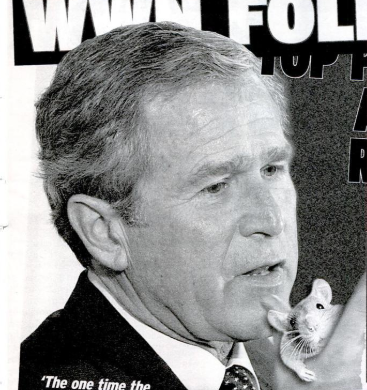
Seeing as how we’re in the midst of another Debate Season, here’s a Weekly World News story I wrote in August 2005, referencing the last time the candidates did the Dance of 1,000 Lies.

TOP PRESIDENTIAL ADVISOR IS A MOUSE
© Weekly World News

Washington, D.C. – Karl Rove. Condoleezza Rice. Dick Rumsfeld. Familiar names to many as advisors to President George W. Bush, but the identity of the commander-in-chief’s very top advisor is a closely guarded secret known, until now, to only a select few.

Because the president’s ranking confidant is a mouse!

This unique relationship was caught on tape by a security camera in the corridor of a Los Angeles hotel where the president was speaking to a gathering of the Republican leadership.

Weekly World News has obtained a copy of this remarkable footage, starting as the president pauses before entering the ballroom to deliver his speech. He moves to a corner where, behind a screen of Secret Service agents, he takes a little white mouse from his pocket and has a hurried whispered conversation with it:

POTUS: I ain’t sure about this speech, Topo.
MOUSE: The speech is fine, W.
POTUS: It doesn’t go far enough!
MOUSE: So, they’ll have to give a little to get what they want.
POTUS: Oh, I get it.
MOUSE: You don’t have to. It’s what I’m here for.

“The president likes to call him Topo Gigio, after the Italian mouse puppet that appeared on the Ed Sullivan show in the 1960s, but his real name is Irwin,” said a high-ranking administration official who confirmed the story on condition of anonymity.

“The president doesn’t make a move without Irwin. Carries that little mouse around with him everywhere he goes.”

Ann Trey, a former White House cook, has seen and heard Irwin for herself. “The president would come into the kitchen for his graham crackers and milk, or sometimes a Pop Tart, and I’d see him sneak little pieces of cheese to the mouse,” said Ms. Trey.

“Well, one time, I heard the mouse say, ‘Give me a piece of that Pop Tart.’ The president said no, that mice ate cheese, but the mouse said it was sick of cheese and wanted some Pop Tart. They got into this whole argument but stopped when they saw me staring. He shoved that mouse into his pocket and skedaddled out of there.”

When asked about Irwin, White House press secretary Scott McClellan told reporters, “I can categorically state that, were any rodents involved in policy discussions, and I’m not saying that any are, they would be involved, not that they necessarily are or are not, on a strictly informal basis.”

But the anonymous administration source said, “Remember that bulge on the president’s back under his suit jacket during the debates? That was Irwin, staying close to whisper answers in the president’s ear.

“Irwin’s pretty darned smart for a mouse. He’s been involved in almost every major policy decision of this administration. The one time the president didn’t take his advice was on how to conduct the Iraqi war and look how that’s turning out.”

A reporter shouting questions about the mouse to the president during his latest five-week vacation at his Crawford, Texas ranch received this response from the commander-in-chief, “Irwin’s just a family friend.”

White House chief of staff Karl Rove amended the president’s statement, saying, “What he meant was, if there was an Irwin, he’d be happy to have him as a friend. But there isn’t. So he doesn’t.”

Vice President Dick Cheney, reportedly jealous of the president’s special advisor, has been seen placing mousetraps around the Oval Office.

Tags: , , , ,

Paul Kupperberg on October 6th, 2008

The Same Old Story, she is written, being read by several friends for consistency and suckishness (my wife’s already read it; not to keep you in suspense, she loved it). It’s also out to an agent of my acquaintance for consideration. I need to leave it alone for a little while longer, then go take it out again and look at the manuscript with a fresh eye. It may take a little while; I’ve been suffering from withdrawal symptoms ever since I finished it. I’d grown accustomed to spending my idle time thinking about the story and how to tell it, looking forward to getting back to Max, Mick, Shelly and the rest for the next 500 words.

I need something new to obsess over so I can cleanse my mental palate of the book I just finished. That would be Supertown, U.S.A., something that’s been around so long, I’m actually embarrassed it hasn’t been long, long done.

Our story so far: 14-year old Wally Crenshaw lives in Crumbly-by-the-Sea, New Jersey, a seaside town to which you can’t get from wherever you might happen to be. Wally wants nothing more than to become one of the superheroes that inhabit his world; he wears a costume under his clothes in case he ever runs into an opportunity to have a secret origin of his own. Charlie Harris, aka The Knave, a non-super-powered hero (a la Batman), has come to take up residence in Crumbly in the house his aunt left him, wanting nothing more than to forget about being a costumed hero—it hurt and he wasn’t very good at it—and he figured the best way to start is by disappearing into out-of-the-way Crumbly. But when he opens the door to his new home, his ex-comrade from the Justice Brigade, William W. Williams, Jr., the obsessive, half-crazy and dimwitted Mr. Justice is waiting there to drag him back to civilization and his responsibilities as a hero. Charlie tells him to go screw, leaving them at a stalemate. It being late in the day, Mr. Justice asks if he can spend the night. Meanwhile, Wally is positive something to do with superheroes is going on inside that house. He’s just entirely wrong about what that something is…
SUPERTOWN, U.S.A.
© Paul Kupperberg

Charlie Harris stepped out onto the back porch of his late aunt’s house. Correction. Onto the back porch of his house. He owned it, free and clear. He put his coffee mug down on the railing, which promptly collapsed under the weight.

“Guess it needs a little work, though,” he murmured.

Well, what if it did? He was retired from the supers biz. Now he could be plain old Charlie Harris, free lance writer on the supers for the National Mask and other publications…and with a newly signed, fairly sweet contract for a series of books about those ex-colleagues remaining in the supers biz. He had all the time in the world to patch up the old place.

Even with Mr. Justice camped out on the sofa in the parlor, finishing up the last of half a dozen frozen dinners Charlie had picked up earlier along with a few other dining necessities from the grocery store on Main Street, Charlie was feeling strangely at peace. He thought it was strange because Charlie couldn’t remember the last time he had felt this way. As a kid, he was always butting heads with his father. As a grown up, he was constantly worried about somebody uncovering his secret identity, or about the next fight he was going to get into and hurt by. On top of that, there was the continual aggravation of trying to have a real life when you never knew what death-defying adventure you would have to take off on with the Brigade, usually in the middle of a date, or while he was supposed to be working. How tough was it to meet a magazine deadline when you were fighting mole men at the center of the Earth the day your article was due? It was a miracle he kept getting assignments — although, the inside scoops he got being (secretly!) a member of the supers community probably made up for his lack of punctuality.

But that was his old life. Gentleman writer, resident of quaint Crumbly-by-the-Sea, that was the new.

“Charlie!” Mr. Justice called from inside.

Charlie sighed and closed his eyes. “Yes, Willie?”

“Did you get anything for dessert?”

Tomorrow morning, he told himself. He’ll be gone in the morning…! And, out loud, he said, in a tone of voice usually reserved for conversations with six-year olds, “Who wants cupcakes and milk?”

Mr. Justice said, “Oh, boy!”

* * *

Wally Crenshaw, Benny Sachem, and Brenda Cunningham gathered at the north end of Kane Street, watching the dirty gray car parked down the street.

“See,” Wally said. “The Accelerator’s car is still here.”

“Wow,” Benny said with a snicker, “it’s the actual Acceleratormobile!”

Brenda poked Benny in the ribs with her elbow, “Cut it out, Benny. How do you know it’s not?”

Benny glanced at his girlfriend, then at Wally. “Am I the only one here who hasn’t gone, like, insane?”

“Probably,” Wally said. He took the folded wanted poster from the pocket of his shorts and held it out to Benny. “But all I want to do is see if the guy in this picture’s the same as the guy who belongs to that car.”

Benny opened the poster and looked at it. Brenda peeked over his shoulder. “New York license plates, gray car.”

“Two for two,” said Wally.

“Unless it just happens to be a gray car from New York,” said Benny.

“Work with us here, Benny,” Brenda said.

Wally started to walk down the quiet street. “Come on,” he whispered to his friends.

“Where?” Benny asked.

“That’s not working with us, Sachem,” Brenda said and yanked on Benny’s arm to get him moving.

“C’mon, Brenda,” Benny pleaded. “Don’t tell me you believe any of this stuff.”

Brenda shrugged and said, softly so Wally couldn’t hear, “No, I don’t. But Wally does. And if it’s important to him, then as his friends it’s important we believe with him. Okay?”

Benny nodded. “Okay. But I still get to make fun of him. If I don’t make fun of him, he’ll think I’m putting him on.”

Even as he walked a half dozen paces ahead of his friends, Wally was formulating a plan of action. They couldn’t just walk up and ring the doorbell. If it was the Accelerator and he was hiding out here in town, he might…well, accelerate them. They needed a distraction, something to draw whoever was in that house outside where Wally could get a good look at him. He wished he had some firecrackers on him. Setting off a string of firecrackers on the front porch would sure get him out in a hurry. Or a siren! Boy, a nice loud siren would sure do the trick.

“So, got a plan, Whiz Kid?” Brenda asked.

Wally shook his head. “Not unless you’ve got a siren in your pocket.”

Benny rolled his eyes. “Oh, brother,” he said, and ignored Brenda’s withering look.

“We just need to get a look at the guy,” Wally muttered.

The slow walking trio had come up alongside the dirt splattered gray car at the curb outside the old Wicker house. Brenda glanced at it, tapping her chin thoughtfully. “We could,” she said, slowly, “just knock on the door.”

“We could,” Wally said, his eyes practically bugging out of his head, “if we wanted to get all accelerated!”

“He’s not going to accelerate some kid,” Brenda said. “Whatever that is,” and went skipping up the sidewalk and then turned up the front walk to 254 Kane Street.

“Brenda!” Wally hissed.

“Don’t!” Benny called.

Brenda ignored them both, pausing only briefly to look back and throw them a sweet smile just before she rapped her knuckles on the weather beaten front door. Wally and Benny, in a sudden fit of not knowing what to do with themselves, almost collided with one another three times before charging around to the street side of the gray car and ducking down in hiding just as the front door swung open.

Charlie Harris, the chocolate frosting from a cupcake on his face, looked at Brenda and smiled. “Hello,” he said.

“Hi, mister,” she said. “I saw your car out there and wanted to know if you wanted it washed. Only five dollars.”

Charlie glanced at the car, wondering why there were the tops of two heads bobbing around behind it. “Sorry, kid,” he said. “It’s not my car. Belongs to someone visiting me.”

“Does he want it washed?”

“I doubt it,” Charlie said. “Sorry. But, hey, you want a cupcake? I’ve got plenty.”

Brenda said, “I don’t think so, thank you. So, could you ask your friend?”

Charlie took a bite from his cupcake. “What’s your name?”

“Brenda,” she said, then quickly added, “My dad’s the sheriff.”

He smiled, and watched the two heads hiding behind Willie’s car as he said, “And a fine, dedicated lawman he is, I’m sure. My name’s Charlie Harris. I just moved to town.”

Brenda tried to peek around Charlie and catch a glimpse of his houseguest as she said, “Did your friend drive you here?”

“No,” Charlie said. “Well, look, it’s been nice meeting you. I’ll see you and your friends around, okay?”

“Sure,” she said, slowly, shifting her feet so she could get a better view inside the house. “So, welcome to Crumbly, I guess.”

Charlie made to close the door, but Brenda held her ground. She smiled sweetly and waved her fingers in farewell, but wouldn’t budge. Charlie was forced to close the door, gently, in her face. “Weird kids in this town,” he said with a sad shake of his head.

Tags: , , , ,

Paul Kupperberg on October 3rd, 2008

Check out Part 1, Part 2, Part 3, Part 4, Part 5 and Part 6! Now read on:

PASSED LIVES
© Paul Kupperberg

The demon army withdrew as the sun began to set. The soldiers of Atlantis staggered about the battlefield, giving aid to fallen comrades and dispatching the wounded among their foes. Kahna did what she could, binding wounds, offering water to the casualties, holding the hand of a young man, a boy more than a man, really, as he died from his wounds, tears streaking his face. She wondered how his mother would feel when she received the news, then quickly banished the thought from her mind.

As she made her way across the battlefield, among the dead both human and demonic, Kahna gathered what she needed from those who had fallen. A scabbard and belt for her sword, a sleeve of armored mail to protect her sword arm, a small round shield of metal, covered in layers of thick hide. Miraculously, she found her bedroll on the side of the road. She never saw the horse again.

The armies of Atlantis regrouped up the road, away from the blood and carnage. There would be no time to bury the dead now.

Kahna sat with a dazed and silent group of infantry from the City of the Mists, warming themselves before a small fire as they made of meal of dried meats and leather-tough biscuits. A clatter of hoofs roused Kahna from her post-battle exhaustion and she looked to see the commander of the army of the City of the Stars and his lieutenants rein up their horses near her campfire.

The commander regarded her. “You are the old woman who fights like a well-trained youth,” he said to her.

Her companions leapt to their feet in the presence of so lofty a personage. Kahna did not rise. “I suppose I am,” she said wearily.

“From where do you hail, mother?” asked one of the lieutenants.

“From the City of the Stars and the City of the Archers,” she said. “Take your pick. And,” she added, staring darkly at the fresh faced officer, “I am not your mother.”

The boy flinched and his commander pretended not to notice. “I hear you are much the warrior,” sniffed the commander. “I hear, too, that you call yourself Kahna and seek the presence of our lord, the mage Thalis.”

“All true.”

“What exactly is your business with Lord Thalis?” the commander said, finally asking the question that had brought him here.

“It is my business,” she said.

The commander raised an eyebrow, then glanced briefly at each of his lieutenants. “I see,” he said.

“Have you much experience battling demons, commander?” she asked before he could think of a way to rephrase his question.

He blinked. “Well…no,” he said. “Have you?”

She nodded. “Enough to know they like to attack in the night, especially after first softening up their foes.”

The commander blinked again.

In the night, the first shrill war cries of the demon army were met with the blaring of trumpets and the roar of the men of the Atlantean army.

* * *

Kahna could not describe the beasts she fought through the night. They were large, with leathery skin as tough as armor. She would catch only the briefest glimpse of them in the flickering light of a torch or a body aflame from eldritch fires, but she did not care what they looked like. All she knew was that they died when cut and did not seem to be particularly clever in the ways of combat. They would come screaming in from the darkness, all but announcing their presence and she would thrust her sword at them, taking their heads, severing limbs, slicing open their bellies, robbing them of whatever manner of life they may have possessed.

Not that it mattered. They were cannon fodder, of course. Savage, snarling monsters sent to weaken and decimate the human troops before they reached the First City. The Darkness fairly crawled with such beasts, all waiting the opportunity to break free to feast on humanity. No doubt the armies racing to defend Atlantis from all points on the compass were being thus met. Whoever, whatever, commanded this hellish army, had sprung wide the gates of Hell and set loose all that was evil and dark.

Kahna battled well past the hour she felt she could fight no longer.

* * *

Kahna slept as one dead, her head resting on her unopened bedroll and her sword, still sticky from the blood and gore of combat, near at hand.

By dawn’s light, the demon army withdrew. They left behind only the rapidly decaying remains of their defeated and the masses of human dead. From her brief survey of the battlefield, it seemed as many as half the soldiers she had marched with the previous day had lost their lives to the demons. The number of demonic dead was even greater, but that did not matter. Their population was near limitless, with only the magical barriers between the Darkness and the mundane world preventing them from overrunning mankind. Rare was the power that could breach those barriers, but such a power now held the First City hostage.

As she slept, near paralyzed with exhaustion, Kahna dreamed. The battle between man and demon raged around her, but she held no sword, no weapon of any kind. Across the field where she walked, thick with blood red mud and fallen warriors, two young girls, sobbing in fear, called out to her. Kahna wanted to go to them, but her way was blocked by the swirl of combat. A step in the wrong direction would mean her death.

But those poor children…

They clung to one other, faces smeared with tears and dirt and gore. Demonic forms fell around them. Soldiers on horseback jumped over their huddled forms. Swords and arrows and spears whistled through the air mere inches from them. No one else seemed to notice or care they were there. Kahna had to save them, but did she dare change her course and go to them?

“Mama,” the children screamed in horror, a decapitated head landing at their feet.

Kahna closed her eyes and turned her head so she would not have to watch them suffer any longer.

“Mama!” Their voices pierced the din of battle.

Kahna awoke with a start, screaming out the names of Malasa’s children.

Shaking, she decided she had slept enough for now.

To be concluded!

Tags: , , , ,

Paul Kupperberg on October 1st, 2008

More of this unpublished 1980s Archie Comics superhero story (Part I and Part II here) I scripted, with art by the incomparable Pat Boyette. As always, click on the images to see them at a readable size…

CAT-GIRL AND THE BLACK QUEEN, Part 3
© Archie Comics


Tags: , , ,

Paul Kupperberg on October 1st, 2008

…’Cause The Same Old Story is done! I typed “the end” last night, 46 days and 57,000 words after I got back to work on the already-started manuscript on August 16, averaging about 1200 words a day, for those keeping score. But, really, this exercise wasn’t about clocking words and tallying a score; it was about finding a rhythm and setting a goal that allowed me to be more productive with my time and energy.

Today, I’ll zip copies out to a few trusted friends for a first read and comments, as well as to an agent who I’ve had looking at my stuff.

In a couple of weeks, once I’ve heard back from those readers with their comments and critiques and I’ve had time to clear my head so I can look at the manuscript with fresh eyes, I’ll go back in to smooth some of the rough edges and fix all the continuity gaffs and other errors that have inevitably crept into the story.

But…it’s done!

Today, I’ll clear my psychic pallet by cleaning up all the stuff that’s accumulated around me while I was focusing on the book, catching up on e-mails, respond to some interview questions that have been waiting, check on the status of other work, file paperwork, etc. Tomorrow, I’ll be ready to get to work on my second young reader Superman storybook for Stone Arch Books, the plot of which was approved a week or so ago. After that, I’ll be starting on a non-fiction book for young readers about Jerry Yang, one of the founders of Yahoo!, for Chelsea House.

And, in a day or three, I’ll start on my next 500-words a day project: a YA novel called Supertown. I’ve already got about 16,000 words, or about a third of it, down on paper and the rest of the story outlined.

If nothing else, this line of work sure keeps me from getting bored.

Tags: , ,

Paul Kupperberg on September 30th, 2008

Bits and pieces of The Same Old Story, my 500-words-a-day-novel-in-progress, are scattered through previous postings (here, here, here, here, here and here). Of course, once things got rolling, I was averaging more than that (better than double) and, for the past several days, I’ve been concentrating exclusively on finishing this up. Today will likely be the day, so here’s an excerpt from one of the later chapters:

THE SAME OLD STORY
© Paul Kupperberg


Chapter 23/ HILLBILLY HANK

The local law was more than a little perturbed when I showed up splattered with another man’s brains to report a suicide. I left out a few pertinent details, especially the part about the $80,000 in cash, which I’d stowed under the DeSoto’s seat cushion, one half-hearted search away from discovery but the best I could do under the circumstances. I didn’t know these local cops from Adam and eighty grand was a tempting target for anyone. I had carried the case back out through the woods to where I’d left the car, then drove back the way I came until I hit something that resembled a town and asked the first person I saw for direction to the police station.

Sheriff Billy Van der Hooven was a beefy but hardy looking specimen with a round face, shining cheeks and an honest desire to want to understand what the hell it was I brought with me when I walked into his office. I told him to call Uncle Mick in New York, tell him it was about me. The sheriff looked none to happy about having to make a long distance telephone call but he took another look at the gore I’d been unable to wipe off my clothes and face and dialed.

The rest was sort of a blur. Sheriff Van der Hooven confiscated my clothes as evidence and left me with a pair of dungarees and a jailhouse shirt to change into it. My number was 877. Two deputies were sent to investigate and, if necessary, secure the cabin. He let me wash up and I scrubbed at my face with lye soap until the skin was stinging and raw and I could no longer feel the little bits of Jimmy’s life that had clung there.

I spent the next three hours telling Van der Hooven what exactly it was that had brought me here. He took extensive notes, breaking only to take a report from the deputy who had been sent back for reinforcements and orders, confirming the dead body. The young deputy said it sure looked like a suicide to him but the sheriff wisely pointed out that such a determination should be made by wiser and more qualified heads.

When there was no other way to tell my story, the sheriff left me in a small locked interrogation room with a table, two chairs and an egg salad sandwich and coffee. I drank the coffee and ignored the sandwich. I couldn’t imagine the next time I’d want to eat again.

I stared at the wall, trying not to replay the sight of Jimmy’s head exploding like a melon, flinging blood and bone and gore all over the cabin. There was nothing left. Jimmy just ended at the shoulders. But that was all I could see. Over and over.

I closed my eyes and thought about Shelly.

She was innocent. Of everything. How come I couldn’t see that? How come I didn’t just believe her when she told me?

Because criminals lie, I told myself. If she had been guilty, she’d have lied about it. How was I supposed to know until I had the evidence.

The testimony of a dead man.

In my mind’s eye, Jimmy Noonan kept killing himself. The click of the trigger, the booming eruption of gunpowder, the slow motion disintegration of his head, like a popping balloon popping balloon full of water.

And then silence, except for my screaming and heaving and crying.

And then I see it again.

So I try looking at something else. The moment before he died.

I’m guilty of a lot of terrible things, he said just before he pulled the trigger, but Bob Konigsberg death ain’t one of them.

Click. Boom.

Dead.

I’m guilty of a lot of terrible things, but Bob Konigsberg death ain’t one of them.

Jimmy Noonan had just confessed to one murder. He knew he was just seconds away from ending his life. Why would he deny killing Bob if had?

He wouldn’t.

I blinked and in my head, all the pieces of the puzzle tumbled into place and made a perfect picture.

Oh, god.

Shelly.

Click. Boom.

Tags: , ,

Paul Kupperberg on September 27th, 2008

I returned home last night after a quick jaunt into New York City to find a big box waiting for me from Kensington Books. Contained therein, my comp copies of Jew-Jitsu: The Hebrew Hands of Fury, which officially goes on sale October 28!

Since it ain’t really a book until you’re holding the printed product in your hand, this is all very exciting. The finished book looks great, complete with photography by my old Weekly World News colleague Michael Simses (and starring another WWN alum, Michael Rovin as Rabbi Daniel Eliezer).

Hats off to the fine folks at Kensington Books, especially my editor Gary Goldstein, without whom this all wouldn’t have been possible.

Tags: , ,

Paul Kupperberg on September 26th, 2008


I’m really not! But The Same Old Story, my 500-words a day novel, now stands at about 68,000 words (4,000 written just today; it speeds up when you’re getting near the end) and I can see the big, bright light at the end of the tunnel, three, maybe four chapters away. I’ve gotten just a tad consumed, but I’ll be back in the next few days with something piping hot and new from the novel. By then, I hope to have the complete first draft manuscript in the hands of a few trusted friends and readers as well as an agent.


In the meantime, the fifth installment of my bi-weekly Bookgasm.com column, Capes, Cowls & Costumes went up this morning, so please click on over there and have a look. This time around, I look at some novels based on British comic book characters.

Alrighty! Enough idle chit-chat…I’m goin’ back in! Wish me luck.

Tags: , , ,

Paul Kupperberg on September 24th, 2008

In July, I posted a “scene” from Hitler’s Bellhop, my What If…? take on a Jerry Lewis-produced movie about Adolph Hitler. This was the essay I wrote to accompany the supposed script fragments of Jerry’s rediscovered un-produced epic:

HITLER’S BELLHOP: The Lost Screenplay
© Paul Kupperberg

Late one evening in 1967, Jerry Lewis sat in the private projection room of his Beverly Hills home, screening for perhaps the one hundredth time, Charlie Chaplain’s classic The Great Dictator. With him was longtime friend, film historian and critic Mel Melman. As was always the case when he watched The Little Tramp at work, Melman later wrote, “he was mesmerized, his gaze locked upon the screen as he watched, no, absorbed Charlie’s antics. Though as different in their cinematic and comedic approaches as night and day, he’d always found inspiration in the work of his predecessor. He saw in Charlie’s pantomime, pathos, and overwhelming bathos a spark from which his own creative fires might be ignited. Not, please understand, as a theft of ideological parenthood, but as a conceptual springboard, if you will. It would not be unfair to say that Charlie was and is his spiritual mentor.

“When Chaplain’s scathing satire of Adolph Hitler’s Nazi Germany ended,” Melman continued, “He turned to me, his eyes wide and sparkling in what, through our long years of personal and professional association I had come to recognize as the first blush of the Muse’s touch, and said, ‘Charlie has his Hitler film. I want mine!’”

Melman reported being shocked by this pronouncement. As a Jew, he was apprehensive about such a concept coming under the scrutiny of the Jerry’s somewhat broad comedic brush. Indeed, almost as a reflex, Melman expressed that concern as soon as the suggestion came out of Lewis’ mouth. The response, he recalls, was chilling, a classic example of Lewis’ legendary temper. “Through clenched teeth, he stared at me as though I was something he had found upon the sole of his shoe and repeated his first thought, biting off each word. ‘Charlie. Has. His. Hitler. Film. I. Want. Mine!’

“With that, he turned his back on me and left the screening room. That was the last time we ever spoke.”

Lewis’ “Hitler film” would turn out to be, at least in screenplay form, Hitler’s Bellhop. After leaving Melman that evening, Lewis retired to his study and in what he later reported to be “a white hot cauldron of creativity,” churned out the screenplay over the course of three days. In the middle of his famous seven picture deal with Paramount, he immediately brought the finished screenplay to the studio as his next picture. Sammy Waldinger, a friend of many years and head of production for Paramount, took a look at the title page and blanched.

“I’ll never forget that moment,” Waldinger said in a 1978 interview with Film Comment Magazine. “I was horrified, I mean physically in fear for my life at the very idea. He honestly thought this was a movie he should make. I asked him, ‘Is this a joke?’ and he gave me that look, that frozen reptile stare of his. ‘I’m serious, Sammy,’ he said, and he was. He sat in that chair for two hours, arguing with me. ‘It’s funny,’ he said. ‘It’s not funny,’ I said. ‘Hitler isn’t grist for the comedic mill.’ What about The Great Dictator, he wanted to know. Or Brooks? Mel was preparing The Producers then. Or To Be or Not to Be?

“But what he never seemed to grasp was that Chaplain aside, those movies weren’t about Hitler per se, but comedies dealing with those around Hitler, or in the case of The Producers, a satire on Broadway more than Hitler himself. He thought that this…screenplay of his fit that mold. ‘It’s not about Hitler. It’s about the Bellhop.’ Well, while we talked, or I should say argued, I was flipping through this thing. And here was Adolph Hitler, that monster, that beast, he should be rotting in Hell even as we speak, being treated like some kind of sitcom next-door-neighbor buffoon. A perfectly harmless and hapless goof who kept getting pushed into committing history’s worst atrocities through his clumsy Bellhop. This is funny?

“Well, finally, I put my foot down. ‘No way,’ I said. ‘This crap doesn’t get made by my studio, not as long as I’m in charge!’ Well, you know him. He said, ‘That can change, Sammy!’ and walked out with his screenplay. Needless to say, I’m still in charge of the studio, and we never made Hitler’s Bellhop. But that was the last time we ever spoke.”

Though a consistent money maker for the studio, Jerry Lewis never did find a sympathetic ear there. His contract did, however, contain a clause that allowed him to make one independent picture a year, and he decided that picture would be Hitler’s Bellhop.

Independent producer Frank Schlessinger, a friend with whom Lewis had made several pictures over the years, remembers the initial pitch meeting. “Kind of surreal, you know what I mean? He was really up about this picture and I think his enthusiasm must have been contagious or something, because by the end of the lunch, I was ready to hop on the bandwagon. Come to think of it, I don’t know if it was his enthusiasm or that fourth martini. At any rate, we shook on it. I was gonna produce Hitler’s Bellhop.”

With the handshake deal in place, Lewis went on a publicity blitz. Bella Leven, a writer for the Hollywood Reporter recalls an interview where Lewis went on at great lengths justifying his choice of subject matter. “Sure,” he said. “I could have played the role of Hitler myself, but who would believe it? You see, the public has in its mind a picture of me as the ‘little guy,’ the poor man trapped in a greater system that is beyond his ability to comprehend or control. That’s why I’ve had such luck in my pictures portraying the little cog in the big machine, if you will. The waiter, the bellhop, the sales clerk, the handyman, what have you. I am not believable as the father figure, or the man in command.

“That’s why I settled on the character of the Bellhop… nameless, you’ll notice, throughout the picture, because he is the every man, the little guy trapped under the boot of authority. You know, there’s a comedic conceit in Jewish humor, although it applies to all forms of humor, of the schlemiel and the schlimazel. The schlemiel is the klutz schnook who trips over his own shoelaces and knocks a bowl of soup out of the waiter’s hand. The schlimazel is the poor bastard on whose head the soup spills. I am the schlemiel. That is my persona. That is what my public expects.”

When Leven asked if the subject matter of Hitler’s Bellhop didn’t trivialize Hitler, Nazism, and the Holocaust, Lewis dismissed the charge. “Never! I would never do such thing. Rather, what I’ve done is expose these horrors to the light of ridicule and broad satire. How scary is the monster once you notice his zipper is open and his wee-wee is hanging out? I’ve opened Hitler’s zipper.” The reporter next questioned the historical value of the screenplay and asked how much research went into its creation. Lighting a cigarette with a three foot high flame from his gold lighter, Lewis smugly conceded that he had not invested any time in research before writing Hitler’s Bellhop. The reporter expressed his incredulity that he would attack such a subject without first researching the historic and psychological aspects of Hitler when Lewis cut him off.

“I’m a Jew,” Lewis snapped, his eyes as cold as ice. “There’s nothing about that momza Hitler that I don’t know here,” he snarled, thumping his fist over his heart. “In my kishkas!” At which point Lewis terminated the interview and never spoke to Leven again.

Eventually, commonsense (or sobriety) got the better of Frank Schlessinger and he backed out of the handshake deal with Lewis. “He was livid,” Schlessinger recalled with a chuckle. “He accused me of everything from censorship to anti-Semitism, but what could I do? I was never going to be able to get backing for this thing, but let’s say I did. Then what? I’m gonna have my name on a comedy about a cuddly Hitler who accidentally perpetrates some of humanity’s evilest acts? What, do I look nuts to you? He ranted, he raved, he badmouthed me up one side of Hollywood and down the other, he sicced I don’t know how many lawyers on me, but it was all just a lot of noise. Pretty soon, he got tired of it and went away.

“I heard he spent the next few years trying to find other backers, but by then the whole industry had heard about this insanity and nobody would touch it with a ten foot pole. Eventually, I guess he just shoved the screenplay in a drawer and forgot about it.” Schlessinger sighed and shook his head sadly. “That was the last time we ever spoke.”

Apparently, Hitler’s Bellhop was forgotten, the screenplay itself lost, until last year when Lewis sold his Beverly Hills home in order to relocate to Florida with his new wife. Old file cabinets left out on the street for trash collection were immediately descended upon by souvenir hunters, one of whom, Audrey R. Freun of the Santa Monica Boulevard movie memorabilia shop StarFinders, discovered the yellowed and crumpled partial manuscript wedged under one of the drawers. “I was very excited,” Ms. Freun said. “Hitler’s Bellhop is something of a Hollywood legend, but no one outside of a few studio honchos had ever read it. Even the remaining bits and pieces that I found are a revelation. Of course, being a huge, huge fan of his, I was doubly thrilled to be able to read some of this lost work. What was most incredible was finding the cast page, featuring his very own ‘dream team’ for the picture.

“We’d met several times,” Ms. Freun continued, “and I’ve sold him some pieces over the years, mostly Chaplainania. I thought we had a cordial relationship, so I called his office to let him know what I found. His secretary put me through to him, and I started to describe what I had and there was just silence on the line. I asked him if there was anything wrong. He said, ‘What are you trying to do? Humiliate me?’ I assured him that wasn’t my intent, but he launched into this diatribe about the people who hate him, who refuse to understand his creative genius and what all. He accused me of all these things and then slammed the phone down. That was the last time we ever spoke.”

Attempts to reach Jerry Lewis concerning the screenplay have met with a wall of silence. He refuses to respond to any questions about it, and friends and associates will not speak without Lewis’ permission, which, needless to say, is not forthcoming. Lewis has not spoken to this writer since 1983, when I published a less than glowing review of his low budget comeback comedy, Salad Bar.

Here, then, the last surviving fragments of Hitler’s Bellhop.

Tags: , , , ,