Another of the series of columns on writing I did about four years ago for the website ComicsCareer.com…some of the references are dated (my son turned 16 last April and he’s finishing up the engineering and editing phase of the album his band Cheerleader just finished recording) but hopefully the advise isn’t…
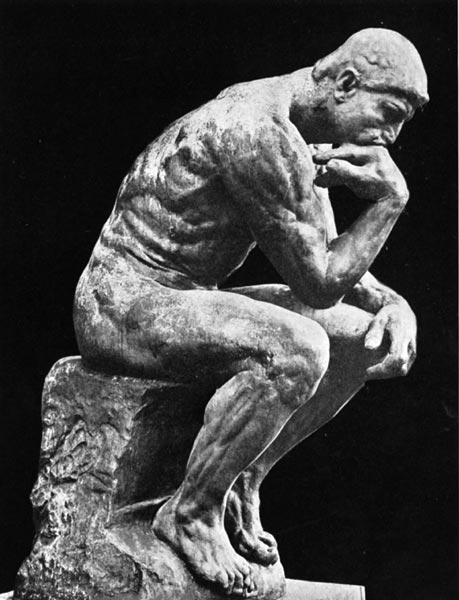
Thought: The Enemy of Art?
About eight, nine months ago, my wife, our soon-to-turn 12-year-old son and I went to see Eric Andersen, a 1960s folk singer we like, play at a small club in a neighboring town. Andersen is one of these guys who travels by himself, playing small clubs and bars here in the States (he’s a much bigger name in certain parts of Europe but likes to come home and perform for the old hippies every year or so) and accessible during intermission and after the show to sell you some CDs, sign stuff, or just talk. We’ve been to enough of his shows that he recognizes us as regulars. This was the first time we brought the kid, who is a musician himself (a drummer, studying for about four years now).
After the show, we went up to say hello. Our son told Andersen that he was also a musician, had a band (they’ve played publicly several times, the last for a local arts & jazz fair as one of the opening acts for a major rock musician, his first paying gig), and asked if he had any advice for performing. Andersen took our son aside and spoke to him for a few minutes privately. After we’d said our good-byes and left we asked what the singer had told him. This is, boiled down to its essence, what he said:
Don’t think. Thought is the enemy of art. And forget about the audience. You’re not playing for them, you’re playing for yourself. Make yourself happy and they’ll be happy too.
That’s pretty profound advice to lay on a 12-year-old newbie, but I’m glad he did it, and I’m glad the kid’s got enough on the ball to understand what the singer was saying; not that you have disdain for the audience, but that you have respect for the music first and that will come through to the audience. I’ve been telling the kid that his entire life, from the moment he could pick up a crayon and started to worry or get frustrated about coloring outside the lines or using the wrong color for Spider-Man’s costume.
There are no rules in art. There is no right or wrong.
He asked me, several years back, why he had to learn all these rules of grammar. He was never going to need to know how to diagram a sentence in real life. Besides, I’m a professional writer and I can’t articulate half the rules of grammar, plus, I break the rules all the time when I write. True, I agreed, but at one time I did know them and could diagram a sentence and, to this very day, though I may not be able to name the parts of speech (a dangling whatthewhosis?), I know when something is wrong and I can fix it. And, besides that, I said:
Yes, I break the rules because there are no rules in art. And, before you start breaking the rules for artistic or any other reasons, you first have to know what the rules are.
I pointed out to him that as a musician, he first had to learn how to read music, then play it by the metronome and by the book before he started to learn jazz and how to improvise. It reminds me of the legendary comic book artist Alex Toth, known for his (brilliantly!) minimalist style, who said:
I spent the first half of my career learning what to put into a picture and the second half what to leave out.
That’s art: Learn it, then turn your back on it and make your own way. Just take the step. Don’t think about it.
Doesn’t sound possible. Writing—I’ll use writing as my example because that is, after all, what I do—is a thought process, putting words on paper in a certain order to achieve a specific narrative or emotional effect. Inform your reader of the locale or the time period, describe a character or setting, evoke fear or sadness, make them horny, whatever. You need to think about that before you jump in and start writing. This stuff doesn’t just happen by itself.
Well…it does and it doesn’t. Sure, you sit down and say, okay, in this scene, I want to achieve this thing that either moves the plot forward or reveals something about your characters, or both. In my recently completed mystery novel (a 1950s period story), I have one scene intended to convey new clues to the police detective; he’s talking to a waitress and short order cook in a diner and, while they drop the requisite information and plot points under his questioning, the scene took on a life of its own and became a set piece more about the character’s love of pie (he eats 3 or 4 pieces during the interview) and his integrity (he won’t take the pie as a freebie and insists on paying because he intends to come back often for the pie and wants to be a welcome visitor instead of a crooked cop on the take).
If had thought about doing a character bit like that, it would have come off as clunky and unconvincing, but by just letting it flow from the process of writing the information I needed into the story, it turned into the one chapter that two out of the four people who have read/are reading it have mentioned.
The real heart of your story comes out in those moments, the unplanned character bits, the spur of the moment inspiration that turns a minor character into a major player…another thing that happened in my mystery. Having elements of pastiche to it, I included a deceased real-life person who I got to know, thirty-five years later than the period in which the book is set, intending to use him in one scene, just as a tip of the hat to a man for whom I cared very much. But art knows no reason and he wound up coming back in later on in the book and, in fact, ends being a sort of Dr. Watson to my detective’s Sherlock Holmes. Didn’t plan that, never would have planned that, but it happened and, without thinking, I went with the flow.
Another example: in a Justice Society of America novel I wrote a few years back, the heroes are all down and about to bite the big one at the hands of the bad guys. The POV character for the book, Mister Terrific, a one-time Olympic athlete, flashes back to his only competitive defeat, a loss by like 2/10th of a second because he allowed himself to be distracted by how his competitor was running his race. It’s maybe 800, 1000 words out of 85,000, but that little flashback, the frustration of not only reliving that moment but of repeating it now when the stakes weren’t a silver medal instead of the gold, but his and his comrades lives as well as the lives of countless innocents, is one of four or five in the book that stand out to me as what these characters are about, not just events that push the story forward (although they do that, too).*
Plotting is a mechanical structure: One comic book writer friend of mine creates elaborate charts of story direction, individual character arcs, introduction of subplots, how long they played out, secondary and tertiary subplots and how they evolved to become major subplots and then the main plots. He can, on the down and dirty, connect the Legos-level of sheer mechanical plotting, wipe the floor with me. My plotting in comics, even ones I wrote over two, three, or four year stretches, was always ad hoc, based on some broad outline that I, sort of, knew where it was headed. Unless I changed my mind and went somewhere else because my free-form plotting allowed me the room to do that. With his plotting, you start pulling on one thread and the whole sweater unraveled.
I’m not bound by the specs of the plot-machine he builds for himself. He has said he envies my ability to write that way, more from the gut and less from the head. The gut is where the passion and the juice come from. The head is where rational thought lies. You want about 25% of the latter and 75% of the former in your work. Know where you’re going, understand the mode of transportation you’ve chosen to take you there, but don’t be bound by some route you’ve laid out on the map before you even left the garage. Take detours, visit interesting roadside attractions, cut across land marked with “No Trespassing” signs, leave the blacktop and explore some dirt roads, and stop every now and then for a couple or four slices of pie at that diner you pass along the way.
Just do it, but whatever else…don’t think!
+ + +
*The excerpt from JSA: Ragnarok follows below; it was finished in July of 2005 and due to various and sundry legal and technical difficulties–including the fact that the DC Universe this was written about no longer exists–I seriously doubt it will ever be published:
The 400 meter was the last event of the first day of the decathlon and Michael Holt felt nothing but good about his chances. The 400 was his event. He had already taken the 100 meter, the long jump, the shot put, and high jump, breaking one personal best and three Olympic records in the doing. He was well ahead in points and the odds-on favorite to take the gold. The whole stadium seemed to be on his side as he took his place at the starting line.
The closest thing he had to competition was the Kenyan, a whippet thin young man with densely corded muscles and deadly serious expression, currently in second place. He had gone over to shake the other man’s hand and wish him luck before the race, but instead of being a gentleman about it, the Kenyan had instead given him only the most perfunctory of handshakes and then turned his back on Michael.
Well.
If that didn’t call for some serious butt kicking, Michael didn’t know what did. He glanced over at his competitor, but the other man had his eyes fixed on the tape, 400 meters, just a shade under 361 feet down the track. The Kenyan was giving away nothing. He had to know he was up against a superior athlete. Any other year, he would have been a cinch for the gold medal. Just his luck to qualify the same year as the one competitor in the world who outclassed him.
Michael took his position, steadying his breathing. Out of the corner of his eye, he watched the Kenyan. The Kenyan ignored him. He only had eyes for the finish line. Too bad Michael’s back was about to block his view.
The starting gun barked and the runners pushed off.
Michael Holt sailed into an easy lead, legs and arms pumping in perfect rhythm, breathing in through his nose, out through his mouth. Every bit of technique he had ever learned and had trained into himself so deeply that it was as natural as the beating of his heart came into play. He wasn’t just running, he was flying, fractions of seconds ticking off in his head with the accuracy of a Swiss timepiece. The world record in the 400 belonged to Michael Johnson at 43.18 seconds. Michael’s best in competition was 43.32. The Kenyan’s was 43.55.
He needed to shave only .14 second to tie, .15 to beat it.
And teach the Kenyan a lesson.
He allowed himself a glance at the Kenyan’s lane to his left. He saw the African was matching him, stride for stride. There was nobody between them. It was down to just them. The damned Kenyan was running the race of his life.
And the spectators knew it. Suddenly, the cheers were no longer for Michael Holt but for the Kenyan.
And then Michael stumbled, not much, just a half-step, nothing anyone but another runner would even notice, but enough to cost him less than a tenth of a second. Less than the blink of an eye.
But enough to lose him the race and cost him the world record.
The Kenyan broke the tape at 43.21.
Michael was right behind him at 43.26.
The stadium went wild. And just before he took his victory lap, the Kenyan turned his head and caught Michael’s glaring eyes, giving him an almost apologetic half-smile and a minute shrug.
Michael Holt went on to win the remaining five events the following day, giving him nine out of the ten and setting a still-unbroken Olympic record for the decathlon. Nine out of ten. The Olympic gold. But what he remembered most about his victory was that .05 of a second loss, all because he got cocky and allowed himself to be distracted by something else, taking his eye off the prize, off the finish line where it belonged.
Losing your focus. That’ll kill you every time.