Paul Kupperberg on August 26th, 2008

A piece I wrote in May, 2006:


CHARITY RAFFLE DRAWING ERUPTS IN VIOLENT BRAWL

© Weekly World News

LAS VEGAS, Nev. – A charity raffle at Las Vegas’s glamorous Greidisimo Hotel and Casino turned ugly when the time came to draw the winning ticket for the grand prize.

“The evening had been going so well,” said Ben Potzerbie, director of event planning for the National Dsylexia Foundation of America (A.F.D.N.). “We had several guest speakers, a nice dinner, and saw excerpts from the show Annie Get Your Nug. Then, disaster.”

“All the tickets were in a big box,” said a shaken Potzerbie. “I pulled out a ticket and announced the winning number, 56647. A woman up front yelled that was her number so I called her onto the stage to check her ticket and claim her prize.”

But before the woman could reach the stage, a man yelled that he held the winning ticket. Then a third ‘winner’ jumped up and that’s when the evening took a really nasty turn.

“The three started arguing, and before we knew it everyone was pushing and fighting,” said Potzerbie. “Hotel security was unable to break it up so they called the police.”

Though the fight resulted in nothing more than a few bloody noses, black eyes and scraped knuckles, it put a damper on the Dyslexia Foundation’s grand event.

“The worst thing is, it was all a misunderstanding,” said Mr. Potzerbie. “As it turned out, none of them had the winning ticket! Their numbers were 67456, 76645 and 45667. The actual winner, the editor of Dam magazine — which is, in fact, about water barriers — just sat there. He thought he was holding ticket number 66547.”

The group will try again next year.

Tags: ,

Paul Kupperberg on August 25th, 2008

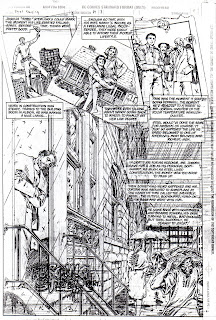
Since I ran Part 1 and Part 2 of this unpublished Steel Sterling story the previous two Mondays, I decided it’s only fair to wrap it up this week. Just click on a page to view it at a readable size. Enjoy!

STEEL STERLING-Part 3
© the respective copyright holders

Tags: , , , , ,

Paul Kupperberg on August 23rd, 2008

On August 16, I decided to return to The Same Old Story, a novel I had started a while ago on which I had written about 21,000 words. The book is a mystery, set in the early 1950s and features a pulp and comic book writer who is the son of a late and legendary N.Y.P.D. homicide cop who solves crimes on the side. The plan is to continue working on The Same Old Story simultaneously with my paying assignments, shooting for a manageable 500 words a day on the novel in addition to whatever else I happen to be working on for a check. In the seven days since I started this program, I’ve written a 12-page comic book script for The Simpsons comics, researched and plotted a 4,400 word Phantom story, wrote two-thirds of another project (this one’s also on spec but it’s a specialty book that I think has legs), and pitched ideas for my second Superman young reader chapter book to the publisher…all while adding 6,125 words to The Same Old Story, averaging 875 words a day.

At this rate, I’ll have a finished novel no later than Thanksgiving.

There’s something to be said for this slow-and-steady thing. Here’s some of what I’ve written in the last couple of days:
THE SAME OLD STORY
THE SAME OLD STORY © Paul Kupperberg

Chapter 9/ FIRST DATES

“Besides, why hurt Moe?” she asked. She looked away, staring at some memory I couldn’t see. “He was harmless.”

“How well did you know him?”

“Well enough, I suppose,” she said and smiled fondly. “We worked in that same damned little cubbyhole of an office together for six years. It’s hard to have secrets under those circumstances.”

“Do you think Moe did?”

Shelly blinked at me over the rim of her cup. “Do I think Moe did what?”

“Have any secrets?”

“Oh, good lord, no,” she laughed. “Morris Schindler was as easy to read as an open book and twice as pale as its pages.”

“So no secret gambling?”

“No. Moe, blanched at the thought of flipping a dime to see which one of us paid for coffee.”

“Booze? Dope?”

“Straight as an arrow.”

“How about Bob?”

Shelly blinked at my sudden change in direction. “Konigsberg?”

I nodded and gave her time to answer while I sipped the bitter little cup of espresso.

“Bob was a lot of things, but he didn’t drink. Not even socially. He couldn’t tolerate alcohol, for medical reasons.”

“And yet he had a small amount of it in his system when he died.”

Shelly Davis shook her head` and said, “That’s not possible. He was on medication. He never touched the stuff. Besides, I was with him, at some chop suey joint, about an hour before he,” and she paused, swallowing hard and revealing the briefest moment of sorrow, “about an hour before he died. I’ll confess to having had a few shots myself.” She laughed self-consciously and hid her face in her cappuccino until she could regain her composure. “It was very stressful, Max. Bob couldn’t accept that I had ended it and he kept looking for ways for me to forgive him and get back together.”

“That wasn’t an option?”

“No, not at all. I don’t know what ever possessed me to take up with him in the first place.” She lighted a new cigarette and blew the smoke at the ceiling. “I guess it was because he was witty.”

“Witty?” I smiled.

“Hmm, yes,” she said around her cigarette. “Debonair. Worldly. He said things I didn’t understand. Deep.”

Now I laughed. “I’m sorry. I know he’s dead, but…”

She held up her hand like a traffic cop. “Please, I know. It hit me after a while, once the intoxicating effects of the Bay Rum aftershave and aged Scotch wore off. He wasn’t deep. He was just sad.”

“He was crazy, Shelly.”

“Because he was so sad. He couldn’t always live with his own thoughts. And me,” she said, drawing on her smoke and watching the tip burn red. “I couldn’t live with him.”

“Any chance he took a drink later, after you last saw him?”

“It’s possible, I just don’t think it’s likely. He’s not a drinker. He’s never liked alcohol or been able to drink, so he didn’t immediately think to reach for the bottle when he was unhappy or scared. It wasn’t how he was conditioned, you know?”

“How was he conditioned?”

“To go off on rants. Sometimes funny, sometimes crazy. To find fault with everyone else and set them straight on their shortcomings. To find a conspiracy everywhere he looked, including an international anti-Semitic organization’s connection to a busy restaurant that was unable to seat us for half an hour.”

“Paranoid?”

“Sometimes. Mostly, though, he was fine. Just full of himself and his superiority, which would have driven me off eventually, anyway.” She looked me in the eyes. “I can tolerate assaults to my self-esteem for a while. Bob used up his allotment of abuse faster than most, that’s all.”

Shelly flicked some ash into the ashtray and leaned back, half closing her eyes and looked, all of a sudden, soft and vulnerable, like a dream. “I’m so tired,” she said. “I haven’t been sleeping very well, I guess. I know it’s ridiculous, but I almost feel like a target, pinned to a fence. There are a bunch of us, lined up in neat little rows, right alongside each other, and bang, the target to my left gets hit, and bang, the target right below me takes a bull’s eye, and bang, the one to my right….” Her eyes popped open wide and she sat back up. “Am I crazy to think that I may be next?”

“You’d be crazy not to act as though you might be,” I said.

“What do people think of me, Max?” she asked, out of the blue.

“What people?”

“The…” she said and made a vague, all-encompassing gesture. “You know, people. The gang.”

“I wasn’t aware you had a gang,” I said with a dubious shake of my head.

“I don’t. You do. So? What do they say about me? Older woman who keeps to herself? Office tramp?”

“Probably something in between those two. We don’t spend a lot of time talking about you.”

“But you do spend some time. Everyone at Blue Chip knew I was seeing Bob, didn’t they?”

“Apparently I was the only one who didn’t.”

She favored me with the flash of a smile. “Aren’t you sweet. I’ll bet you dollars to donuts that Bob told everyone about us himself. That bastard liked to brag about his conquests, real and imagined.”

I looked at her with an inquisitor’s raised eyebrow. “That sounds cryptic,” I said.

“His medication,” she said with a shrug. “It often interfered with certain otherwise…normal functions. He wasn’t quite all the man he liked to brag he was. Mostly he was after someone to decorate his arm and listen adoringly to him ramble on.”

I started to signal the waitress for another round but Shelly shook her head. Instead, I stole one of Shelly’s Old Golds. Everything she told me seemed to make sense, but nothing suggested any reason for both these men to be dead. Maybe just having Shelly Davis in common was dangerous, but I’d take that chance.

There was a reason I hadn’t told Uncle Mick I was off to meet one of the principles in his double-murder investigation for coffee, but I’ll be damned if I had it figured out yet. A tiny little voice was shouting somewhere deep in my head not to trust her, that she wasn’t the woman she was making herself out to be. I didn’t want to listen, though. Maybe I’d never pursued Shelly, kept our relationship friendly, but this wasn’t a woman you wanted as a friend, not once you saw past the mask she wore at the office. Of course, I always knew she was beautiful and I understood why she made the men over fifty sigh and the ones under trip all over themselves opening doors for her. I suppose since I’d never given her a signal, she’s never turned on the switch with me.

But now she had. And I still had not given her a signal. I could assume my familiarity with Detective Sergeant Michael O’Connor had been a motivating factor. Or maybe she was just tired of going home with jackasses and jerks like Bob Konigsberg and was looking to take a chance on a nice guy like me for a change. Whatever her reasons, I wanted to believe her and, for tonight, at least, I would.

“I live just a few blocks from here,” she said, starting to gather up her cigarettes and lighter. “If you still want that second cup of coffee, I have an espresso pot.”

“I don’t need any more coffee.”

“I still live just a few blocks away,” she said and looked at me in a way that made the back of my neck feel warm.

Even though she lived close by, we took a taxi anyway. We didn’t talk about murder any more that night.

Tags: , , , , ,

Paul Kupperberg on August 22nd, 2008

On August 8, I ran the first segment of an unpublished short story from 2002, “Passed Lives.” Here’s some more:

“Passed Lives”
© Paul Kupperberg

The blackness slid across the face of the sun and, as Malasa had promised, emerged whole and unchanged at the end. Khar had fallen to his knees, spending the next hour of the day that became night in prayer to Atlannis and any other deity he thought might be open to hearing his pleas of salvation for himself and his family.

Malasa watched him through the window after, at last, stifling her laughter and finding the words to comfort and calm the children. The moment had passed, her awakening leaving her both unsettled and strangely calmed, as though the forty-seven years of this life had been something she had only imagined, a brief interruption in reality. But that was not true. Khar, this house, the fourteen children she had birthed, the three she had buried before their first years had passed, her life up to this instant…hardly an hallucination.

And yet…

She set the children to preparing fresh bread for their supper. Ordinarily, they baked only once a week, on the eve of the resting day, but she wanted to distract them from the waning sun. Khar seemed rooted to the ground, unwilling to cease his prayers until he either believed the danger had passed or he found himself face-to-face with the gods.

…Malasa could no more deny the life she lead than she could the one, from so long ago, that the sight of the eclipsing sun had awakened. She remembered them both, vividly, the details of whichever one her mind happened to light upon the more strongly remembered, until memory leapt from the one back to the other. She was Kahna, the tenth generation warrior priestess of the Emerald Temple of the City of the Archer. She was Malasa, wife of Khar of the City of the Stars. She had lived as the former many centuries past. She lived now as the latter. And now, suddenly, after the passage of too many years, that previous existence had come back to her, whole and fully remembered as though she lived it still.

“Why now?” Malasa whispered as the last vestige of darkness slipped away from the sun and the day became whole again.

In a dark corner of her mind, in the part that was now Kahna, she believed she knew and that knowledge made her shudder.

* * *

In the night, with the house’s great room glowing in near light from the banked embers in the hearth, Khar stirred in bed and whispered her name.

“Yes, Khar?” she said, quiet so that the girls were not awakened.

“How did you know?” he asked in a tone that said he was not accustomed to his wife knowing what he did not.

“How did I know what?” she answered, pretending to have been awoken from a sound sleep. Malasa could scarce breathe, having waited all day for him to ask this question, knowing there was no sane answer she could give him.

About the sun,” he said.

Malasa moved her shoulders. “I didn’t,” she said. “I lied, so the children wouldn’t be frightened.”

His voice came softly out of the darkness. “No,” he said. “No, you didn’t. I know you, Malasa. After a lifetime together, I can read your every tone. You spoke the truth.”

“I’m tired, Khar,” she said.

“I thought we were doomed,” Khar said. He shifted in bed, pressing his body against hers. She could smell the smoke and tang of metal that clung to him no matter well how he scrubbed himself clean every night. He pushed aside her long hair, auburn streaked with gray, and kissed the back of her neck. “I was scared,” he said in strangled voice. “To lose you.” Another kiss. “Our children.” His hand crept up her hip.

“No, Khar,” she said without moving. “Please, not tonight.”

Khar was silent, then said, “You’ve never denied me before, Malasa.”

Malasa drew the heavy wool cover to her chin, her eyes wide open and staring at something that was not in the room.

“Malasa?”

“I can’t tonight, just not tonight, Khar,” she whispered.

Khar exhaled heavily and withdrew to his side of the bed. “Sleep well, Malasa,” he said.

“Sleep well,” she said. But Malasa was sure there would be no sleep for her. She had much to think upon now that it was dark and quiet and she could be alone with her thoughts. She could think about what it was to be Kahna, to be Malasa, two women sharing a single mind. To wonder why, in the eclipsed light of the noonday sun she was suddenly made to know that hers was Kahna’s soul reborn. And how, in the name of Crghas and the Darkness, she would ever explain it to Khar and the children.

And most troubling of all, the matter that had her wracked with guilt, shivering with longing. How was she to find Thalis? And what he would see when Kahna stood before him, old and worn to a gray tatter by Malasa’s life?

What would he see, the lover she had last seen so many centuries ago?

* * *

The day after the eclipse, the priests proclaimed a time of prayer and meditation. Malasa, like the rest of the citizens of the City ignored them and went about their business. Perhaps a priest or a nobleman might spare a day to commune with unhearing gods, but she could not. Khar did not speak of the previous day, but Malasa caught him casting furrow-browed looks in her direction all morning. Shartra and Vannga spent their time in the corner or across the yard from their mother, watching her and whispering to one another.

After the midday meal, Malasa could stand it no more.

She stood in the door of Khar’s smithing shack. “I am going to the City,” she told him.

He frowned. “It’s late to start off now, isn’t it?”

She shrugged. “There is bread and meat for your evening meal. I’ll stay the night at an inn and return in the morning.”

Khar’s frown deepened, a black smudge across his sweat and soot stained forehead. “Malasa,” he started to say.

She looked at him, Malasa loving her husband of thirty years, Kahna not knowing him at all. “I will be home tomorrow, Khar,” she said. She turned and began walking away. She stopped and without turning back to look at him added, “I promise.”

Then she was gone. A little while later, Khar heard the sound of hoofs clattering across the yard, then fading as his wife rode away, out of all hearing and sight.

Tags: , , ,

Paul Kupperberg on August 20th, 2008

Here’s a Weekly World News piece I wrote in September 2005. I’m a regular Nostradamus, ain’t I?

BYE-BYE, BUCKS, HELLO TARS
New Currency Issued on U.S.’s New Oil-Based Economy
© Weekly World News
DISNEY DOLLARS
© Disney

WASHINGTON, D.C. — According to a secret report leaked to Weekly World News, the U.S. Mint has been busy printing new bills like money was going out of style.

That’s because it is! At least, the money we knew.

“The president felt it was time to replace the old dollar with a new unit of currency,” admitted Assistant Deputy Treasury Secretary Mindy Doe. “Look at our cash — all those pictures of dead presidents, buildings and sayings most people don’t recognize. Is that the kind of thing to have on currency?

“And gold — what’s that about? Except for jewelry and teeth, what do we actually do with it? Is that a substance on which to base an economy?”

According to the White House, the answer is no.

“Beginning in 2007, the familiar greenback, or dollar bill, is to be phased out and replaced by the newly created ‘tarback,’” said Doe. “Its value will be backed by the price of oil as we switch from a gold-based to petroleum-based economy.”

“I personally think it’s a great idea,” confided Representative Tom LeDay (R-Alaska). “One tarback will be worth the price of one barrel of oil. That should help take the sting out of the so-called ‘high cost of filling your gas tank.’

“First, of course, Americans will have to turn in their current currency,” LeDay added. “It will cost at least eighty dollars to purchase one Tarbuck.”

The new currency is the same size as the current bills, colored gray rather than green. The pictures of former American presidents will be replaced by images of gas pumps through history. The picture of the pyramid on the $1 bill is being changed to a Texas oil rig.

The government plans to eliminate coins altogether, since they will be practically worthless.

“That will also solve the problem of all those homeless people annoying us by rattling coffee cups filled with change,” Doe added.

Tags: , ,

Paul Kupperberg on August 19th, 2008

My hard drive is full of bits and pieces of incomplete stories, novels, characters, bits and ideas. Some of them will never go anywhere, some will wind up cannibalized and used elsewhere, and others are far enough along that I really have no excuse not to do something with them…like, maybe, finish them. One of the latter is The Same Old Story, a mystery set in the early 1950s world of the comic book industry from which I ran an excerpt on August 2 (containing my beloved Pincus the ribbon salesman joke). I had about 21,000 words written on the book, eleven or twelve chapters, and a pretty solid idea where the story was going, but I hadn’t touched the thing in more than a year.

It occurred to me that if I’d written even 500 words a day on it during that year, the book would have been finished months ago…as would a second book, with a third one in progress. Five hundred words a day, even on top of regular schedule of paying work, is no great strain. So on August 16, I sat down to inaugurate a 500-words a day regiment aimed at finishing this novel in the course of the next three to four months; I ended up totaling 1,200 words that first day and between 600-800 words each day since. These are those first 1,200:

THE SAME OLD STORY
THE SAME OLD STORY © Paul Kupperberg
BIG TOWN
© the respective copyright holders

Chapter 8/BIG TOWN

It was after lunch by the time I got back to Brooklyn, so I took the cold brisket on rye mom had left for me and a mug of reheated coffee into my room and ate while I got to work. I’d spent so much time during the week looking for work, I’d hardly gotten anything done on the assignments I already had. First up were the Big Town story pitches for Schwartz at National. Since I’d practically grown up listening to the radio program, I was pretty much up to speed on the relationship of newspaper editor Steve Wilson and his gal pal Ona Munson, but I read through the issues of the comic book I’d been given anyway. I was guessing there was a formula of some sort that the writers followed, just like the program it was based on could be counted on to tell its stories in a certain way.

It took me all of two stories to get the formula, which wasn’t really much different from every other crime comic on the racks. Introduce your characters, throw a criminal plot in their path, take them through a couple of twists and turns that winds up with them facing the wrong end of a gun or hanging from the face of a building, than provide an incredible last-second save based on their knowing something the bad guy did not or some slip-up on the villain’s part. I jotted some notes as I read; crimes with interesting twists, compelling bad guys, a few death traps, some obscure forensics trivia. From what I had heard and could read for myself, Schwartz was a gimmick-guy. He loved a great bit, a twist, preferably based on some scientific or historic fact, always fairly introduced somewhere in the story. “That so-called jungle orchard in your hothouse produces the chemical surgeons use to paralyze and immobilize their patients on the operating table!” Writers I knew who worked with him said he was a challenge, always twisting the story out from under you, taking the rough lump of your idea and polishing it until it glistened with all the facets of what he thought this type of story needed. It also made me understand Al Roth’s comments about how they wanted him to draw like “everyone else.” Everyone wrote like everyone else, at least on their crime books. Everyone was squeaky clean, even the cartoon gangsters pulling outlandish crimes too incredible to be taken seriously by even those brain dead hotheads talking censorship in Washington.

But, as my grandfather, Chiam the peddler, liked to say, “You sell what people are buying.” It used to be I was selling pulp stories. Right now it was crime comics, but look where that was going. The 25¢ paperback was looking good as the next big thing; all I needed was a solid novel to peddle to one of the publishing houses, not that I had the time to work on something like that. Whenever I sat down at my desk, and I spent an awful lot of time parked there, it was to work on a paying job. I was too busy scrambling to pay the rent and have something resembling a life to concentrate on anything like a novel on spec. Sooner or later, though, I’ll have to do it. Better I should be writing it now, two, three, even five hundred words a day, than start sweating it out with no time to do anything good…

Except that was just my mind trying to divert my attention from what I should be doing, procrastinating at the thought of having to tackle something new like the Big Town stories. The hypothetical novel would have to wait, at least until I was caught up with my story outlines and scripts.

I rolled a sandwich of carbon paper between two sheets of white bond into my trusty old Underwood Noiseless Portable 77 and started typing. I figured I would come up with six or eight springboards, jumping off points for stories that Mr. Schwartz and I could mold and shape together in reasoned dialog. Why spend all the time to construct tight little eight-page mysteries that will unravel at his first change anyway? I was willing to go in, offer him the raw material with which to build a story he was comfortable with then work with him to finish as something we both can live with.

The act of typing was enough to raise my confidence. I always figured I could write anything…I just needed to get to it and put the actual words down on paper. Typing meant I’d gotten to it, on the same typewriter I’d been getting to it on since 1937. I don’t know how many hundreds of thousands or even millions of words I’d logged on that old Underwood. The E, S, and RETURN keys were practically worn out and the bell that rang at the end of each line was starting to sound a bit tinny, but we worked well together. I wasn’t a fast typist, poking away at a reasonable speed, about as fast as I know what the next word is going to be, so the keys never jammed on me and were always just the right amount of springy under my fingers.

I’d paid Mr. Baum at the pawn shop on St. John’s Place $13.50 for the Underwood in 1937. Or maybe it was more accurate to say I rented the sleek black machine from him for 5¢ a week for over three years until I’d paid him his asking price. Mr. Baum had seen me wandering past the store several times a day for almost two weeks, pausing to stare forlornly at that machine before moving on. One day, he happened to be outside sweeping the sidewalk when I came by and he and his broom joined me at the window.

“You like that typewriter machine?” he asked.

“Yeah,” I said. “But I ain’t got thirteen and a half bucks.”

“You do know ‘ain’t’ isn’t a real word.”

“I know, but that’s how everybody else talks so I do too.”

“So, this typewriter. What’s so special about it?”

“I don’t know. I just really like it.”

“What I’m asking is, what do you want it for?”

“Oh. To write. I’m a writer.”

“You are?”

I nodded. “Well, I will be when I get a typewriter. Right now, I write everything on nickel tablets, but that’s just until I can get a real typewriter. All the real writers use them.”

“I’ll tell you what. Since I too would like to see you become a real writer, and because I know your father, I can let you take this magnificent machine home on a special time payment program of one nickel a week, when you got it. When you don’t, you come sweep up the sidewalk or the floor inside, do some errands, you’ll work it off. And if after a few weeks you decide you don’t want to keep it, I’ll give you a…”

“That’s okay, Mr. Baum, that won’t happen. This is a final sale.” I stuck out my hand and shook on the deal with Mr. Baum before he could change his mind. With extra hours on weekends, I owned the Underwood outright in three years and I let Mr. Baum read everything I wrote with it. He called that collecting interest payments on the loan.

Tags: , , ,

Paul Kupperberg on August 18th, 2008

Last Monday, I posted the first of three unpublished 5-page back-up comic book stories starring superhero Steel Sterling, written by myself and drawn by Gene Ha for the relaunch of DC’s 1990s Impact Comics line. Today, the second part. Just click on a page to view it at a readable size:

STEEL STERLING-Part 2
© the respective copyright holders


Tags: , ,

Paul Kupperberg on August 16th, 2008
The second installment of Capes, Cowls & Costumes, my superhero prose review column, is up on Bookgasm.com. This time around, it’s a look at the early Marvel novels. Stop by, have a read, leave a comment. Thanks!

Tags:

Paul Kupperberg on August 15th, 2008

An article written in May 2005:

RABBITS SUE TO KEEP THEIR FEET ON THE GROUND…AND OFF KEYCHAINS!

© Weekly World News
Garbage Pail Kids
© The Topps Cpmpany, Inc.

They are a familiar sight in animal shelters and pet shops across the nation: rabbit amputees, their limbs sacrificed by the millions every year in the name of good luck.

Bad luck for their poor little missing hindquarters,” sneered Harvey P. Dowd, an attorney representing Help Outlaw Paw Pruning Sadists, an organization devoted to ending the barbaric human practice of cutting off rabbit’s feet and carrying them for good luck. “The foot of the Leporidae — which is the Latin name for rabbits — has been used as a good luck charm since before 600 B.C. These trinkets grew from ancient superstitions about fertility and pacifism. But there is nothing peaceful about this grisly practice.”

In criminal papers filed in U.S. District Court, H.O.P.P.S. seeks an injunction against the ‘foot fetish peddlers,’ as they call them. Not only does the suit claim ‘cruel and unusual punishment,’ it accuses the defendants of trafficking in stolen goods. H.O.P.P.S. has also filed a separate class action civil suit seeking monetary compensation for the many millions of victims of the powerful rabbits foot industry.

“This is an abuse of the legal system,” said Dutch D’Argent, spokesperson for plush animal and trinket-industry giant Fun Fur All. “Owning a rabbit’s foot is part of the rite-of-passage in America. It’s like your first jackknife or BB gun — which, frankly, is one reason a kid needs a good luck charm.

“I mean, we’re talking about rabbits,” D’Argent went on. “People slaughter billions of animals every year for food. Heck, we take the rabbit’s feet but at least we leave the animals alive!”

Alive and at the center of an expensive health care crisis.

“It might be more merciful if D’Argent and his fellow sadists did just kill them,” Dowd said bitterly. “Instead, they leave behind wounded, wretched ruins with nothing to look forward to but more bad hare days.”

Dexter Palomino and his wife, Satin, run a rabbit rescue farm in Fresno, California. It’s located in a quiet, rustic setting on Bunny Lake.

“Most of our guests are victims of the good luck charm industry,” Dexter said. “Our farm is crawling with bunny amputees. Well, not crawling. Most of them get around on those little carts with wheels. Unfortunately, our financial resources are stretched to the limit. There’s a waiting list of rabbits to get in.”

“That’s why we’re also suing for funding,” said Mr. Dowd. “The bill should be footed, so to speak, by the people who crippled these poor creatures in the first place.”

The rabbits foot industry claims not to be worried by the lawsuit. “These rabbits don’t have a leg to stand on, legally and otherwise,” said Mr. D’Argent.

“We’ll see about that,” Dowd told us. “We’ll also see something else — whether a few hundred thousand rabbit’s feet can actually bring a heartless businessman any luck.”

Tags: ,

Paul Kupperberg on August 11th, 2008

Back in the 1990s, DC briefly licensed from Archie Comics their line of superheroes (the Fly, Jaguar, Black Hood, etc.) and published them, unsuccessfully, as the Impact Comics line. At some point, the line was canceled and a new editorial team was suppose to fix ’em and relaunch them. The fixes were made, a miniseries called The Crucible published, and there the line died. We had, however, started work on first issues of the three relaunched titles, which were to include a back-up feature running through them that I was writing. We made it as far as pencil art (by the excellent and soon to be star-artist Gene Ha) and lettering (by my go-to letterer guy and pal, John Costanza) before the pin was pulled on the project. So here is the first 5-page installment of the Steel Sterling feature. Just click on a page to view it at a readable size:

STEEL STERLING
© the respective copyright holders


Tags: , , ,