Paul Kupperberg on October 4th, 2016

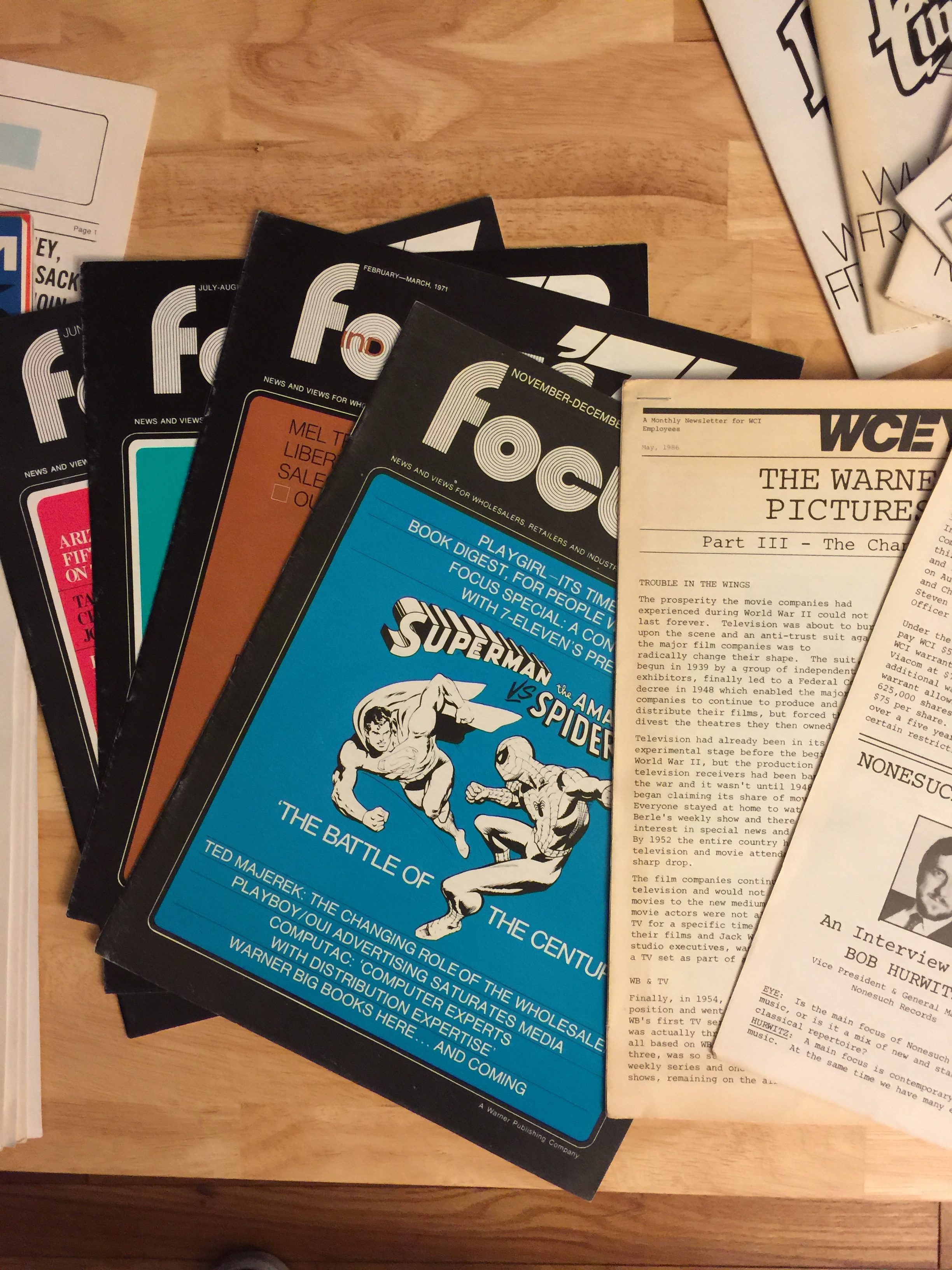
img_2383Once upon a time, the mighty Warner Entertainment was known as Warner Bros. and it wasn’t so mighty. In fact, in 1968, it was sold to Steve Ross’s Kinney National Company, a small conglomerate consisting of a Hollywood talent agency, parking lots, cleaning companies, and funeral homes for $64 million. A year earlier, Kinney had also bought National Periodical Publications, better known as DC Comics, publishers of Superman, Batman, and Wonder Woman, not to mention Mad Magazine. The new company would soon change its name to Warner Communications.

Like most companies of the day, Kinney/Warner published a variety of in-house company newsletters, including Kinagram, Focus, Warnercom Ink, and WCEye, all designed to showcase the company’s different divisions, including DC Comics. I recently found a stash of WB and DC Comics newsletters and promotional flyers from between 1969 and 1985, each containing news or features of interest to comic fans and historians, including:

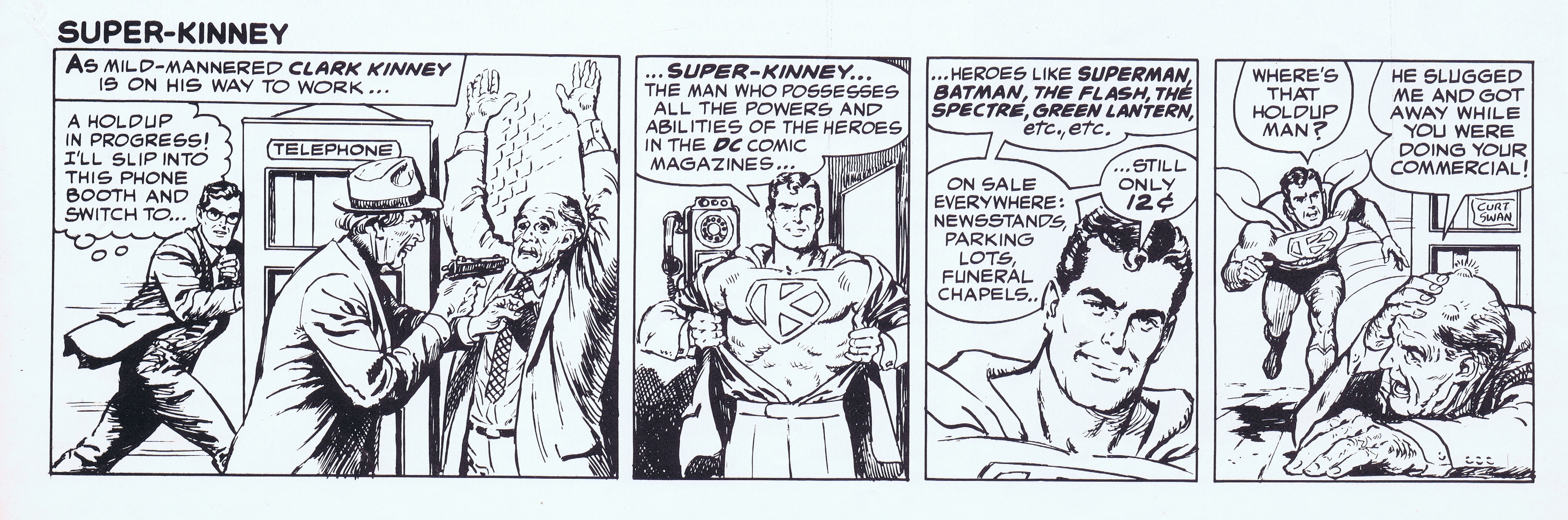
super-kinney_swan1-1969

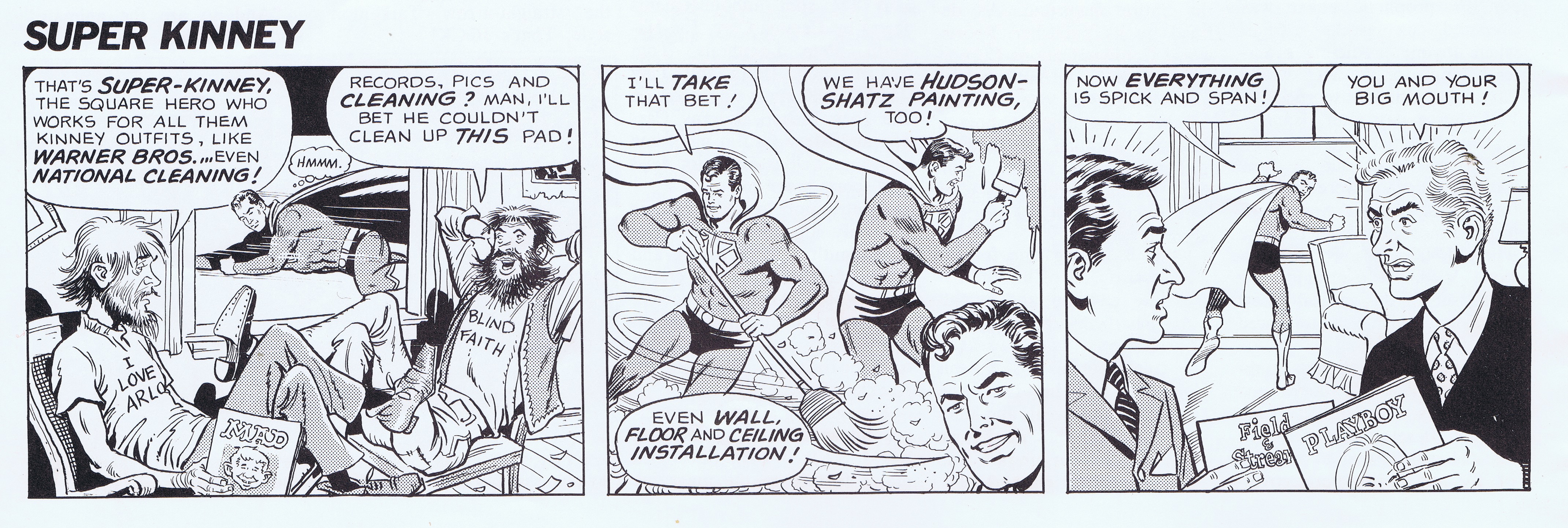
super-kinney_swan2-1969

Yes, it’s Super-Kinney…a thinly disguised Superman sent to Earth to promote Kinney corporate culture. These strips from a 1969 issue of Kinagrams feature art by Curt Swan and is unique in that it’s a rare instance of Curt inking his own work…and of drawing Mad mascot Alfred E. Neuman. I am guessing that the strips were written by Mad writer and DC writer/editor E. Nelson Bridwell.


super-kinney_plastino1-1970

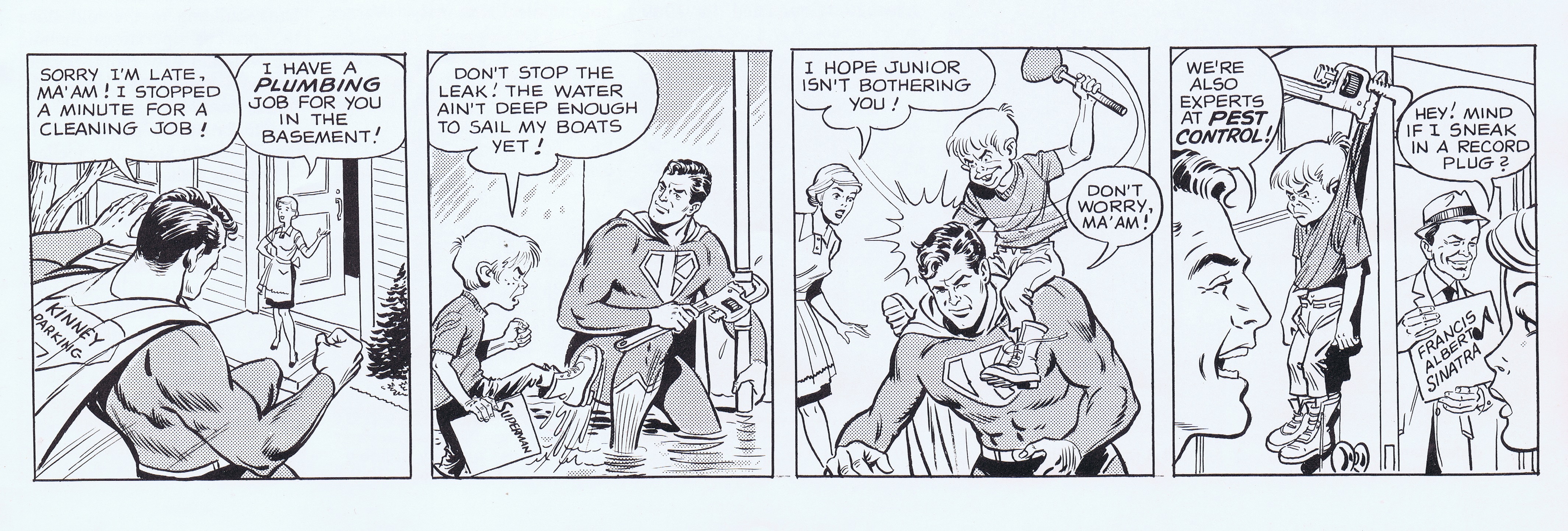
super-kinney_plastino2-1970

Super-Kinney 1970, guest-starring Warner Records star Frank Sinatra, art by Al Plastino and, again, I’m guessing written by Bridwell.


enb_puzzle-kinagram-1969

enb_puzzle-kinagram-1970

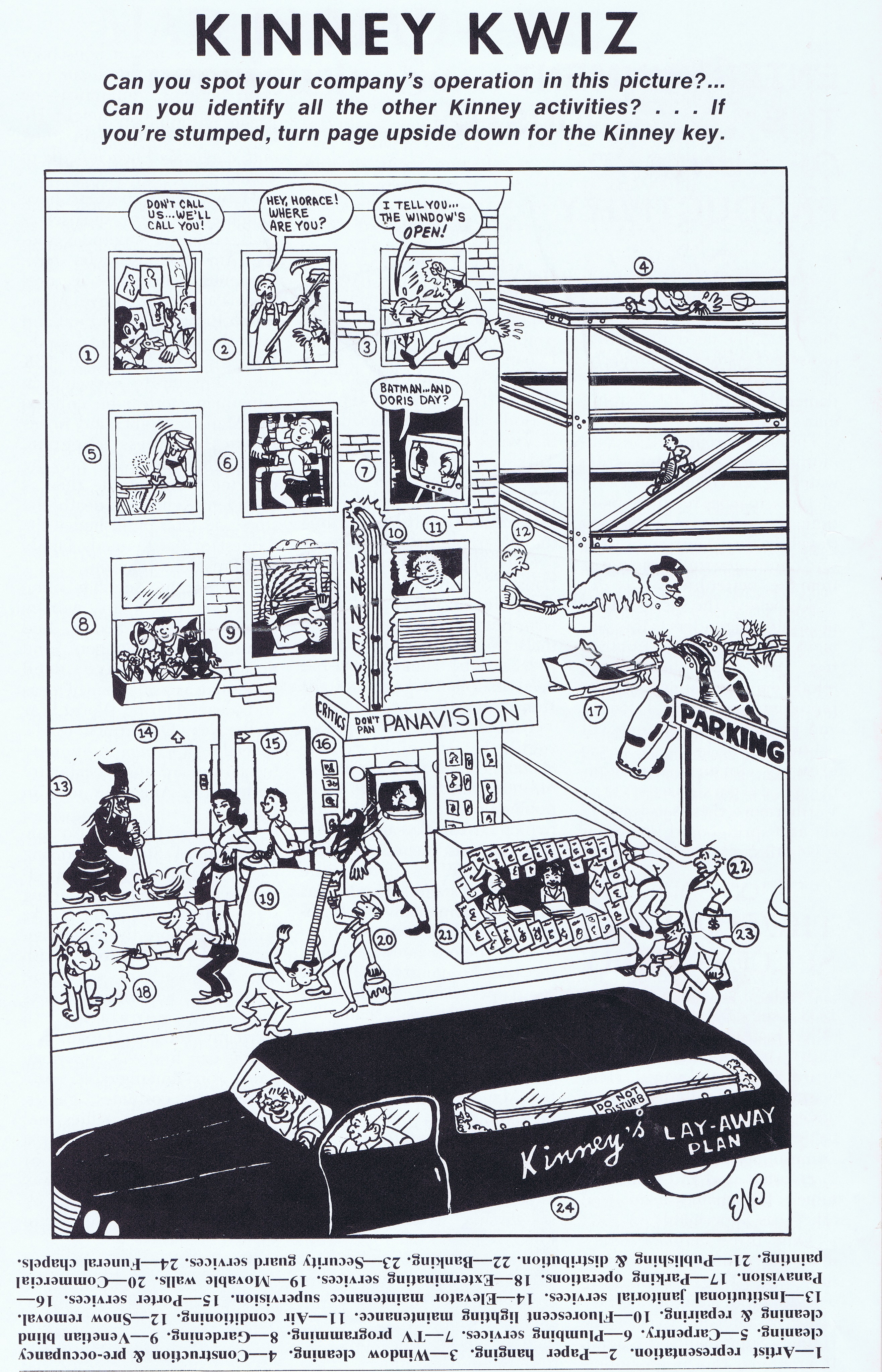
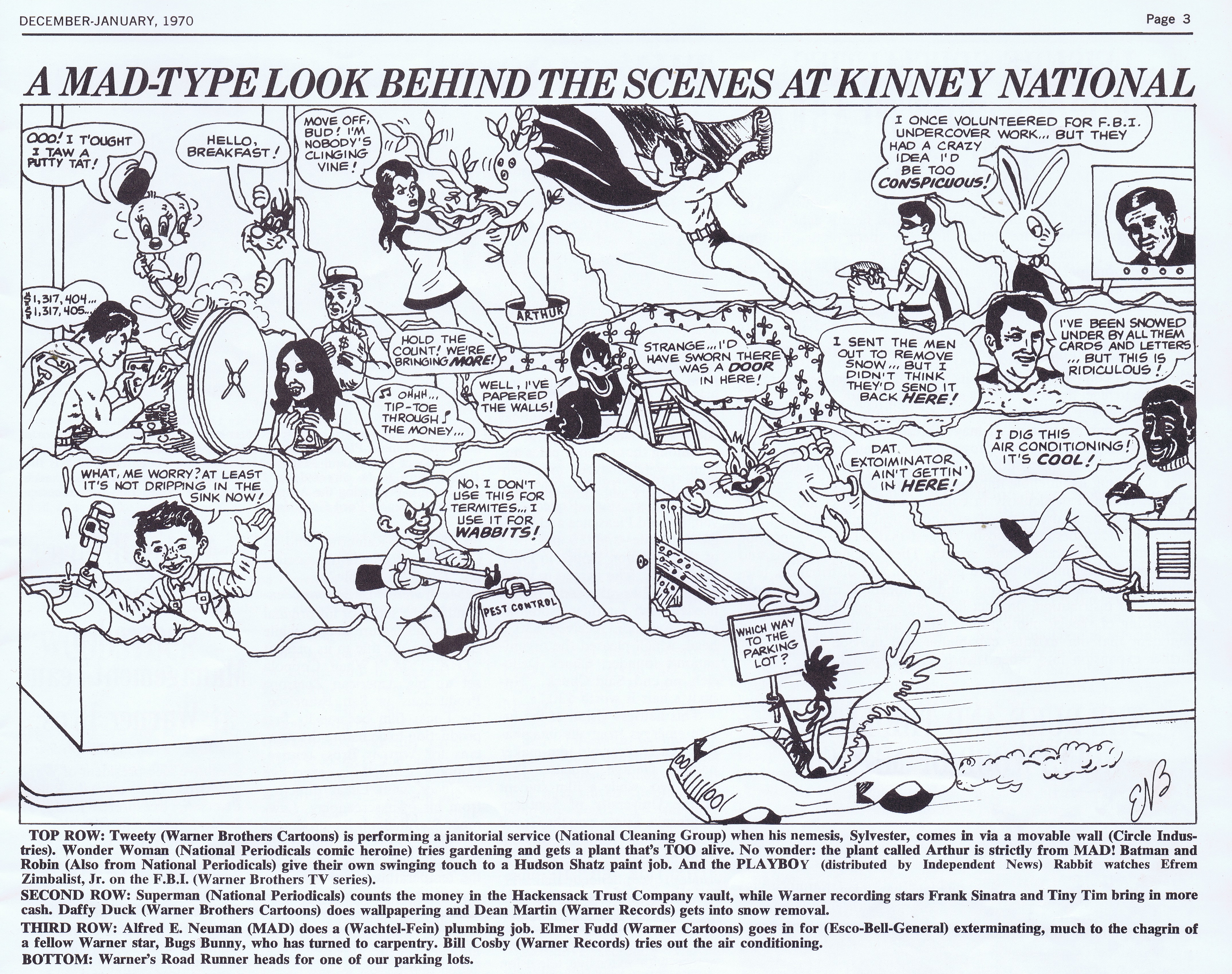
Speaking of E. Nelson Bridwell, a pair of features he wrote and drew for Kinagrams, “Kinney Kwiz” from 1969 and “A Mad-Type Look Behind The Scenes at Kinney National” from 1970.

focus1972-shazam

A 1972 issue of Focus carried the news of the return of SHAZAM! The Original Captain Marvel.

kinneyracking-infantino1972

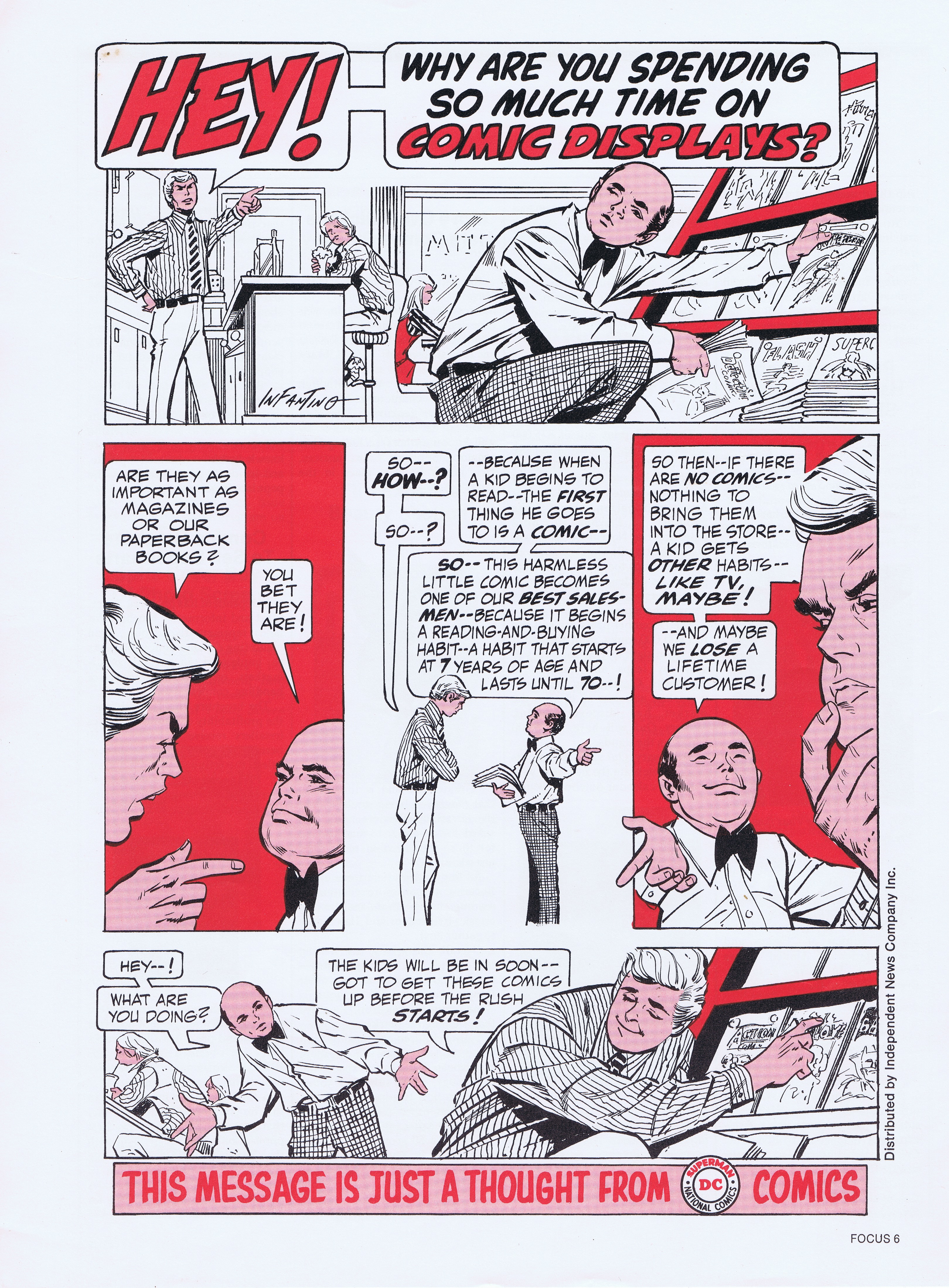
Artist Carmine Infantino (write unknown) asks the musical question, “Hey! Why Are You Spending So Much Time on Comic Displays?” in this 1972 feature, lettered by Gaspar Saladino.

dc-softball_1985

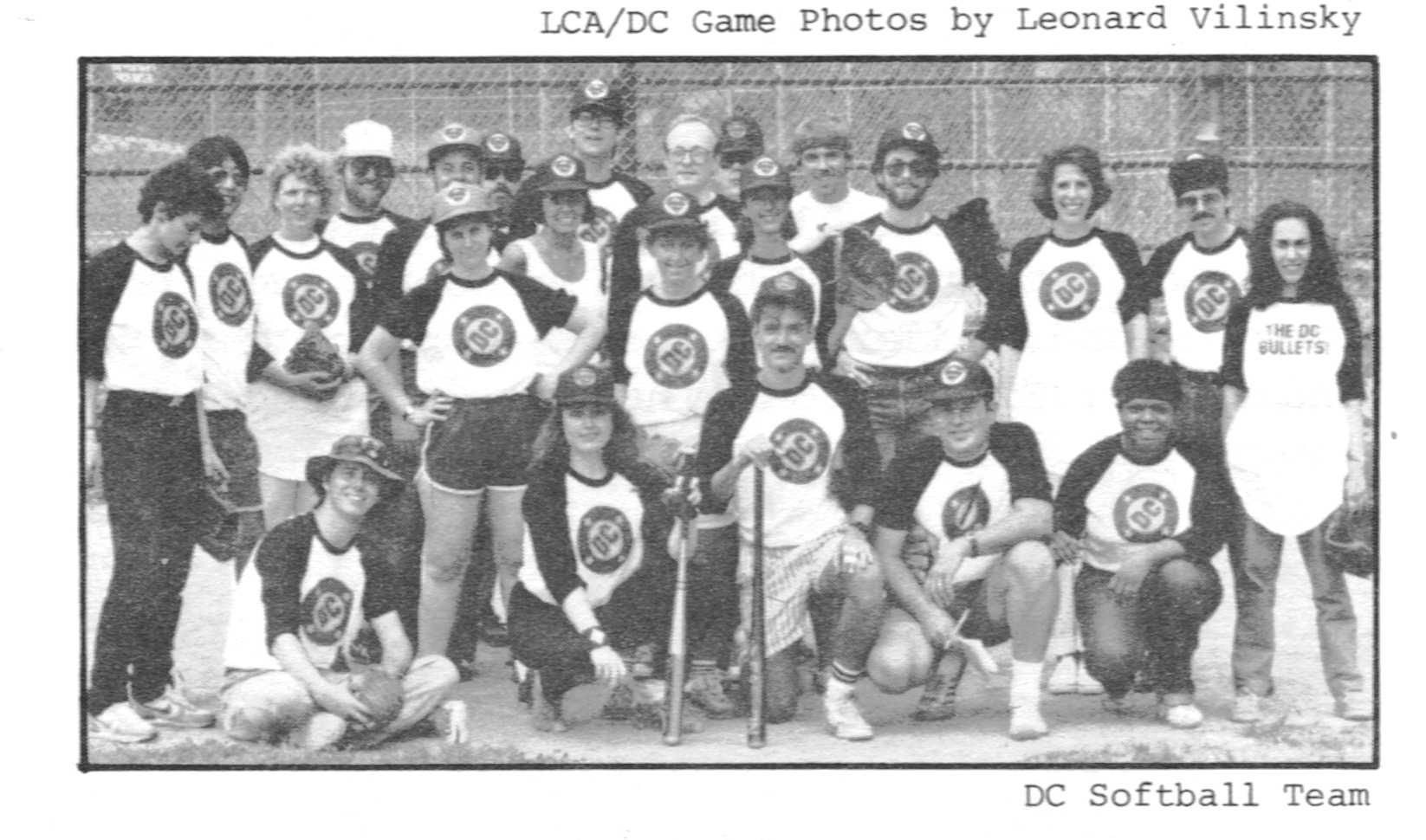
Ladies and gentlemen, your 1985 DC Bullets softball team, featuring Len Wein, Bob Smith, Bob Rozakis, Bob Greenberger, Paul Levitz, and other DC staffers.

Tags: , , , , , , , , , , , , , , , , , , , , , ,

Paul Kupperberg on September 15th, 2016

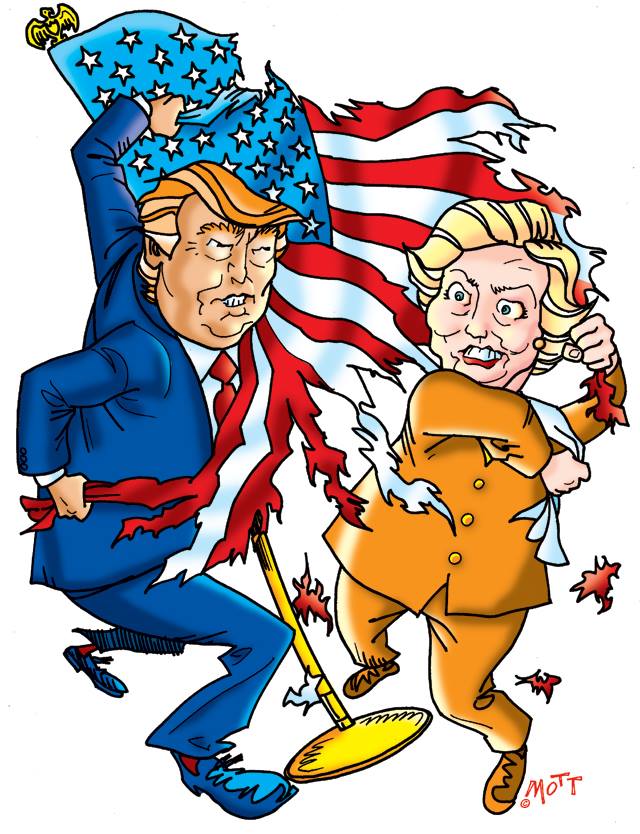
trumpvhill-colorFor most of the year, I’ve been at work on projects near and dear to me, producing several hundred thousand words of prose on two non-fiction books (oh, the stories I could tell…and I do), a few short stories for anthologies from Titan Books (Aliens: Bug Hunt and Planet of the Apes: Tales From the Forbidden Zone) and Crazy 8 Press, comic book scripts for Charlton Neo Comics, and a nonfiction graphic novel that I’m in active talks with a major book publisher about.

(Support us!)

But no matter how busy I am, there’s always time to make fun of American politics!

(Support us!)

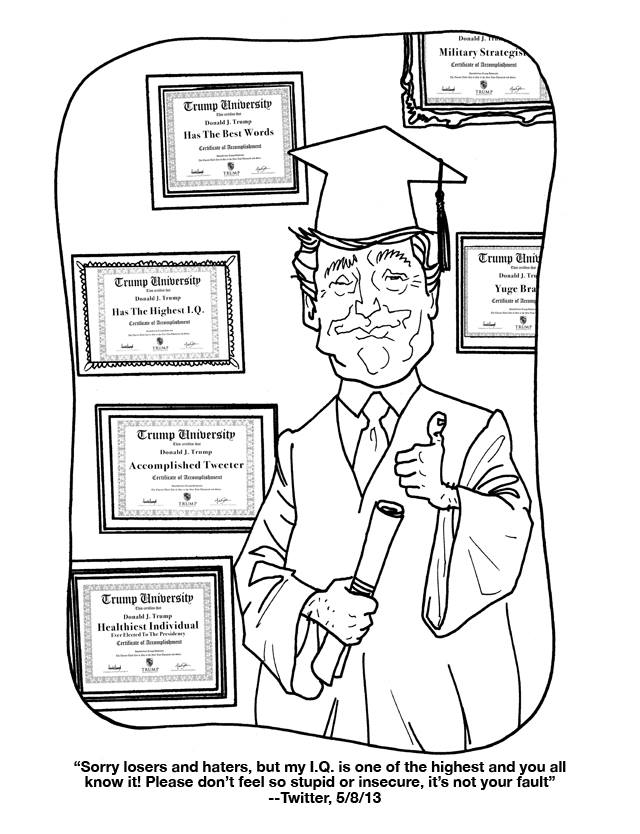
See, I was watching one of the Sunday morning news programs a while back and, as has become necessary in this election cycle, they were reporting on the latest ridiculous thing that Donald Trump had said. I don’t remember exactly which ridiculous thing it was he said that day, but when I heard it, a funny picture popped into my mind, so I wrote it down. And then I Googled some other ridiculous things he’s said, and reading them evoked yet more funny pictures, and before I knew it, I had a 16-page coloring book written.

(Support us!)

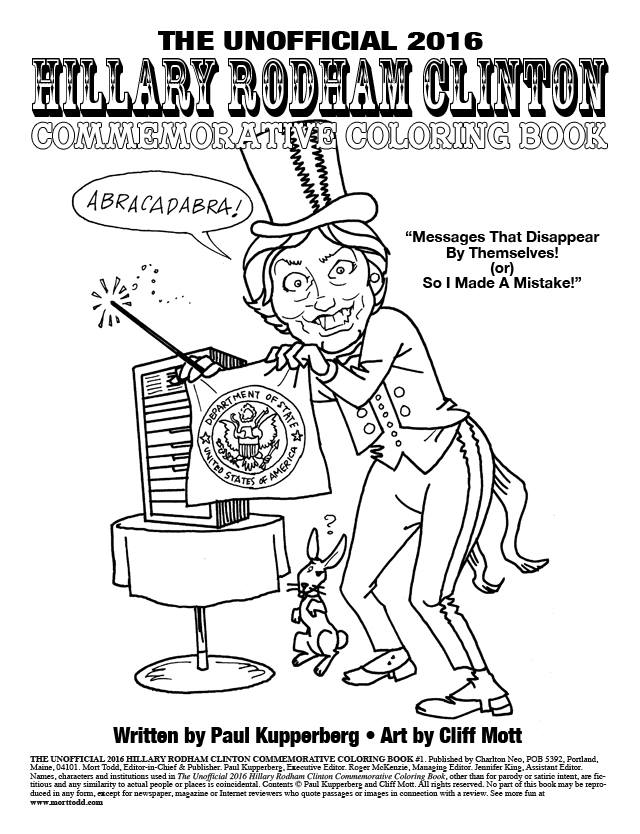
I sent the script to my Charlton Neo Comics colleague Mort Todd for his opinion. He wrote back that I should write a second book, this one based on Hillary Clinton’s own words, and we should get these puppies drawn and published as soon as possible! I did as commanded and Mort, former editor of Cracked Magazine, lined up the amazing Cliff Mott to draw the books, and before I knew it, we were making coloring books!

(Support us!)

hillary-1

Charlton Neo’s Kickstarter campaign for THE UNOFFICIAL 2016 DONALD J. TRUMP COMMEMORATIVE COLORING BOOK  and THE UNOFFICIAL 2016 HILLARY RODHAM CLINTON COMMEMORATIVE COLORING BOOK went live yesterday and will run through September 29, with plans to ship the books out to all out supporters and contributors by early October…by which time we’ll all need a good laugh ’cause there’ll still be a whole freakin’ month of the campaign to go!

trump-8

(Support us!)

Rewards include the Donald Coloring Book or the Hillary Coloring Book…or both, plus anti-certificates, prints, custom crayons, autographed scripts, hand-colored and autographed pages (by me!) and even Cliff Mott’s amazing original art used in the books!

(Support us!)

Help Make America Great Again…or vote for one of the candidates! Our goal is modest…but the rewards are YUGE!

(Support us!)

Thanks to all who have already given us their support…and to all who will join our campaign to help Make American Coloring Books Great Again!

(Support us!)

Thank you!

Tags: , , , , , , , , , , , ,

Paul Kupperberg on September 7th, 2016

POTA_Cover13th Dimension had the news first: Coming from Titan Books next January 24, a new anthology edited by my buddy Jim Beard and Rich Handley, Planet of the Apes: Tales From the Forbidden Zone, featuring stories set during the first five films and the CBS TV series. This is my first foray into the Apes franchise, giving me a great excuse to revisit the original movies—coincidentally, I was in Costco about a week after being offered the gig and they had a DVD box set on sale for $16—and I join “an all-star line-up of writers,” which you can check out below.

J. Fred Muggs says, “Vootie!” and that’s a recommendation you can take to the bank!

Planet of the Apes: Tales From the Forbidden Zone is available for pre-order on Amazon!


“Introduction” by Rich Handley

“Unfired” by Dan Abnett

“More Than Human, Less Than Ape” by Nancy Collins

“Blood Brothers” by Will Murray

“The Pacing Place” by Bob Mayer

“Murderers’ Row” by John Jackson Miller

“Endangered Species” by Greg Cox

“Dangerous Imaginings” by Paul Kupperberg

“Of Monsters and Men” by Kevin J. Anderson and Sam Knight

“The Unknown Ape” by Andrew E.C. Gaska

“Silenced” by Jim Beard

“Who Is This Man? What Sort of Devil Is He?” by Robert Greenberger

“Stone Monkey” by Greg Keyes

“Milo’s Tale” by Ty Templeton

“Message in a Bottle” by Dayton Ward

“The King Is Dead—Long Live the King” by Rich Handley

“Banana Republic” by Jonathan Maberry

“A Question of Simian Survival—An Afterword” by Jim Beard

Paul Kupperberg on August 29th, 2016

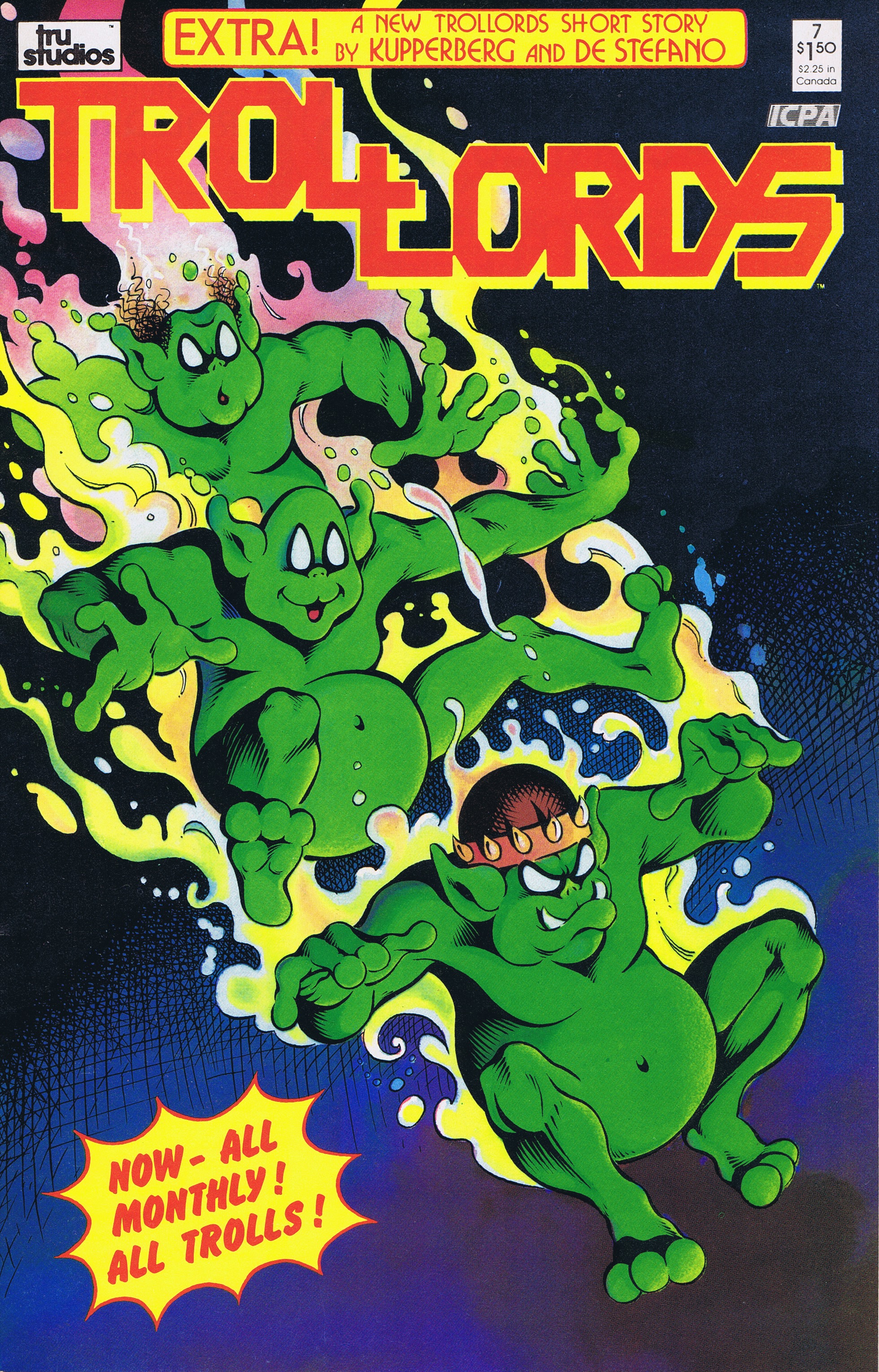
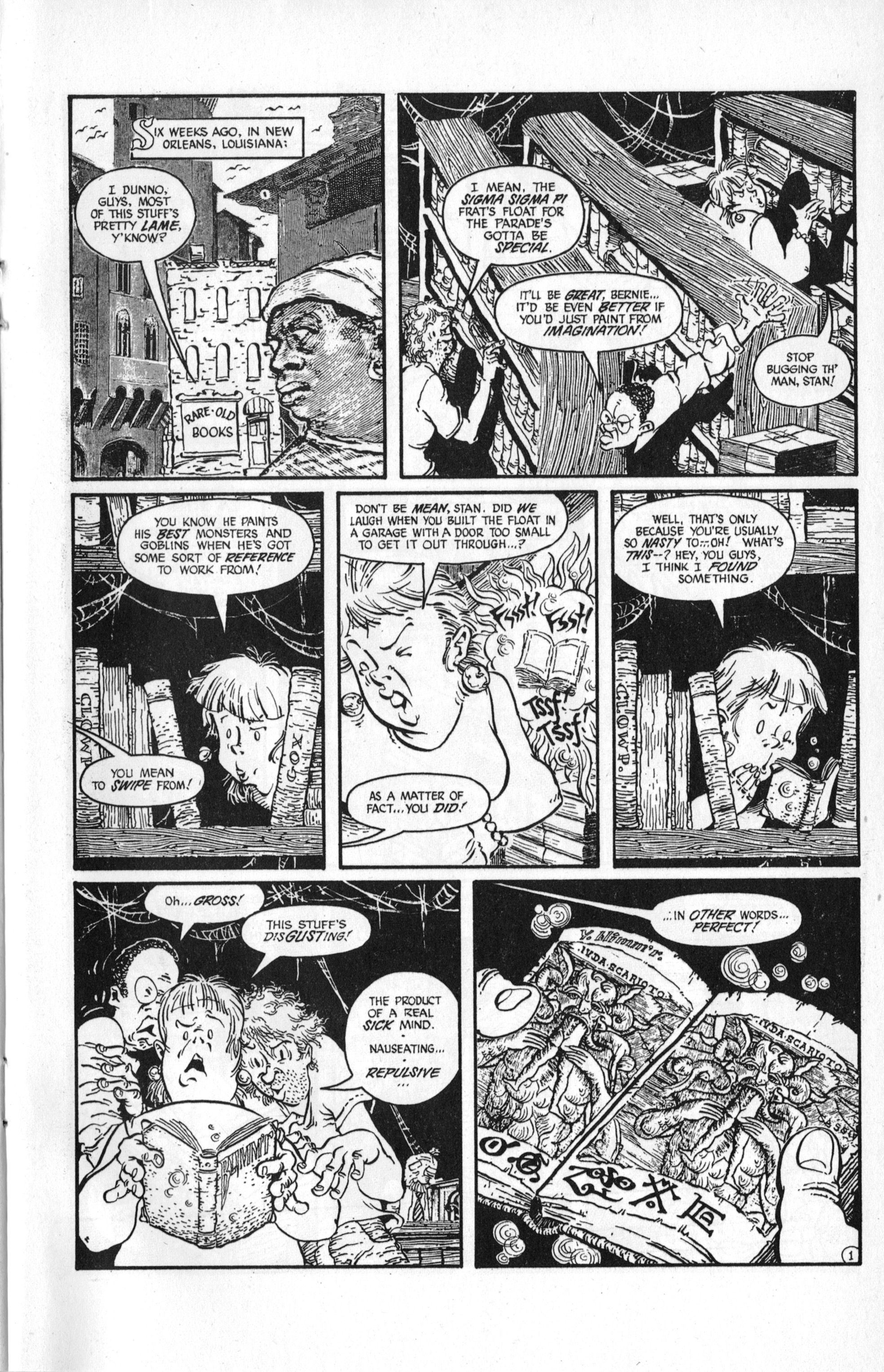
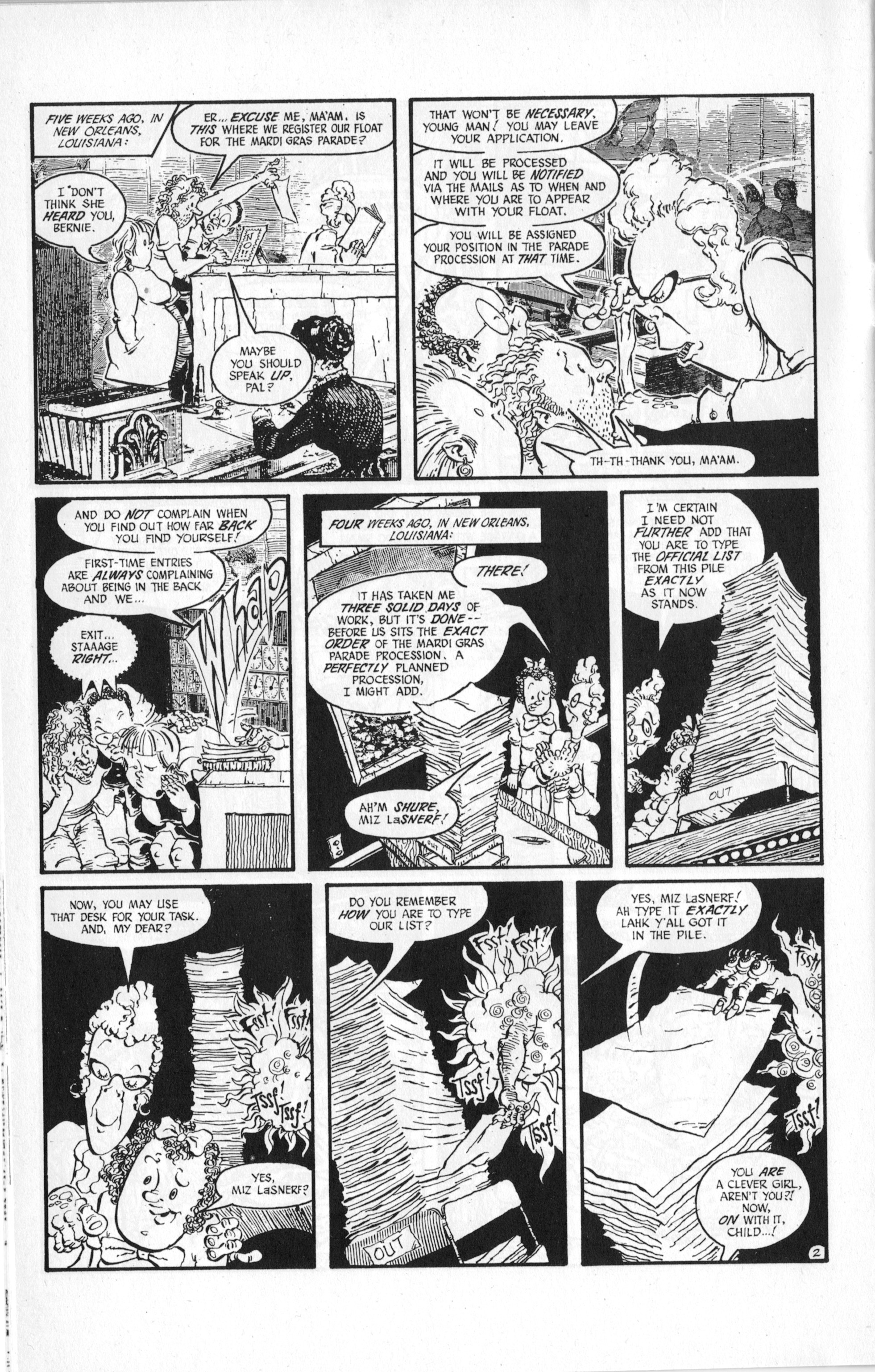
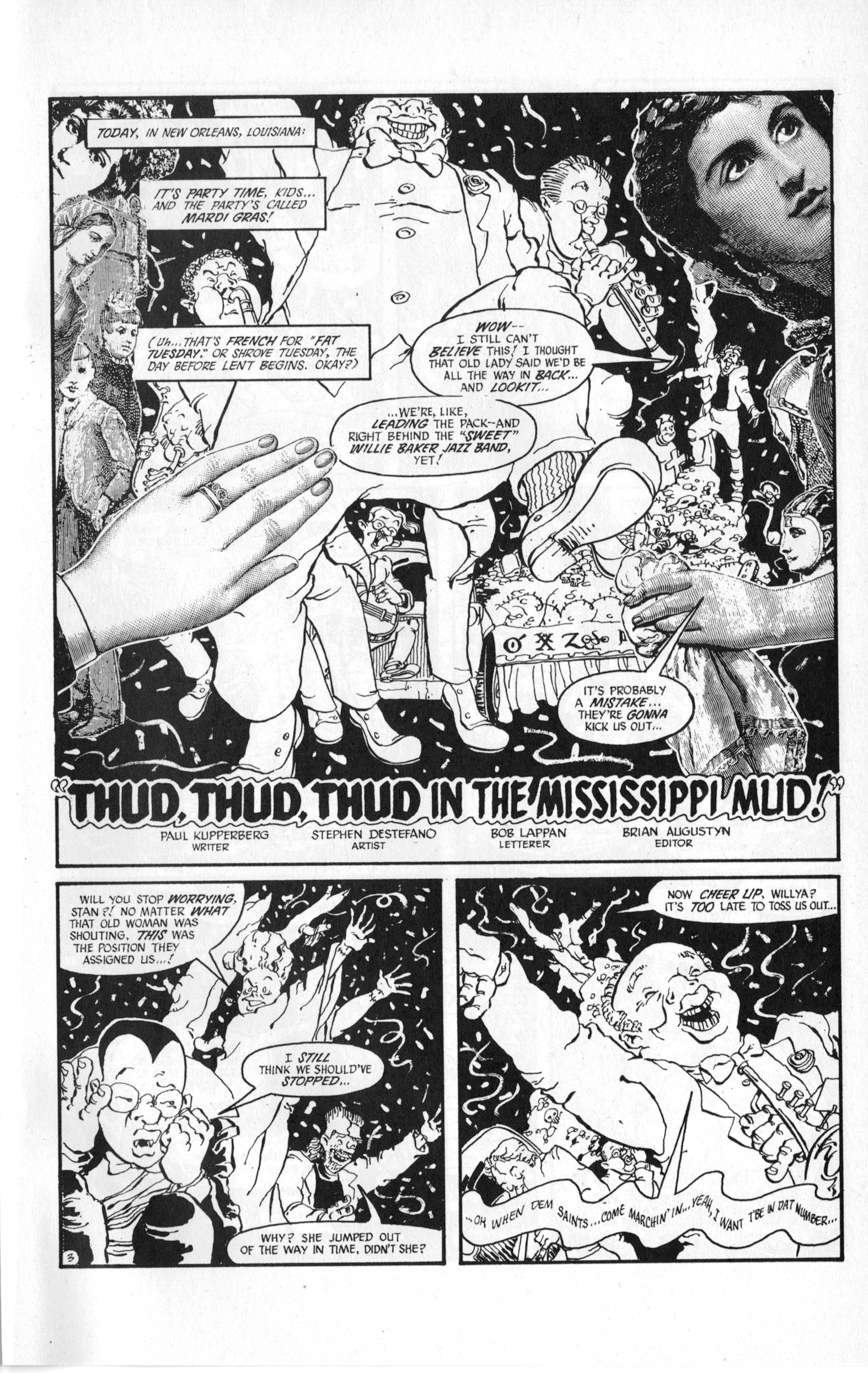
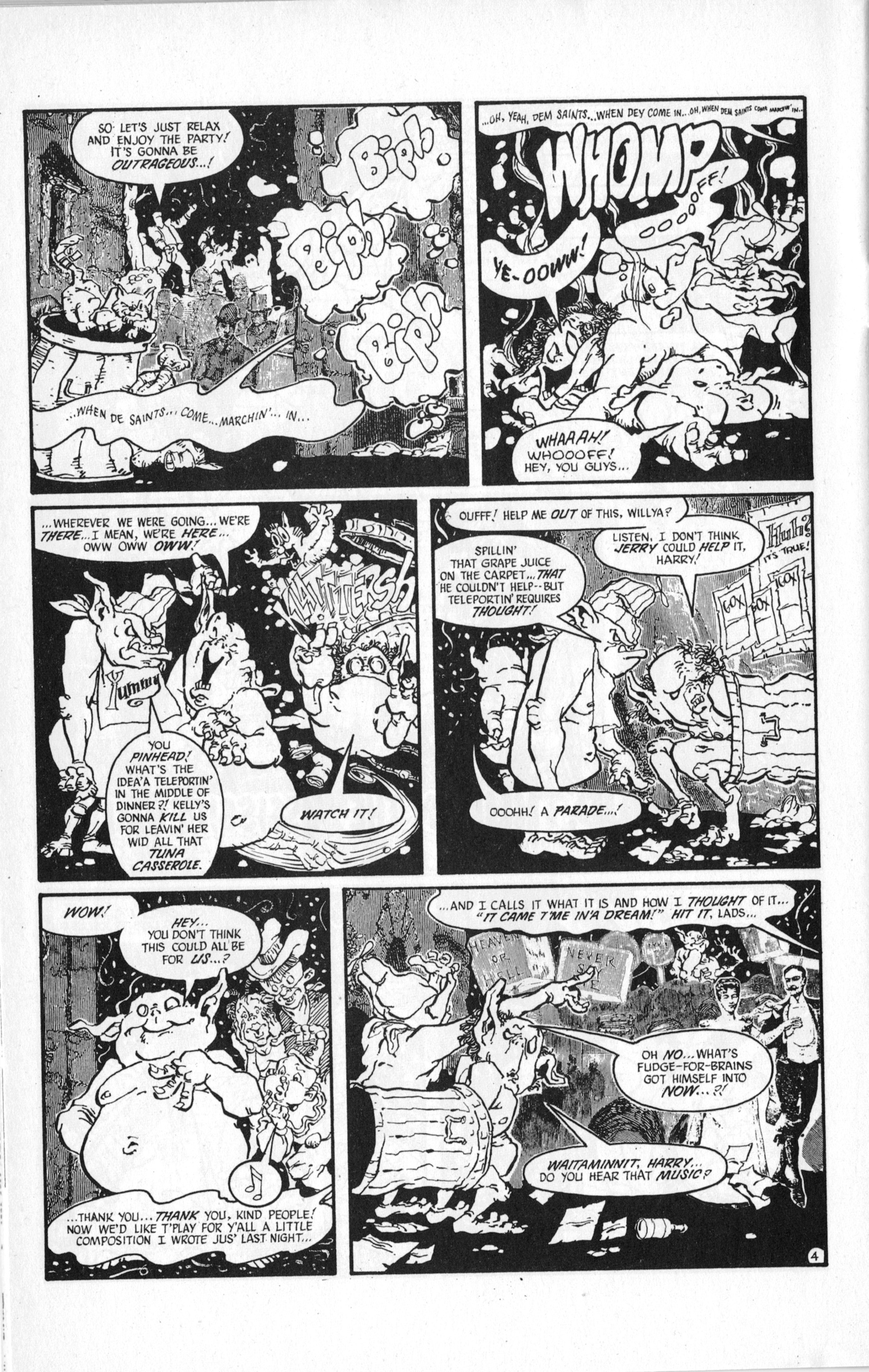
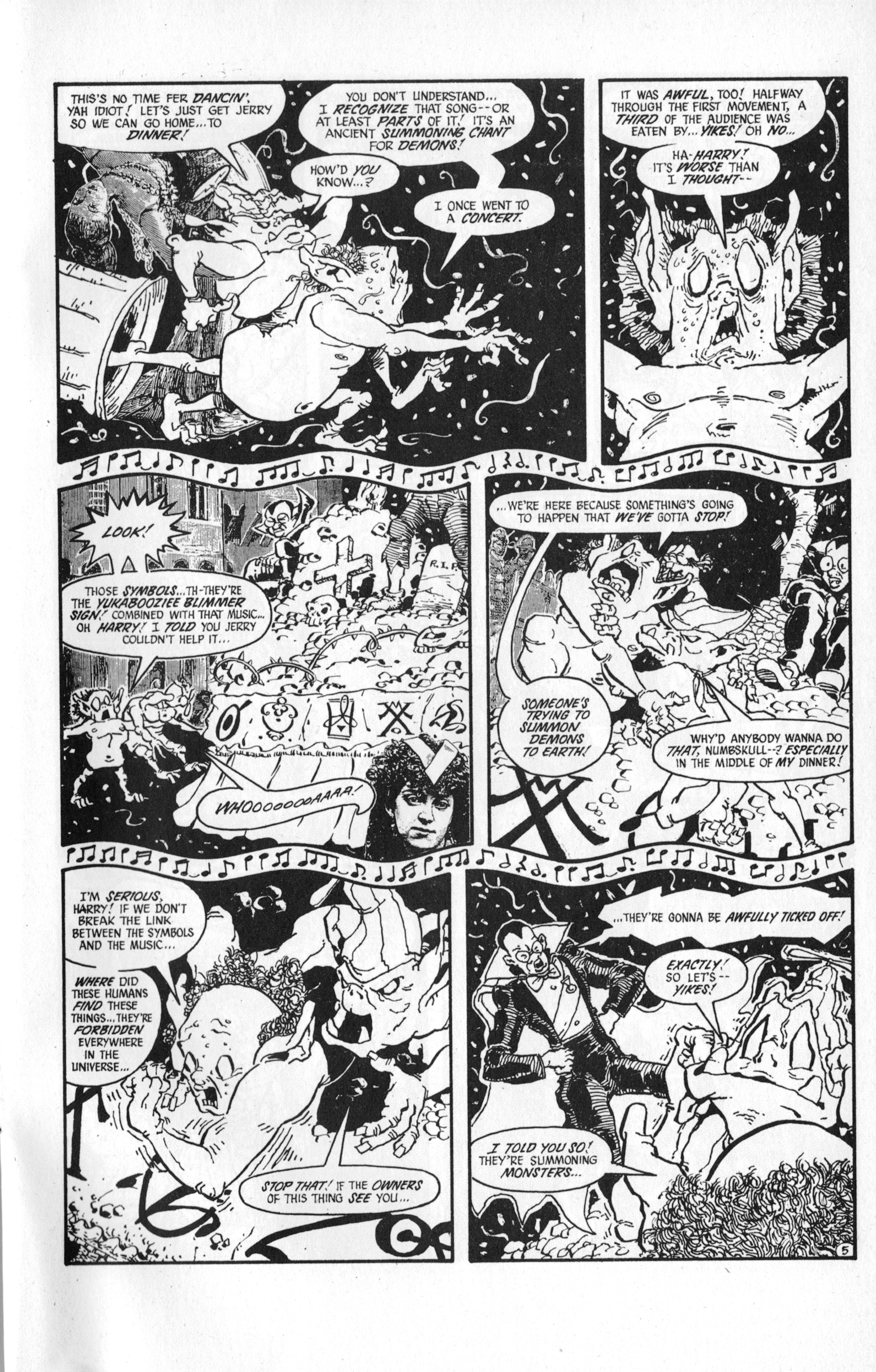
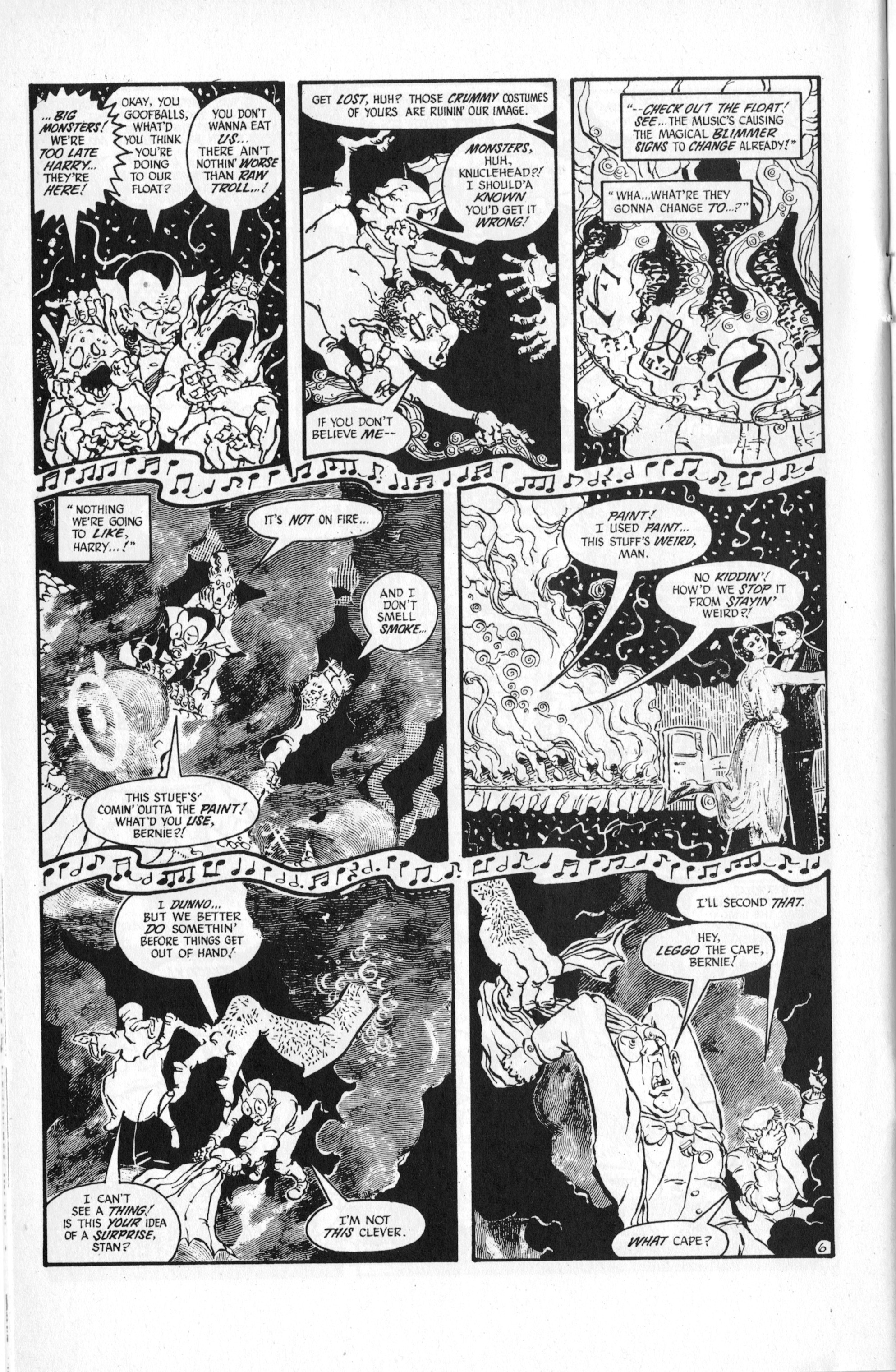
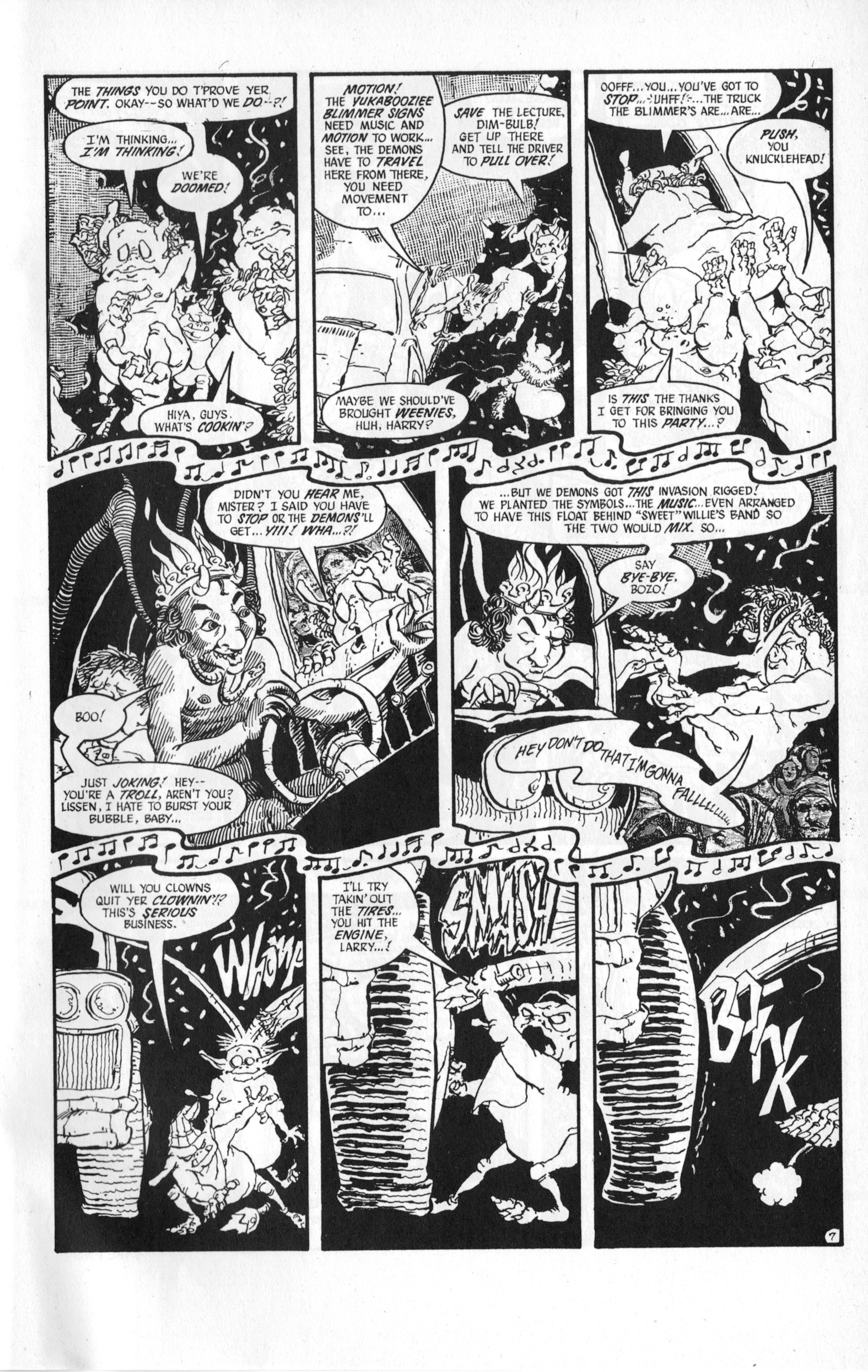
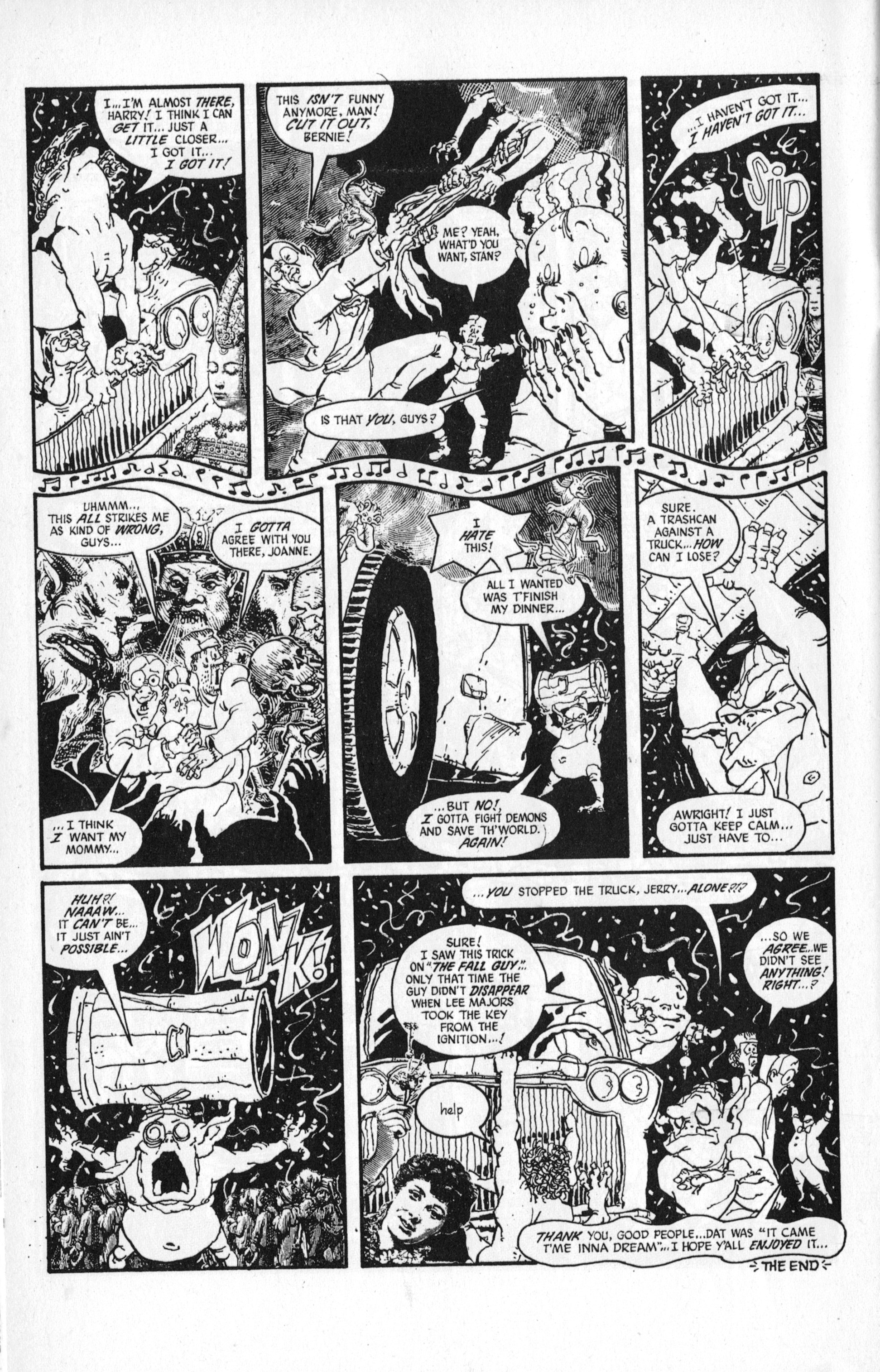
TrolLords_CoverIn the mid-1980s, Tru Studios out of Chicago, Illinois was publishing TrolLords, a player in the independent black and white comics boom. The editor at Tru was my friend Brian Augustyn, who I have known since the days I lived in the Windy City, around 1980, and would later work with on staff and as a freelancer at DC Comics (and who I just had a chance to visit with at length at this year’s TerrifiCon in Connecticut). TrolLords had gathered a nice little following (the text page of this issue features a short but gushing letter of comment from Harlan Ellison) and, with the seventh issue (May, 1987), had gone monthly, which might have had something to do with the use of a back up story that month. Brian invited me to contribute a script for the 8-pager which I set in New Orleans during Mardi Gras, during which nasty magical stuff ensues. “Thud, Thud, Thud In The Mississippi Mud” is beautifully drawn by the talented and lovely cartoonist and animator, Stephen DeStefano, co-creator ‘Mazing Man and drawer of lots of good things, and lettered by Bob Lappan.

TrolLords_1

TrolLords_2

TrolLords_3

TrolLords_4

TrolLords_5

TrolLords_6

TrolLords_7

TrolLords_8

Tags: , , , , , , ,

Paul Kupperberg on August 22nd, 2016

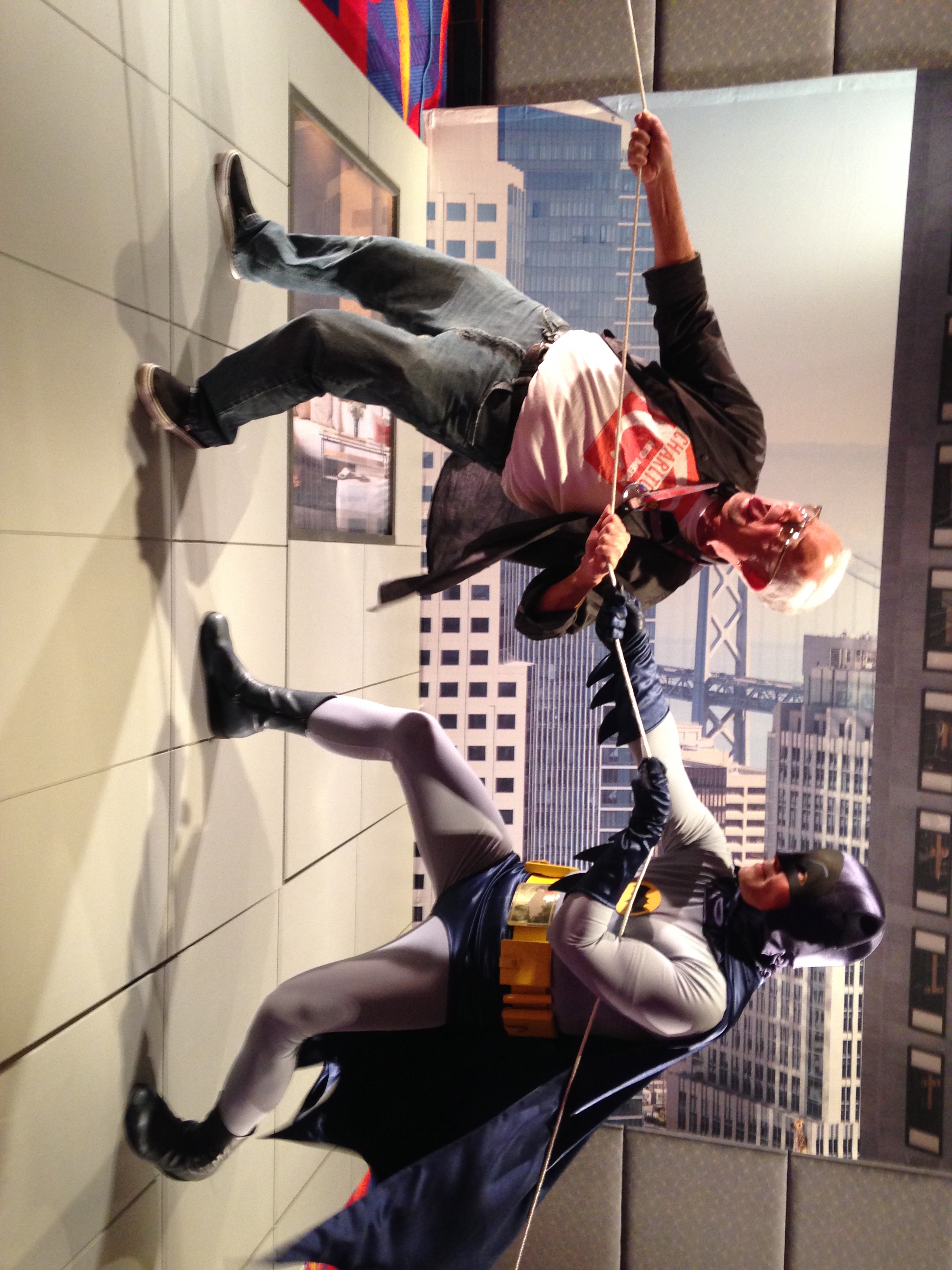
BatwallClimbing-3I had a great time at the 2016 TerrifiCon at the Mohegan Sun in Uncasville, CT. I did several panels over the weekend, including one called “The History of DC Comics” with my old friend, former DC Comics president and publisher and author of  the exhaustive 75 Years of DC Comics: The Art of Modern Mythmaking. I figured this would be an easy panel to do; I just thought of comedian George Burns’ answer to the question of what it was like to work with Gracie Allen, his wife who played a lovable ditz. Burns said, “I just ask her, ‘So, how’s your sister, Gracie?’ and she does half an hour while I stand there and smoke my cigar.”


Tags: , , ,

Paul Kupperberg on August 17th, 2016

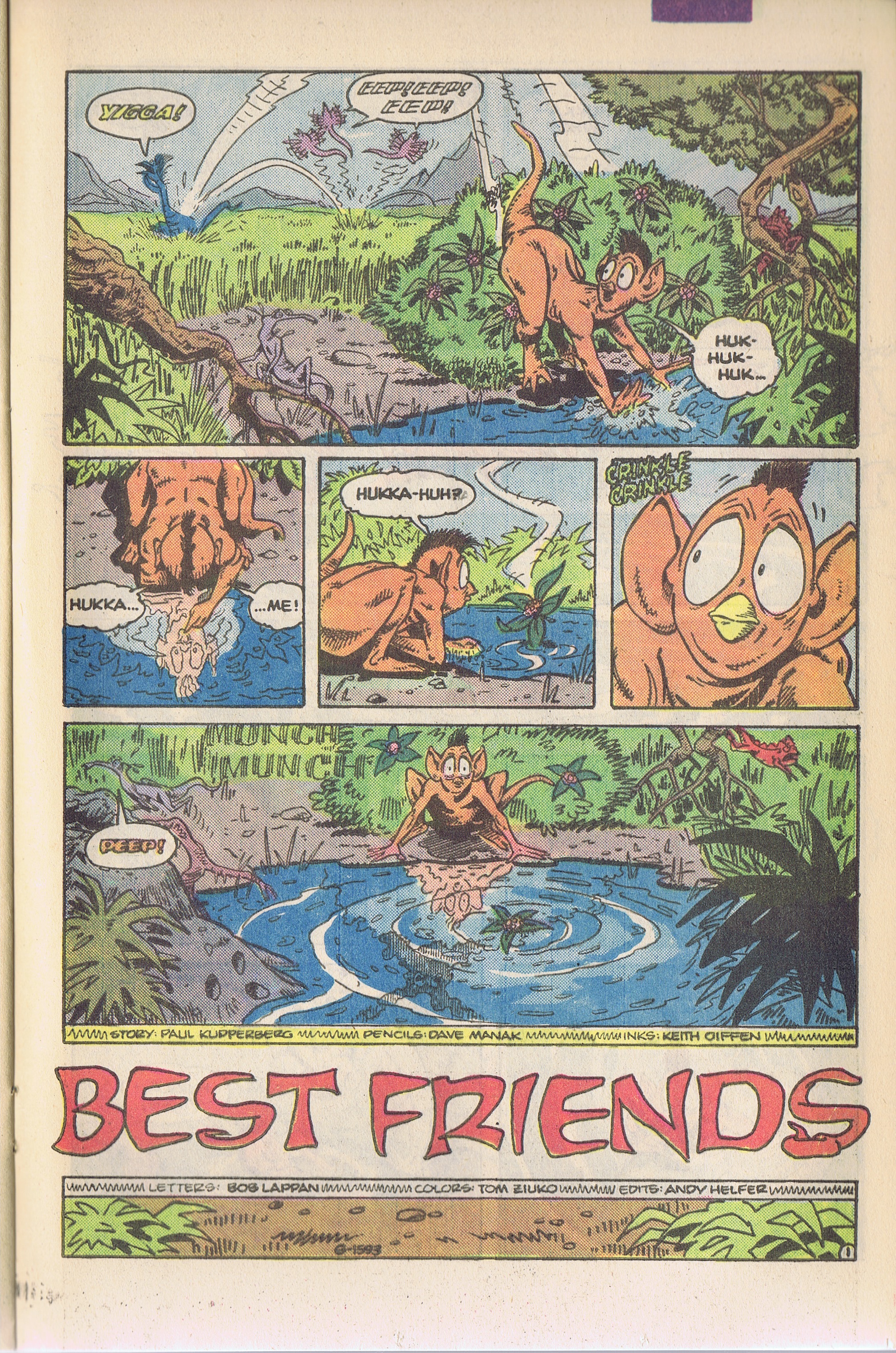
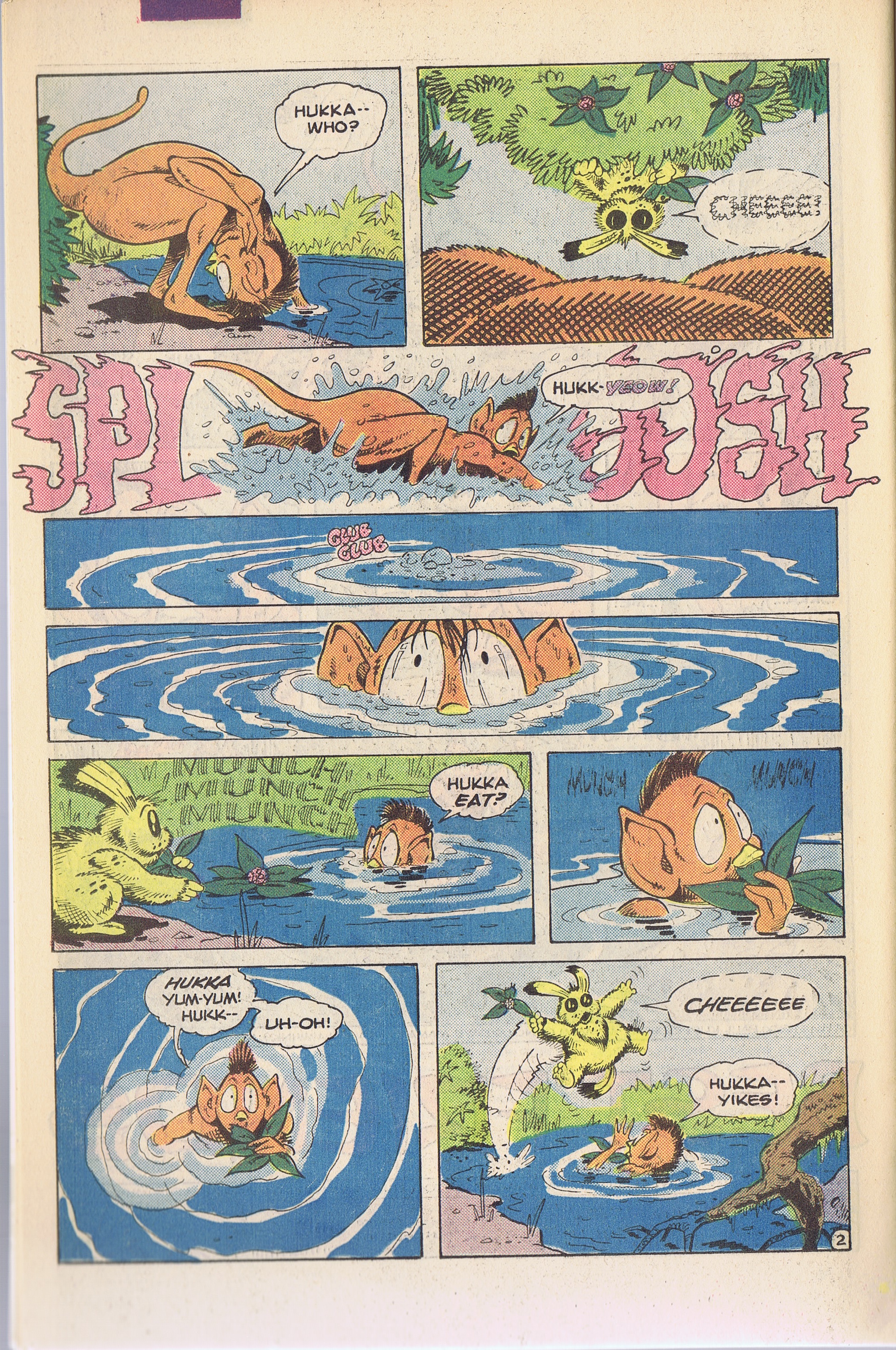
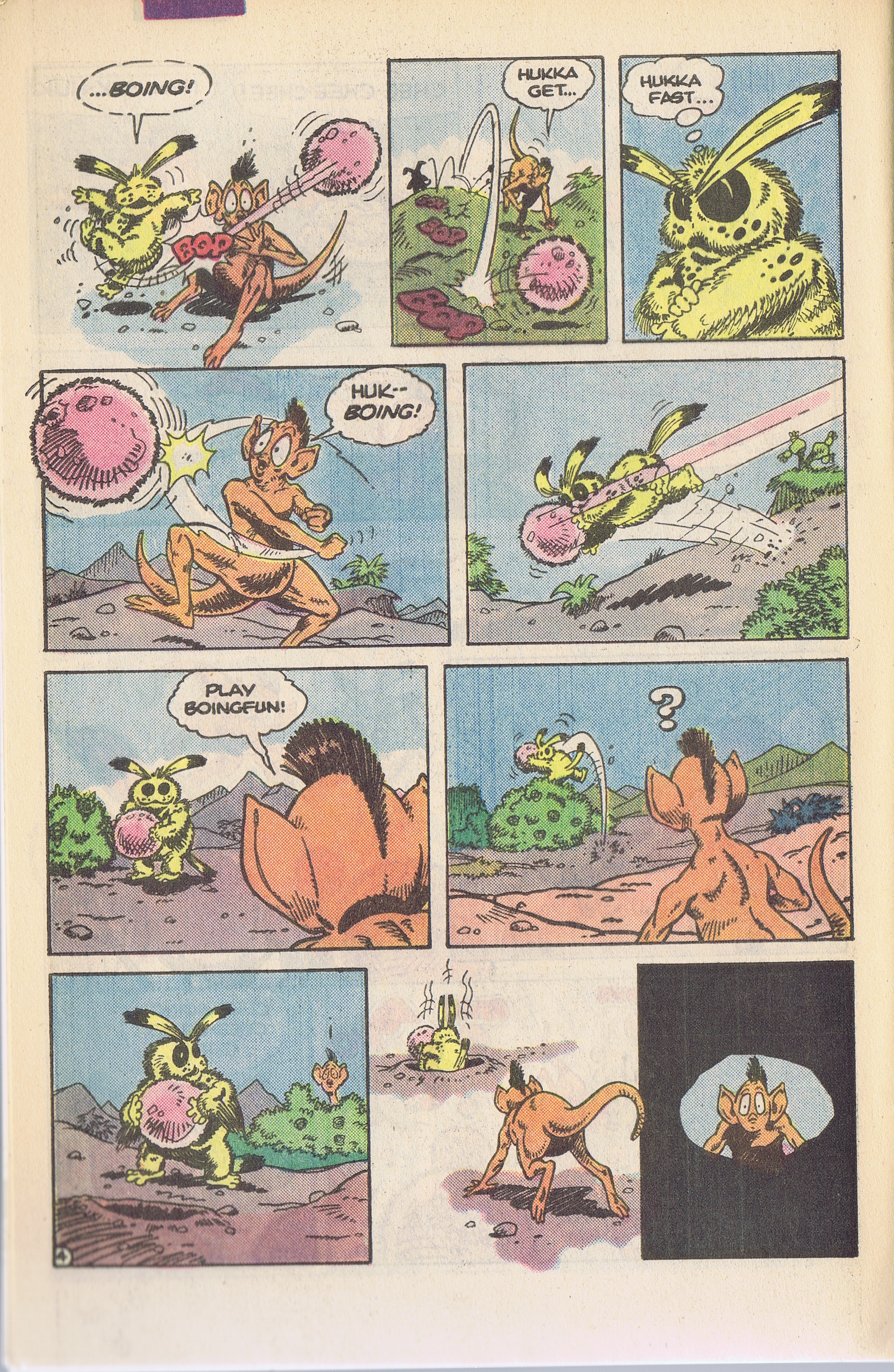
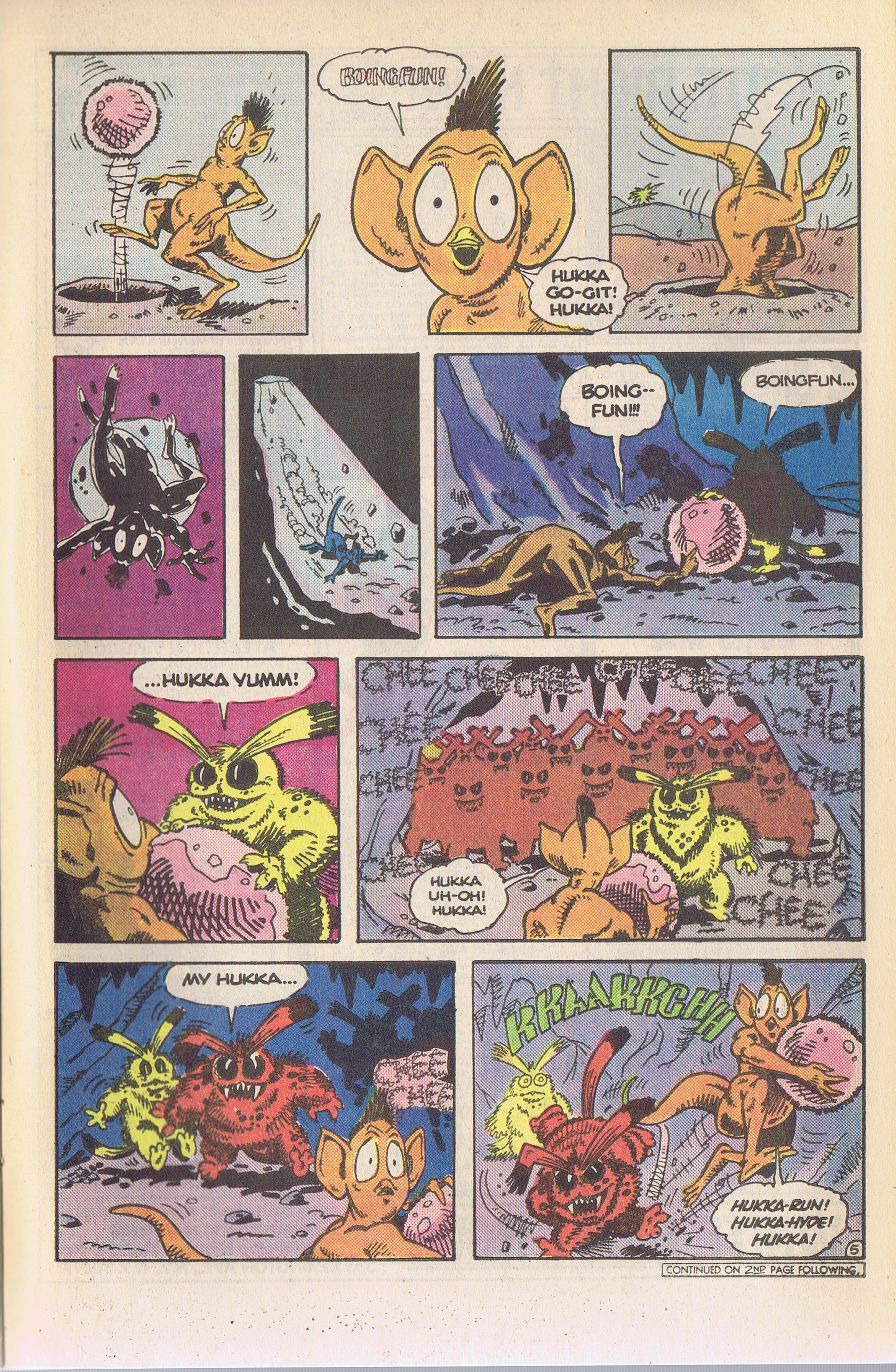
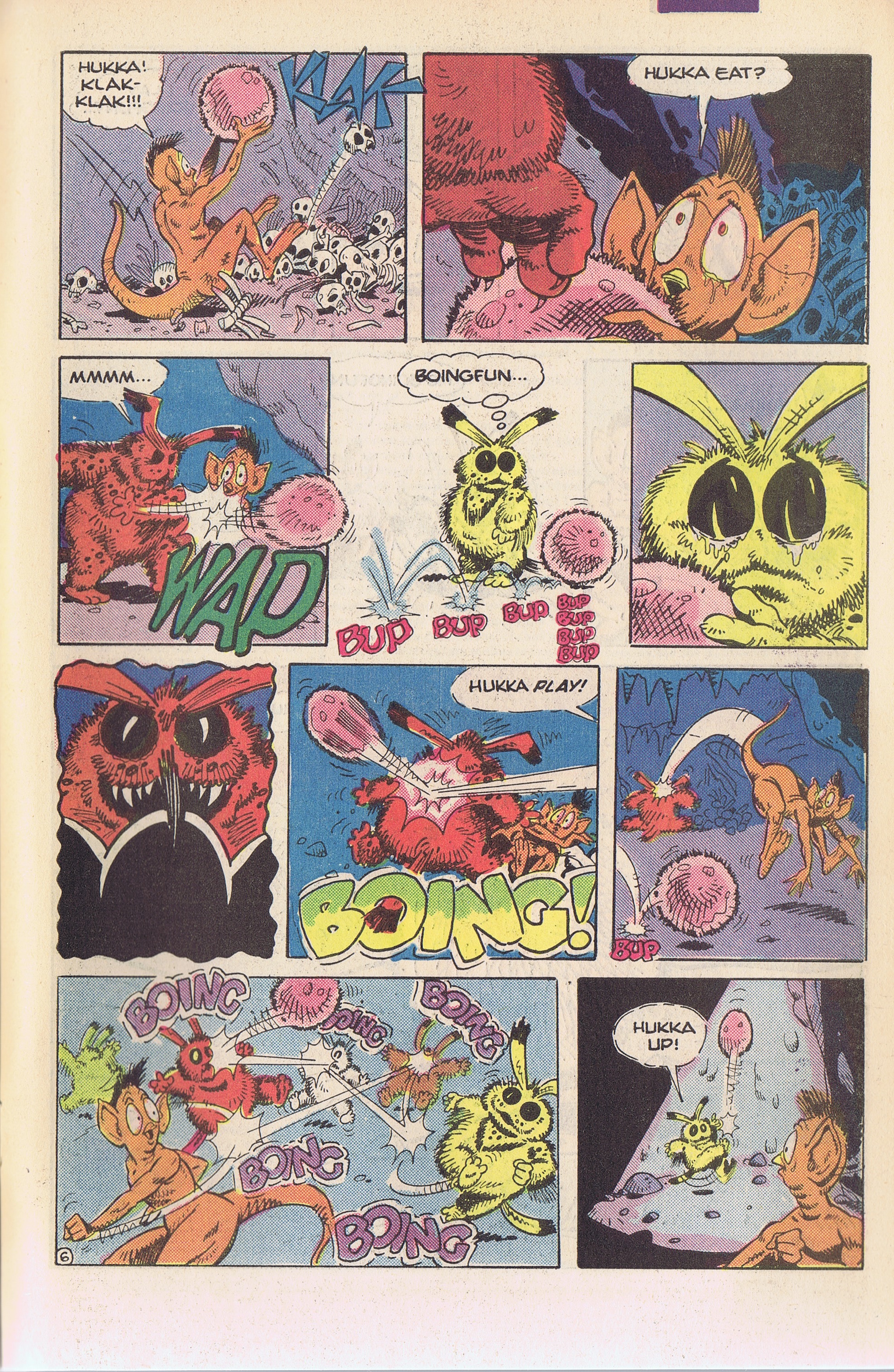
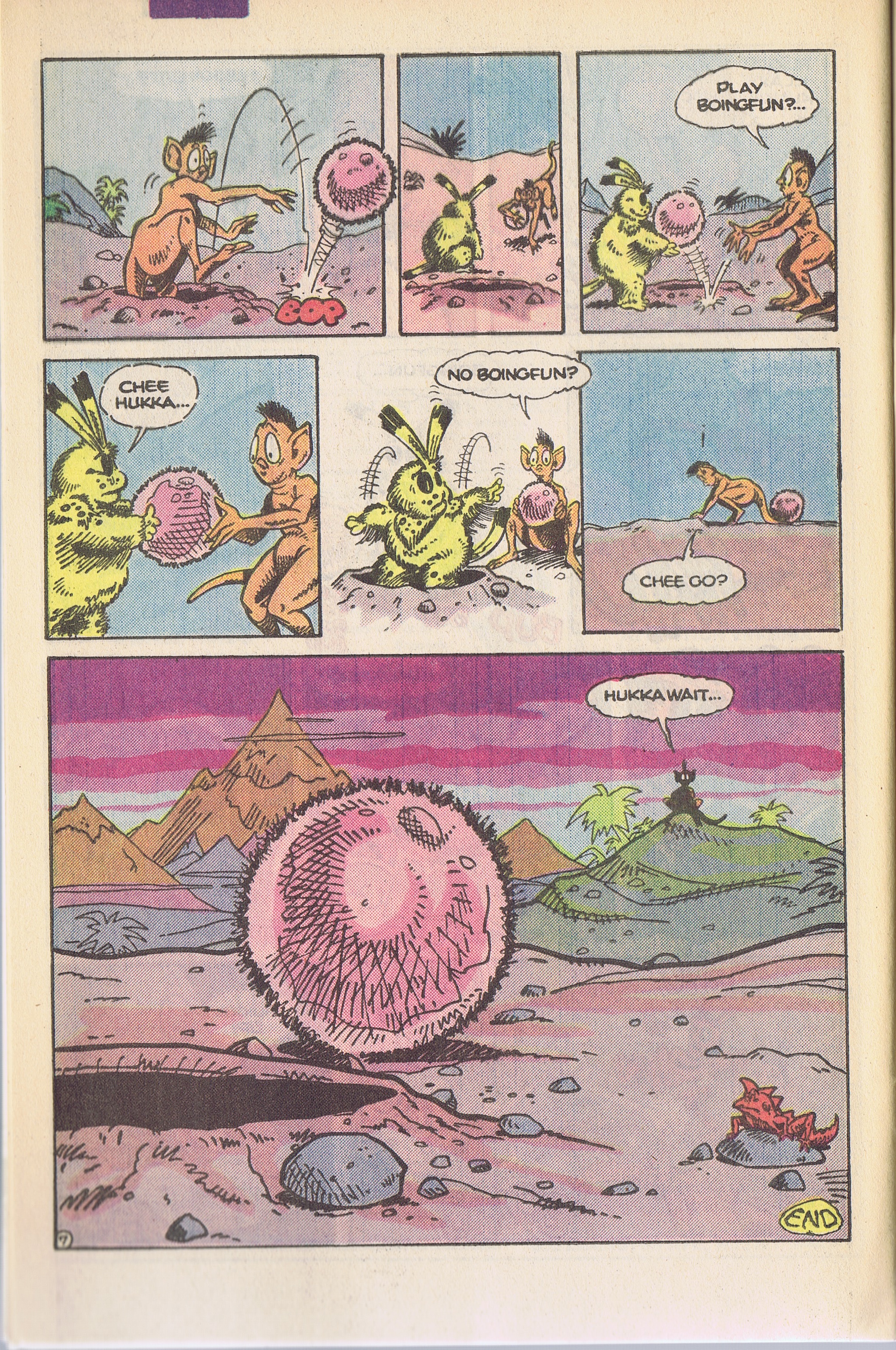
A back-up story I wrote for DC Comics’ Atari Force #13 (January 1985), pencilled by Dave Manak and inked by Keith Giffen that I have no recollection of, even after just stumbling across it in a box of old duplicates. And even though I wrote it, I still gotta ask: What’s a Hukka?

AtariForce-Hukka_1

AtariForce-Hukka_2

AtariForce-Hukka_3AtariForce-Hukka_4

AtariForce-Hukka_5

AtariForce-Hukka_6

AtariForce-Hukka_7

© Atari, Inc.


Tags: , , , ,

Paul Kupperberg on July 16th, 2016

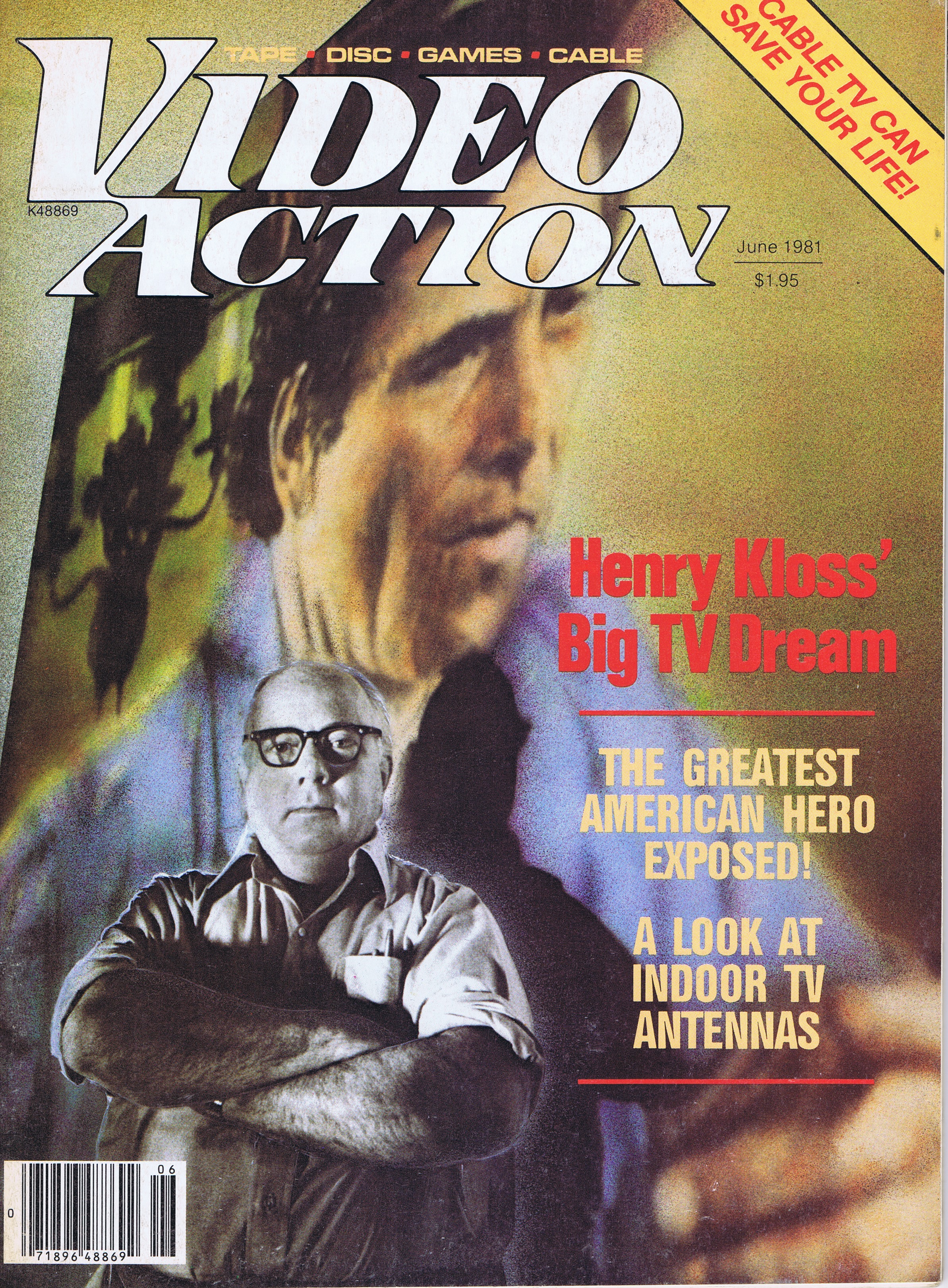
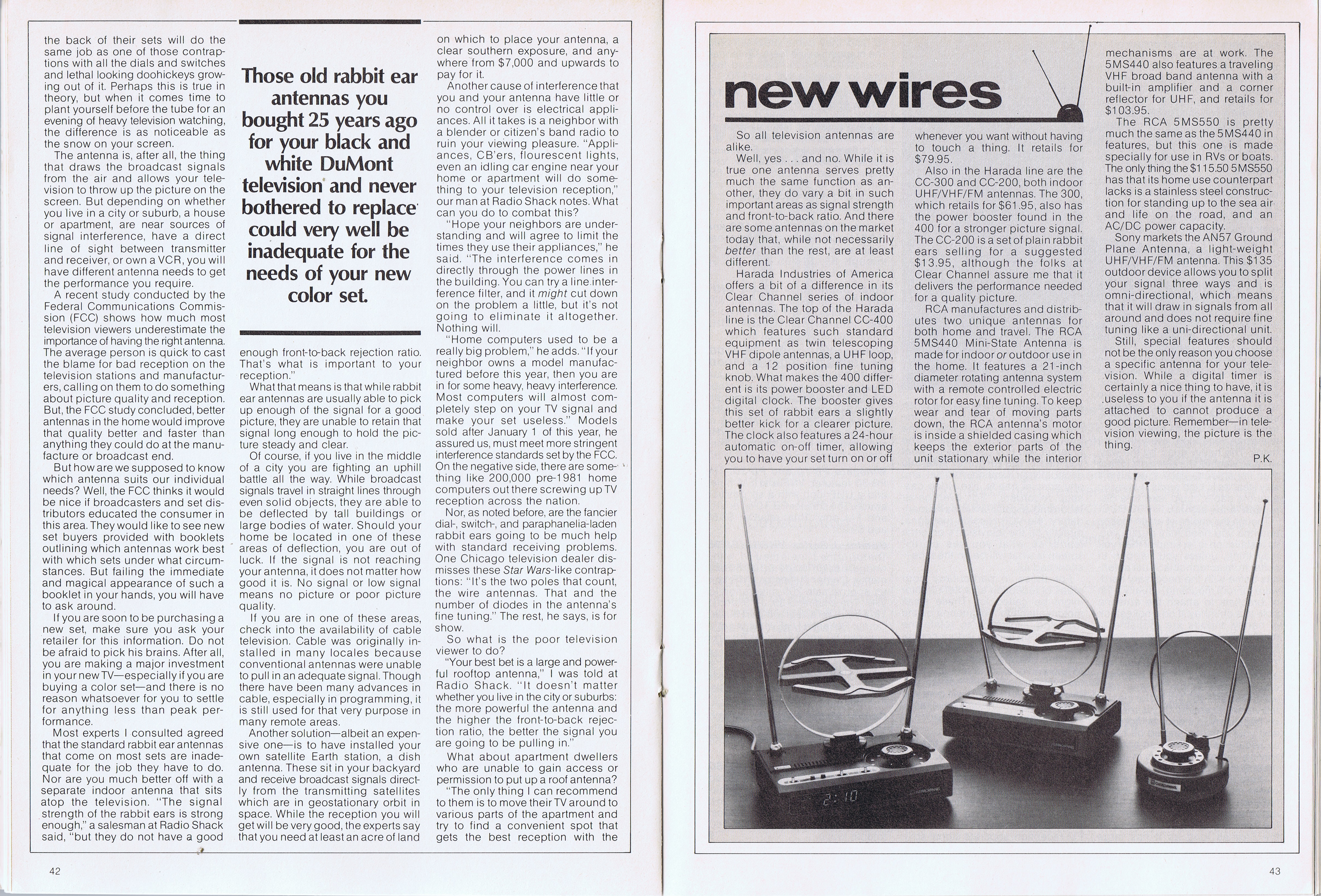
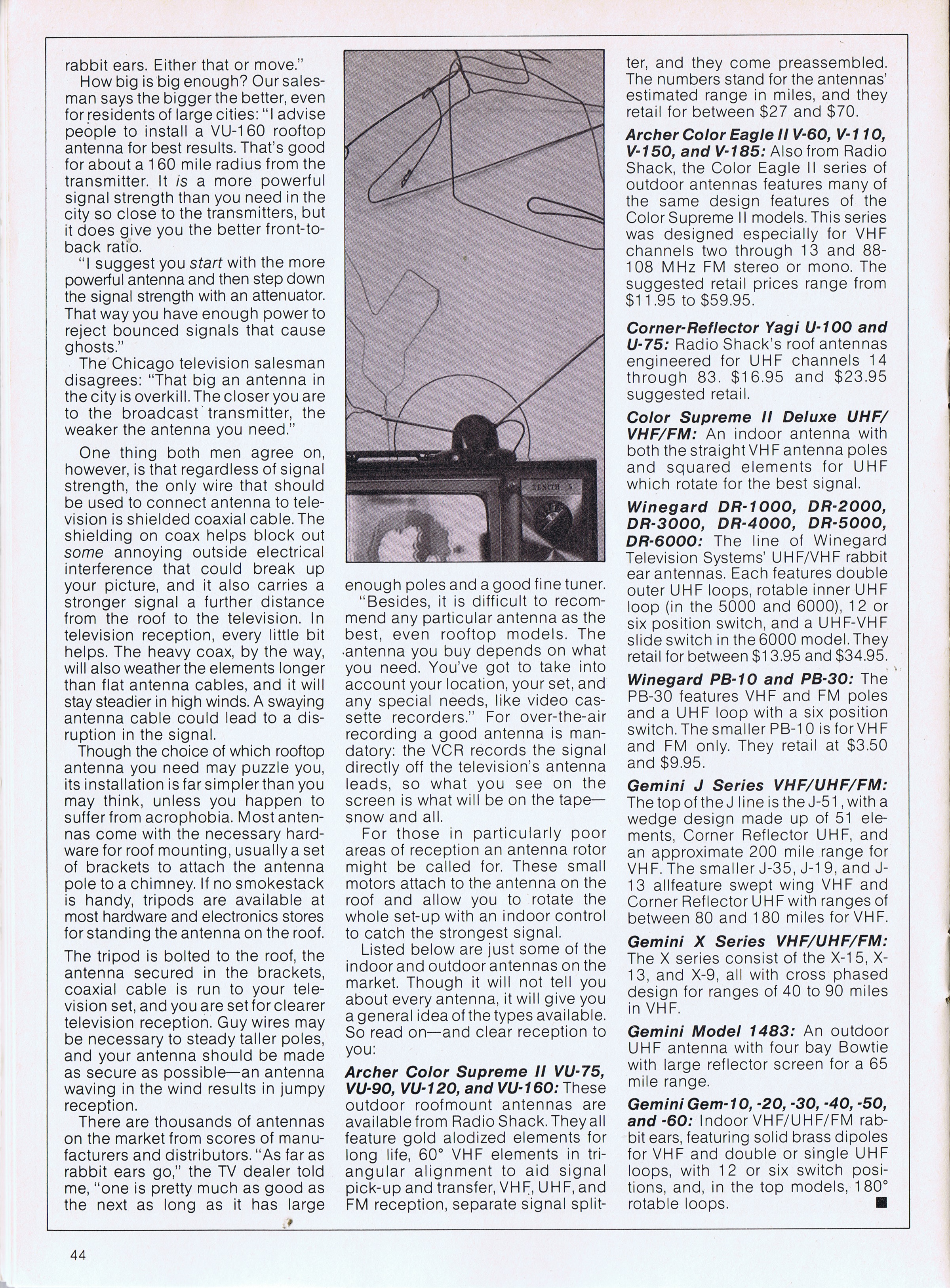
Before television became wireless after all those years of connection by coaxial cable, they had, in fact, originally been wireless…believe it or not!

Broadcasts would send a signal out into the air where they were captured by antennas connected to individual TV sets to be viewed by any and all. The earliest antennas were little more than metal rods whose greater surface area captured more of the radio waves carrying the sound and picture and turned it into electric power. Later models added all sorts of electronic gadgetry to boost the signal and improve the picture on your screen; in the olden days it wasn’t unusual to spend several minutes adjusting set top antennas—popularly known as “rabbit ears” for their V-shaped design—to get the clearest signal. If you lived in an area where TV reception was poor, you could augment your reception with a larger rooftop antenna, or try to boost the signal by wrapping a large piece of aluminum foil around the antenna to capture more of the signal.

I wrote all there was to write on the subject in the June 1981 issue of Video Action…

Vid_Act-Antenna-1

Vid_Act-Antenna-2

Vid_Act-Antenna-3

Vid_Act-Antenna-4

Tags: , , , ,

Paul Kupperberg on July 13th, 2016

During my time writing nonfiction books for the YA school library market, I did books on the great and the near great, including Jerry Yang (2010) for Chelsea House’s “Asian Americas of Achievement” series. That’s right, 22,000 words on a computer geek. Someone else grabbed Bruce Lee before I could. Yang_cover1Yahoo!

Asian Americans of Achievement: Jerry Yang

Chapter 1: November 17, 2008

The headline on the November 17, 2008 New York Times article read simply, “Jerry Yang, Yahoo Chief, Plans to Step Down.” Less than a year and a half earlier, the 40-year old co-founder of one of the world’s most successful internet companies had replaced Terry Semel, the former long-time co-head of Warner Bros Studios in Hollywood he had selected to run Yahoo in 2001, as Chief Executive Officer, or C.E.O. The seven years that followed were to be a mixed bag of success and failure, with phenomenal growth and a presence on the internet that made Yahoo! one of these most popular internet portals and surfing destinations on the World Wide Web.

At that time, Yahoo! had grown from an online list of favorite websites compiled by two graduate student roommates to one of the busiest websites in the world. Under its banner, Yahoo! offered internet users a powerful search engine, email, chat groups and chat rooms, bulletin boards, maps and directions, help wanted and for sale ads, ads for homes and cars, dating and music, weather, shopping, sites to store your photographs, and more.

More people visit Yahoo! to take advantage of all these services than use Google, the next larges search engine (500 million visitors a month versus Google’s 380 million), but Google offers, in the opinion of many, a superior search engine and the site generates significantly more income through advertising, which is the chief source of making money on the internet, than does Yahoo!.

Yahoo was, according to the article “How Yahoo! Aims To Reboot “ in the February 2, 2007 edition of the New York Times, “a company that has divided its attention among dozens of products and services,” and quoted Drew Neisser, C.E.O. of the Renegade Marketing Group advertising agency, “Yahoo! is many things to so many people, whereas the beauty of Google is that at the end of the day, it’s search done well.”

In December 2006, according to the same article, Myspace.com and YouTube.com together had 32 million unique visitors (or individual visitors, each counted once no matter how often they visited the site during the month), while Yahoo! alone had 39 million unique visitors, as well as 250 million users of its email service.

Peanut Butter

The problem most people saw with Yahoo was that it had grown too large and, unlike rival Google, was not focused on doing one thing and doing that well, but Semel was working hard at changing that perception. In the February 2 New York Times article Stewart Butterfield, co-founder of the online image storage site Flickr, which Yahoo bought in March 2005 and then director of product management Yahoo’s said, “There’s always been some ambiguity about whether it’s a tech company or a media company. But there’s been a shift in the internal messaging. I never hear execs refer to Yahoo! as a media company. A year and a half ago, there wasn’t a satisfying articulation of what the mission of the company was. That has changed.”

But it was Semel’s efforts, which included reducing the company’s 44 business departments down to four (a later reorganization would reduce the company to three distinct business units: Web communities, advertisers and infrastructure) that helped Butterfield decide to sell his website to there instead of to Google. Yahoo was also in the process of changing the way the site handled ads. This change would allow the advertisers to take control of the way their ads were displayed. The new advertising platform, called Panama, also allowed Yahoo! to show ads relevant to user’s search, so if a user were to do a search for “plumbing,” the ads for plumbing goods and services would pop up highlighted and at the top of the list. Before that, advertisers simply paid a premium to have their ads come first regardless of what the user was searching. With Panama, ads would be displayed more efficiently and be aimed at users who had shown an interest in the subject.

According to the Times, “Google bought YouTube, which has generated a mountain of buzz, but Yahoo! has quietly leveraged Flickr, Answers and Del.icio.us, among other recent acquisitions and launches, to get its audience–which includes nearly half of the world’s Web users–to spend more time on its network of sites. Yahoo!’s new ad system will capitalize on their presence–and on data it collects from their interactions–more efficiently, with more carefully targeted ads.”

Under Semel, Yahoo was trying, in the minds of many, to decide what it wanted to be when it grew up. Was it a search engine? An advertising platform? A content provider? An online community? Some felt these efforts to decide the direction the company should take had caused it to lose even more focus. In a company memo that was leaked to the public, Yahoo senior vice president Brad Garlinghouse likened the situation to trying to spread a finite amount of peanut butter onto an ever-growing slice of bread. “The result,” he wrote, was “a thin layer of investment spread across everything we do and thus we focus on nothing in particular. I hate peanut butter. We all should.” He went on to note that, “We lack decisiveness (and) we are held hostage by our analysis paralysis.” In other words, he wanted the company to make up its mind.

By early-2007, analysts were looking at Yahoo and beginning to predict that unless the company found a way to catch up with or overtake Google, both it and Terry Semel were in trouble. Some suggested the way to do this would be through a merger with AOL, a division of Time-Warner, or forming a business alliance with Microsoft. The inability to catch Google kept Yahoo in second place and had a disastrous effect on its stock price. For all that Semel had accomplished during his six years, including increasing Yahoo’s annual revenues by 900 percent and adding $30 billion to the company’s net work, the stock market and Yahoo investors would only stand watching the company’s stock prices slide for so long before they wanted change.

The Chief Yahoo Takes Charge

Company co-founder Jerry Yang stepped in to fill the void left by Semel’s departure. Like his predecessor in the executive hot seat, Yang’s first order of business was to come up with a plan to take on and beat Google at what it did best: search and online advertising. In October of 2007, Yahoo announced that, though still profitable, its third quarter (or the three month period of time from July through September) had made two-thirds less money than it had in the previous three month period. In October, Yang was forced to lay off ten percent of the company’s 15,000 employees in order to save money.

Earlier, in February of that year, Microsoft, the software giant founded by Bill Gates, made an offer to buy Yahoo for an amount almost three times higher than the current stock price, or $33 a share while Yahoo stock was trading at between $10 – $11. Yang refused the $44.6 billion deal. By May, Microsoft withdrew its offer.

Next, Yang made a deal with rival Google to share advertising revenues across the two sites. The deal could have been worth anywhere from $250 million to $450 million a year to Yahoo. The government, however, worried that the combined power of these two internet giants would give them an unfair advantage over smaller companies competing for the same advertising dollars. The fear was that they could use their vastly superior size and financial resources to offer advertisers rates that the smaller websites could not afford to match, eventually driving its smaller rivals out of business. Under pressure from government regulators, Google decided not to go through with the deal

By late 2008 Yahoo was still announcing disappointing lower than expected revenues, or profits, and shareholders were beginning to question whether Yang should even be running the company he helped create. Jerry, apparently agreed, as the November 17 announcement was, according to the New York Times article, “…’mutual” and ‘in progress for a while.” Jerry’s own statement on the change in corporate leadership said, “Having set Yahoo on a new, more open path, the time is right for me to transition the C.E.O. role and our global talent to a new leader.”

Jerry wasn’t going far, however. As he wrote in a memo explaining this move to his staff, “All of you know that I have always, and will always bleed purple,” a reference to Yahoo’s corporate color and his dedication to the company. Jerry was to remain on Yahoo’s Board of Directors, or the people elected by stockholders to set corporate policies and make management decisions. He would also help in the search for the person who would replace him as C.E.O. And, more importantly, he would be returning to his earlier position as “Chief Yahoo,” a corporate guru and visionary role.

If the present path is any indication of the road that lies ahead, whoever takes over guiding Yahoo’s future from Jerry Yang is facing a challenge almost as formidable as the one Jerry and his former grad school roommate and company co-founder David Filo did in creating the company in the first place.

Tags: , , , , ,

Paul Kupperberg on July 6th, 2016

Another of the books I did for Rosen Publishing’s young adult school library series was Critical Perspectives on The Great Depression, part of a series called “Critical Anthologies of Nonfiction Writing.” It was a collection of contemporary writings tracing the arc of the Great Depression, from the stock market crash of 1929 through to the death of FDR in 1945. I selected the articles for the book and wrote the introductory material.

Great-Depression_coverCritical Perspectives on The Great Depression: Introduction

“The only thing we have to fear is fear itself.”

President Franklin D. Roosevelt, first inaugural address, March 4, 1933

Social Security. The federal income tax. Unemployment insurance. Welfare. The Federal Bank Deposit Insurance Corporation. The Tennessee Valley Authority. The National Labor Relations Board. The Securities and Exchange Commission. The Federal Housing Authority.

These are just some of the federal institutions and agencies that we today either take for granted or resent for their intrusions into our lives and business. Before October 29, 1929, most of these federal institutions (and dozens more just like them) would have been unthinkable to the citizens of the United States, accustomed as they were to a laissez-faire, or hands-off, style of government. Yet after 1929, these programs resurrected the United States from the depths of the greatest economic disaster to ever strike this country, the crash and near-decade long recovery that came to be known as the Great Depression.

It seemed was as though no one wanted to see it coming. Ever since 1919 and the end of the first World War, the United States had been on what appeared to be an ever-cresting tide of economic growth, with no end in sight. Gone were the restraints of the staid, pre-War Edwardian era, shoved roughly aside by returning veterans with a reckless disregard for what lay ahead. Here were the Roaring Twenties, the swinging Jazz Age, a decade of exuberance, of excess, of wild abandon. While the Eighteenth Amendment had outlawed the transportation and sale of alcoholic beverages (1919), anyone wanting a drink knew where to find the nearest speakeasy for a shot of illegal whiskey, accompanied by the hot sounds of the popular new jazz music.

The nation was fairly exploding with prosperity, innovation, and creativity. With only a little money down, and little government regulation or interference, anyone could invest in the booming stock market and find themselves—on paper, at least—instantly wealthy. Air travel went from being a novelty craze to commercial viability with Charles Lindbergh’s successful 1927 solo flight across the Atlantic Ocean, even as Americans bought millions of Henry Ford’s new Model A automobiles to create the most mobile society in the history of the world. F. Scott Fitzgerald, Theodore Dreiser, and Ernest Hemingway brought literature into the modern age with such works as “The Great Gatsby,” “An American Tragedy,” and “A Farewell to Arms,” while motion pictures learned to talk, starting with “The Jazz Singer.”

There seemed no stopping America. “The chief business of the American people is business,” President Calvin Coolidge told the press in 1925 and no one could argue with that assessment. For most of its first century, the U.S. had been a largely agrarian society, but by the end of the first third of the Twentieth Century, the country had turned decidedly urban and industrialized, with a majority of its population living, for the first time, in cities rather than on farms. Washington, D.C., the nation’s capital, was still considered a sleepy little Southern town, “A strange city, set up in the first place to be the center of government and, like government itself at that time, a city moving slowly and doing little,” according to reporter David Brinkley in his book, “Washington Goes to War.” Government was kept small, operating with a bureaucracy that can only be called miniscule compared to the hundreds of thousands of federal workers that today keeps the monolithic machine of government humming.

Herbert Hoover, who in 1922 spoke of “American individualism” over governmental regulation and interference in the lives of its citizens, was elected president in 1928. President Hoover, former head of the American Relief Administration (which organized shipments of food for an estimated one billion starving people in fifty-seven countries in post-World War I Europe) and Secretary of Commerce under Presidents Warren G. Harding and Calvin Coolidge, was a believer in balancing responsibility for the welfare of the people with a faith in free enterprise. During his 1929 campaign, Hoover proclaimed “We in America are nearer to the final triumph over poverty than ever before in the history of any land.”

Between May 1928 and September 1929, the average price of stocks rose forty per cent, with trading exploding from two to three million shares per day to over five million. Those interested in investing in the stock market could do so “on margin,” that is, for a small cash down payment, using the stock itself as collateral for its purchase; full payment came due when the stock was sold…usually, in those heady days, for a significant profit that would more than cover the purchase price. The market, once the playground of the wealthy, was suddenly open to Everyman. The railroad tycoon and the shoeshine boy stood side-by-side, watching the rise and fall (but mostly rise) of the Wall Street stock ticker.

Stock prices spiraled upwards, speculation ran rampant, and investors kept jumping on board the money-making wagon. But that wagon could support only so many before it collapsed under the weight and, on Tuesday, October 29, 1929, that’s exactly what happened, dumping the United States and the rest of the world into the throes of the Great Depression. In a single day, billions of dollars were lost (it is estimated that on the New York Stock Exchange alone, losses exceeded $8,000,000,000; this at a time when the average per capita urban household income was $750 a year and $273 for farming households) as more than 16,000,000 shares were frantically traded in a futile attempt to staunch the financial bloodletting. Small investors who had made their paper-profits on stocks purchased at ten per cent of face value were suddenly forced to pay the balance due on their stocks. But with prices plummeting so low, a majority of these small-timers had no profits to cover them and lost everything.

Jazz Age exuberance and excess turned almost immediately to desperation and deprivation. Banks and businesses failed, the money supply shrank, and, by 1932, the unemployment rate would reach a staggering 23.6 per cent (and continue on up, peaking at 24.9 per cent) as over thirteen million Americans lost their jobs. Relief efforts were organized across the country as families with no source of income were forced to stand in the infamous bread lines and soup kitchens, which were, for many, their only source of food.

Hundreds of thousands took to the road seeking work at any wage; entire families begin a westward migration from the southern and northern Plain states (Kansas, Oklahoma, Texas, New Mexico, Nevada, and Arkansas), which suffered the added tragedy of one of the worst droughts in history that turned a large section of the nation into a Dust Bowl. President Hoover took a number of steps to stem the tide of desperation, including the Reconstruction Finance Corporation (RFC), the Federal Home Loan Bank Act, and the banking regulatory Glass-Steagall Act of 1932, but it wasn’t until newly elected President Franklin D. Roosevelt took office in 1933 that the government’s response was equal to the magnitude of the crisis. As the Democratic nominee for president, Roosevelt had promised “I pledge you, I pledge myself, to a new deal for the American people.”

Roosevelt was as good as his word. In the first one hundred days of his administration, his “New Deal” instituted a concentrated program of legislative activity, sending recovery bill after recovery bill to a Congress that, unsure how to respond, had not done nearly enough to help their constituents through this unprecedented financial catastrophe. Under the president’s guidance, Congress created, in swift succession, the Agricultural Adjustment Administration (AAA), the Civilian Conservation Corps (CCC), the Farm Credit Administration (FCA), the Federal Deposit Insurance Corporation (FDIC), the Federal Emergency Relief Administration (FERA), the National Recovery Act (NRA), the Public Works Administration (PWA), and the Tennessee Valley Authority (TVA), to name a few. This alphabet soup of federal agencies—along with a rash of banking, securities, and credit acts that followed—were all aimed at getting Americans back to work and the floundering economy back on track.

But for all the efforts of FDR (whose popularity as leader would lead him to being reelected an unprecedented three times) and his dedicated administration, it would be more than a decade before the nation, and the world, would truly recover from the events of that single, terrible day.

# # #

Introduction to “Stocks Collapse in 16,410,030-Share Day, but Rally at Close Cheers Brokers; Bankers Optimistic, to Continue Aid”

It is difficult to point to any single cause of the Crash of 1929, but an editorial in The New York Times just days before the calamitous events of October 29 pointed to the “orgy of speculation” that had driven stock prices so high as the main culprit.

In “Looking Back at the Crash of 1929,” (October 29, 1999), The New York Times wrote, “’Playing the stock market has become a major American pastime,’ reported The Times in a magazine article published on March 24, 1929. ‘It is quite true that the people who know the least about the stock market have made the most money out of it in the last few months. Fools who rushed in where wise men feared to tread ran up high gains.’”

Fools continued rushing in and, following two days in which the Stock Market lost nearly one-quarter of its value, the bottom gave way and there was no where else to go but down. By the time the plunge had been checked, the Dow would drop eighty-nine percent from its 1929 peak.

“Stocks Collapse in 16,410,030-Share Day, but Rally at Close Cheers Brokers; Bankers Optimistic, to Continue Aid”

by The New York Times

Originally published in The New York Times (October 30, 1929)

Stock prices virtually collapsed yesterday, swept downward with gigantic losses in the most disastrous trading day in the stock market’s history. Billions of dollars in open market values were wiped out as prices crumbled under the pressure of liquidation of securities which had to be sold at any price.

There was an impressive rally just at the close, which brought many leading stocks back from four to fourteen points from their lowest points of the day.

Trading on the New York Stock Exchange aggregated 16,410,030 shares; on the Curb, 7,096,300 shares were dealt in. Both totals far exceeded any previous day’s dealings.

From every point of view, in the extent of losses sustained, in total turnover, in the number of speculators wiped out, the day was the most disastrous in Wall Street’s history. Hysteria swept the country and stocks went overboard for just what they would bring at forced sale.

Efforts to estimate yesterday’s market losses in dollars are futile because of the vast number of securities quoted over the counter and on out-of-town exchanges on which no calculations are possible. However, it was estimated that 880 issues, on the New York Stock Exchange, lost between $8,000,000,000 and $9,000,000,000 yesterday. Added to that loss is to be reckoned the depreciation on issues on the Curb Market, in the over the counter market and on other exchanges.

Two Extra Dividends Declared

There were two cheerful notes, however, which sounded through the pall of gloom which overhung the financial centers of the country. One was the brisk rally of stocks at the close, on tremendous buying by those who believe that prices have sunk too low. The other was that the liquidation has been so violent, as well as widespread, that many bankers, brokers and industrial leaders expressed the belief last night that it now has run its course.

A further note of optimism in the soundness of fundamentals was sounded by the directors of the United States Steel Corporation and the American Can Company, each of which declared an extra dividend of $1 a share at their late afternoon meetings.

Banking support, which would have been impressive and successful under ordinary circumstances, was swept violently aside, as block after block of stock, tremendous in proportions, deluged the market. Bid prices placed by bankers, industrial leaders and brokers trying to halt the decline were crashed through violently, their orders were filled, and quotations plunged downward in a day of disorganization, confusion and financial impotence.

Change Is Expected Today

That there will be a change today seemed likely from statements made last night by financial and business leaders. Organized support will be accorded to the market from the start, it is believed, but those who are staking their all on the country’s leading securities are placing a great deal of confidence, too, in the expectation that there will be an overnight change in sentiment; that the counsel of cool heads will prevail and that the mob psychology which has been so largely responsible for the market’s debacle will be broken.

The fact that the leading stocks were able to rally in the final fifteen minutes of trading yesterday was considered a good omen, especially as the weakest period of the day had developed just prior to that time and the minimum prices for the day had then been established. It was a quick run-up which followed the announcement that the American Can directors had declared an extra dividend of $1. The advances in leading stocks in this last fifteen minutes represented a measurable snapback from the lows. American Can gained 10; United States Steel common, 7 1/2, General Electric, 12; New York Central, 14 1/2, Anaconda Copper, 9 1/2; Chrysler Motors 5 1/4; Montgomery Ward, 4 1/4 and Johns Manville, 8. Even with these recoveries the losses of these particular stocks, and practically all others, were staggering.

Yesterday’s market crash was one which largely affected rich men, institutions, investment trusts and others who participate in the stock market on a broad and intelligent scale. It was not the margin traders who were caught in the rush to sell, but the rich men of the country who are able to swing blocks of 5,000, 10,000 up to 100,000 shares of high-priced stocks. They went overboard with no more consideration than the little trader who was swept out on the first day of the market’s upheaval, whose prices, even at their lowest of last Thursday, now look high in comparison.

The market on the rampage is no respecter of persons. It washed fortune after fortune away yesterday and financially crippled thousands of individuals in all parts of the world. It was not until after the market had closed that the financial district began to realize that a good-sized rally had taken place and that there was a stopping place on the downgrade for good stocks.
Third Day of Collapse

The market has now passed through three days of collapse, and so violent has it been that most authorities believe that the end is not far away. It started last Thursday, when 12,800,000 shares were dealt in on the Exchange, and holders of stocks commenced to learn just what a decline in the market means. This was followed by a moderate rally on Friday and entirely normal conditions on Saturday, with fluctuations on a comparatively narrow scale and with the efforts of the leading bankers to stabilize the market evidently successful. But the storm broke anew on Monday, with prices slaughtered in every direction, to be followed by yesterday’s tremendous trading of 16,410,030 shares.

Sentiment had been generally unsettled since the first of September. Market prices had then reached peak levels, and, try as they would, pool operators and other friends of the market could not get them higher. It was a gradual downward sag, gaining momentum as it went on, then to break out into an open market smash in which the good, the bad, and indifferent stocks went down alike. Thousands of traders were able to weather the first storm and answered their margin calls; thousands fell by the wayside Monday and again yesterday, unable to meet the demands of their brokers that their accounts be protected.

There was no quibbling at all between customer and broker yesterday. In any case where margin became thin a peremptory call went out. If there was no immediate answer the stock was sold out “at the market” for just what it would bring. Thousands, sold out on the decline and amid the confusion, found themselves in debt to their brokers last night.

Three Factors in Market

Three factors stood out most prominently last night after the market’s close. They were:

Wall Street has been able to weather the storm with but a single Curb failure, small in size, and no member of the New York Stock Exchange has announced himself unable to meet commitments.

The smashing decline has brought stocks down to a level where, in the opinion of leading bankers and industrialists, they are a buy on their merits and prospects, and brokers have so advised their customers.

The very violence of the liquidation, which has cleaned up many hundreds of sore spots which honeycombed the market, and the expected ability of the market to right itself, since millions of shares of stock have passed to strong hands from weak ones.

Bids Provided Where Needed

One of the factors which Wall Street failed to take into consideration throughout the entire debacle was that the banking consortium has no idea of putting stocks up or to save any individuals from loss, but that its sole purpose was to alleviate the wave of financial hysteria sweeping the country and provide bids, at some price, where needed. It was pointed out in many quarters that no broad liquidating movement in the stock market has ever been stopped by so-called good buying. This is helpful, of course, but it never stops an avalanche of liquidation, as was this one.

There is only one factor, it was pointed out, which can and always does stop a down swing–that is, the actual cessation of forced liquidation. It is usually the case, too, that when the last of the forced selling has been completed the stock market always faces a wide-open gap in which there are practically no offerings of securities at all. When that point is reached, buying springs up from everywhere and always accounts for a sharp, almost perpendicular recovery in the best stocks. The opinion was widely expressed in Wall Street last night that that point has been reached, or at least very nearly reached.

Huge Blocks Offered at Opening

The opening bell on the Stock Exchange released such a flood of selling as has never before been witnessed in this country. The failure of the market to rally consistently on the previous day, the tremendous shrinkage of open market values and the wave of hysteria which appeared to sweep the country brought an avalanche of stock to the market to be sold at whatever price it would bring.

From the very first quotation until thirty minutes after 10 o’clock it was evident that the day’s market would be an unprecedented one. In that first thirty-minutes of trading stocks were poured out in 5,000, 10,000, 20,000 and 50,000 share blocks at tremendous sacrifices as compared with the previous closing. The declines ranged from a point or so to as much as 29 1/2 points, and the reports of opening prices brought selling into the market in confused volume that has never before been equaled.

In this first half hour of trading on the Stock Exchange a total of 3,250,800 shares were dealt in. The volume of the first twenty-six blocks of stock dealt in at the opening totaled more than 630,000 shares.

There was simply no near-by demand for even the country’s leading industrial and railroad shares, and many millions of dollars in values were lost in the first quotations tapped out. All considerations other than to get rid of the stock at any price were brushed aside.

Brokerage Offices Crowded

Wall Street was a street of vanished hopes, of curiously silent apprehension and of a sort of paralyzed hypnosis yesterday. Men and women crowded the brokerage offices, even those who have been long since wiped out, and followed the figures on the tape. Little groups gathered here and there to discuss the fall in prices in hushed and awed tones. They were participating in the making of financial history. It was the consensus of bankers and brokers alike that no such scenes ever again will be witnessed by this generation. To most of those who have been in the market it is all the more awe-inspiring because their financial history is limited to bull markets.

The machinery of the New York Stock Exchange and the Curb market were unable to handle the tremendous volume of trading which went over them. Early in the day they kept up well, because most of the trading was in big blocks, but as the day progressed the tickers fell further and further behind, and as on the previous big days of this week and last it was only by printing late quotations of stocks on the bond tickers and by the ten-minute flashes on stock prices put out by Dow, Jones & Co. and the Wall Street News Bureau that the financial district could get any idea of what was happening in the wild mob of brokers on the Exchange and the Curb.

Peaks Reached in September

The bull market, the most extensive in the history of the country, started in the Coolidge Administration and reached its height with a tremendous burst of speculation in the public utility issues, the flames of speculation being fed by mergers, new groupings, combinations and good earnings.

The highest prices were reached in early September. At that time the market had a quick break and an equally rapid recovery. Then started a slow sag. Two developments, not considered important at the time, served to start the ball rolling downhill. The first of these was the refusal of the Massachusetts Public Service Commission to permit the Boston Edison Company to split its shares; the second was the collapse of a pool in International Combustion Engineering shares on the Stock Exchange, an over-exploited industrial which had been pushed across 100 by a pool and which crashed when the corporation passed its dividend.

In the meanwhile, the Hatry failure abroad had diverted a tremendous volume of selling to the United States, and under these influences the market continued to sag until it literally crumpled of its own weight.

# # #

Introduction to “James Agee On the Death of FDR”

“Zest for living is one of his most conspicuous characteristics, and he has enjoyed to the full a job that ruined and broke so many other men…. He rises to an emergency as a trout to the fly…. In Franklin Roosevelt there is fireman’s blood, and he responds to the three-alarm bell like a veteran.”

—Marquis W. Childs, “Mr. Roosevelt,” Survey Graphic (May 1, 1940)

In many ways, the story of the Great Depression is also FDR’s story. His election in 1932 marked the renewal of America’s hope and the first steps towards recovery. By the time of his death, on April 12, 1945—four months before the war’s end—the country had emerged from the dark days of the Depression. The post-War boon would carry the country into the 1960s.

Franklin Roosevelt’s death was a shock to the national psyche. But it is testament to his leadership that the country, freed from the burden of the Depression and soon to be done with war, would have the strength to endure whatever was to come….

James Agee on the Death of FDR

Originally published in Time Magazine, April 12, 1945

In Chungking the spring dawn was milky when an MP on the graveyard shift picked up the ringing phone in U.S. Army Headquarters. At first he heard no voice on the other end; then a San Francisco broadcast coming over the phone line made clear to him why his informant could find no words. A colonel came in. The MP just stared at him. The colonel stared back. After the moment the MP blurted two words. The colonel’s jaw dropped; he hesitated; then without a word he walked away.

It was fresh daylight on Okinawa. Officers and men of the amphibious fleet were at breakfast when the broadcast told them. By noon the news was known to the men at the front, at the far sharp edge of the world’s struggle. With no time for grief, they went on with their work; but there, while they worked, many a soldier wept.

At home, the news came to people in the hot soft light of the afternoon, in taxicabs, along the streets, in offices and bars and factories. In a Cleveland barbershop, 60 year old Sam Katz was giving a customer a shave when the radio stabbed out the news. Sam Katz walked over to the water cooler, took a long, slow drink, sat down and stared into space for nearly ten minutes. Finally he got up and painted a sign on his window, “Roosevelt is Dead.” Then he finished the shave. In an Omaha poolhall, men racked up their cues without finishing their games, walked out. In a Manhattan taxicab, a fare told the driver, who pulled over to the curb, sat with his head bowed, and after two minutes resumed his driving.

Everywhere, to almost everyone, the news came with the force of a personal shock. The realization was expressed in the messages of the eminent; it was expressed in the stammering and wordlessness of the humble. A woman in Detroit said: “It doesn’t seem possible. It seems to me that he will be back on the radio tomorrow, reassuring us all that it was just a mistake.”

It was the same through that evening, and the next day, and the next: the darkened restaurants, the shuttered nightclubs, the hand lettered signs in the windows of stores: “Closed out of Reverence for F.D.R.”; the unbroken, 85 hour dirge of the nation’s radio; the typical tributes of typical Americans in the death notice columns of their newspapers (said one signed by Samuel and Al Gordon: “A Soldier Died Today”)

It was the same on the cotton fields and in the stunned cities between Warm Springs and Washington, while the train, at funeral pace, bore the coffin up April’s glowing South in reenactment of Whitman’s great threnody.

It was the same in Washington, in the thousands on thousands of grief wrung faces which walled the caisson’s grim progression with prayers and with tears. It was the same on Sunday morning in the gentle landscape at Hyde Park, when the burial service of the Episcopal Church spoke its old, strong, quiet words of farewell; and it was the same at that later moment when all save the gravemen were withdrawn and reporters, in awe felt hiding, saw how a brave woman, a widow, returned, and watched over the grave alone, until the grave was filled.


Tags: , , , , ,

Paul Kupperberg on July 3rd, 2016

A boy never forgets…his first nonfiction book for the school library market. Mine was a 6,000 word little beauty called, When Disaster Strikes: The Tragedy of the Titanic (Rosen Publishing, 2001). Oh, sure, there wasn’t a lot of text to her but what was there was cherce…!

TragedyofTitanicChapter Two: The Maiden Voyage of THE Titanic

At approximately noon on April 10, 1912, the Titanic set sail from Southampton, England on her maiden voyage. She made stops at Cherbourg, France and Queenstown, Ireland to pick up additional passengers before embarking for her final destination, New York City with 2,223 people aboard.

The mood aboard ship was festive, with a passenger list made up of some of the most famous names on the social register. In addition to Mr. and Mrs. John Jacob Astor, the Titanic’s passengers included Charles H. Hays, President of the Grand Trunk Railroad, publisher Henry Sleeper Harper, Broadway producer Henry B. Harris and his wife, steel magnate Arthur Ryerson, the painter Frank Millet, writer Jacques Futrelle, Washington A. Roebling 2nd, the son and grandson of the men who built the Brooklyn Bridge, members of the wealthy Rothschild banking family, and wealthy department store owner Isidor Straus and his wife.

It was only fitting that the Titanic sailed under the command of Captain Edward J. Smith, the senior captain of the White Star Line. After years at sea, this was to be Captain Smith’s final voyage before retirement. No one questioned that this highly regarded and skilled sailor deserved to see the greatest ship ever built through her maiden voyage.

According to Senator William Alden Smith, “For 40 years storms sought in vain to vex him or menace his craft….Each new advancing type of ship built by his company was handed over to him as a reward for faithful services and as an evidence of confidence in his skill. Strong of limb, intent of purpose, pure in character, dauntless as a sailor should be, he walked the deck of his majestic structure as master of her keel.”

As much faith as his employers, passengers and crew had in him, Smith held the same high regard for his new ship. In speaking of the Titanic, Smith was reported in a newspaper account of the day to have told friends Mr. and Mrs. W.P. Willie of Flushing, Long Island that the Titanic marked a high point of safety and comfort in the evolution of ocean travel. He also had complete faith in the Titanic’s seaworthiness, telling the Willies that it was impossible for the great ship to sink.

Other reports quoted Captain Smith as saying that the Titanic’s sister ship, the Olympic, was “…Unsinkable, and Titanic will be the same when she is put in commission. Why, either of these vessels could be cut in halves and each half would remain afloat almost indefinitely. The non-sinkable vessel has been reached in these two wonderful craft. I venture to add that even if the engines and boilers of these vessels were to fall through their bottoms, the vessels would remain afloat.”

Neither the White Star Line or shipbuilders Harland and Wolff ever publicly claimed that the Titanic was unsinkable. Under the right circumstances and with enough damage, any ship could go down. But the press so played up lifesaving devices like automatic watertight doors and bulkheads that the public came to regard the great ship as invulnerable.

Of course, there was no reason to believe that the Titanic would encounter anything on her voyage that might test that belief. For all the publicity, it was a fairly routine Atlantic crossing, made each year by hundreds of ships in all sorts of weather. Captain Smith, the experienced, veteran commander, was himself no stranger to the route that took them through well charted and regularly traveled waters. Their course was west across the Atlantic Ocean from England to the Canadian province of Newfoundland on the east coast of North America, then south to New York in the United States.

In fact, the entire trip up until the fateful hour on the night of April 14 was strictly routine. The weather was clear for virtually the entire voyage, the sea calm, with sunshine all day and bright starlight every night.

As the Titanic steamed across a placid North Atlantic at 21 or 22 knots, the passengers were relaxed, enjoying their voyage and the amenities the ship had to offer. It had been a perfect voyage, justifying White Star’s pride in the new queen of their line.

But the “unsinkable” Titanic was about to meet her fate.


Chapter Five: THE LEGACY OF THE TITANIC

 Resting somewhere on the ocean floor off Newfoundland, the Titanic was to rise to the status of legend. Over the years following the disaster, countless books, fact, fiction and wild speculation alike, would be written about the great ship. Films, television programs, even a Broadway play, would continue to feed the public’s fascination with her. The Titanic grew from a symbol of the Gilded Age in which she sailed to a chapter of history.

But before that happened, the failure of the Titanic would serve as a warning for what might go wrong on so large a ship. Clearly the way these giant steamships were constructed and operated needed to be examined and many changes made.

The Senate Inquiry pinpointed several key causes of the accident and the massive loss of life that followed. Not the least of these was that the Titanic’s failure to carry enough lifeboats for the safety of her passengers. It was recommended that a statute be passed requiring all ships entering U.S. ports to provide enough lifeboats for every one on board. (A step the White Star Line had already taken on all its ships.)

It then noted that the Titanic had not held adequate lifeboat drills before sailing, and that neither crew nor passengers had been given lifeboat assignments. Under new regulations, crews were required to perform lifeboat drills at least twice a month. Passengers were also to be drilled and lifeboat assignments posted.

Wireless radio was then still a relatively new addition to ships, but it was there largely as a convenience for passengers. Radios were not required and those that did have them didn’t keep them switched on all the time. After the Titanic, ships were required to be equipped with a wireless manned 24-hours a day by operators.

In light of the Californian having ignored as fireworks the emergency rockets the Titanic had fired off throughout the night, Congress also passed legislation that made it a crime to fire “rockets or candles on the high sea for any other purpose than as a signal of distress.”

Many other changes resulted, including the structural requirements for ocean-going passenger steamers. New ships would feature watertight skins and watertight compartments, bulkheads and decks, designed in light of what had been learned from the failure of the Titanic’s design.

Beginning in 1912, the U.S. Navy assigned two of its ships to patrol the “ice limits,” the area of the North Atlantic south of the iceberg zone. In 1914, thirteen nations involved in North Atlantic shipping banded together and formed the International Ice Patrol.

The function of both of these services was to be on the watch for and provide information to mariners on any ice that might drift from the northern ice fields into the regularly traveled shipping lanes. The IIP is still in existence, maintained in the U.S. by the Coast Guard, patrolling the waters around the Grand Banks of Newfoundland by ship and aircraft. According to the IIP, there has not been a collision between a ship and an iceberg since the service has been in existence.

Of course, the true extent of the damage done to the Titanic remained a mystery that many believed would never be solved. The exact location of the ship was unknown and it was, at any rate, resting more than two miles below the surface. While many searched for the lost ship, few believed it would ever be found.

However, on Sunday, September 1, 1985, a joint French-American scientific expedition led by Dr. Robert Ballard of the Woods Hole Oceanographic Institution in Massachusetts, did just that: a little more than 73 years after the Titanic sank, the great ship was found. Utilizing sonar, imaging devices, unmanned submersible crafts, and underwater cameras, Ballard and his team systematically searched the vicinity where the Titanic was believed to have gone down.

For several reasons, pinpointing the ship’s exact location when she went down was no easy task. In 1912, ships navigated at night by the stars, a practical but imprecise method of navigation as compared with today’s satellite aided navigation. That, combined with not knowing the ship’s exact speed to compute the distance traveled, gave the expedition a wide area to search. When she was eventually located, the Titanic was two and one half miles to the south and 15 1/2 miles to the east of her last reported position.

What Dr. Ballard and his associates found answered many of the mysteries surrounding the fate of the Titanic. Her last minutes had been violent and destructive ones. Modern-day computer stress analysis based on the condition of the ship shows that she was tearing apart, her water-filled bow pulling away from the stern. The ship was also bending in the middle from the staggering weight of the water flooding into her. When she finally sank, she was most likely in one piece, but just barely. Eventually, underwater and out of sight of witnesses, the two halves broke apart.

They eventually settled on the ocean floor, some 12,500 feet below. They landed less than 2000 feet apart, with a field of debris (everything from broken pieces of the hull to cabin furniture to cutlery) stretched between them.

It had long been believed that the iceberg had ripped a 300-foot long gash in the hull. But investigation of the wreckage showed that rather than creating a single, huge gash, the collision caused a series of small tears in the hull as it scraped along the ice. Some of these rips were no more than an inch wide but they occurred where the plates of the hull had been riveted together.

Samples of steel from the hull brought up from the wreck of the Titanic underwent metallurgical analysis. The results, published in the Journal of Metals, showed the steel was contaminated with high levels of sulfur, oxygen and phosphorus, making it vulnerable to fracturing under impact. “It is apparent,” the report stated, “that the steel used for the hull was not suited for service at low temperatures. The seawater temperature at the time of the collision was -2 degrees C (28 degrees F).”

In other words, the icy waters of the North Atlantic had made the ship’s hull brittle. When the frozen steel slammed against the iceberg, it shattered, rivets holding the steel plates to the ship popping, allowing the plates to pull apart. Even the rivets themselves are now believed to have been defective, at least by modern standards. Those few that have been recovered and examined (out of some three million used in her construction) show them to have been contaminated with slag, which would have weakened them.

But, the Journal of Metals study doesn’t assign any blame to the shipbuilders for using this unsuitable steel. It concludes, “The steel used in constructing the Titanic was probably the best plain carbon ship plate available in the period of 1909 to 1911, but it would not be acceptable at the present time for any construction purposes and particularly not for ship construction.”

The best steel available at the time. But not up to the demands placed on it by the designers of the Titanic. She was created to be the biggest, most luxurious ship ever conceived. The White Star Line knew that so grand a ship could be built and spared no expense to do so in a time when science and technology were expected to perform miracles. They believed that if it could be done, it should be done.

But as Senator Smith observed “…Overconfidence seems to have dulled the faculties usually so alert.” Their desire to make the biggest and best was well ahead of the available technology–in this case, the quality of the steel available to make this dream ship a reality. No one believed they were using anything but the finest steel money could buy. But as good as it was, it wasn’t good enough for the job it had been called upon to do.

And, of course, it would be years until the devices that now make travel by sea so much safer would be developed and put in use. Modern passenger liners–not to mention military and commercial ships–are equipped with radar, sonar and satellite positioning technology. The captain can see at a glance what is around him, beneath him, and approaching him from a distance. His exact position, accurate to within inches in the middle of a vast ocean, is logged by satellites orbiting high above the Earth. Radar will warn him of an iceberg long before he will ever be able to see it with his own eye. Real-time weather maps from satellites show him exactly what conditions he’s sailing into.

None of this equipment guarantees there will never be another accident at sea. But they do make the likelihood of one of the same magnitude far more unlikely by placing every available resource for safety in the captain’s hands.

As for the Titanic, she will remain where she was found, 12,500 feet below the ocean’s surface, a monument to man’s achievements and a memorial to our failures.

Tags: , , , , ,