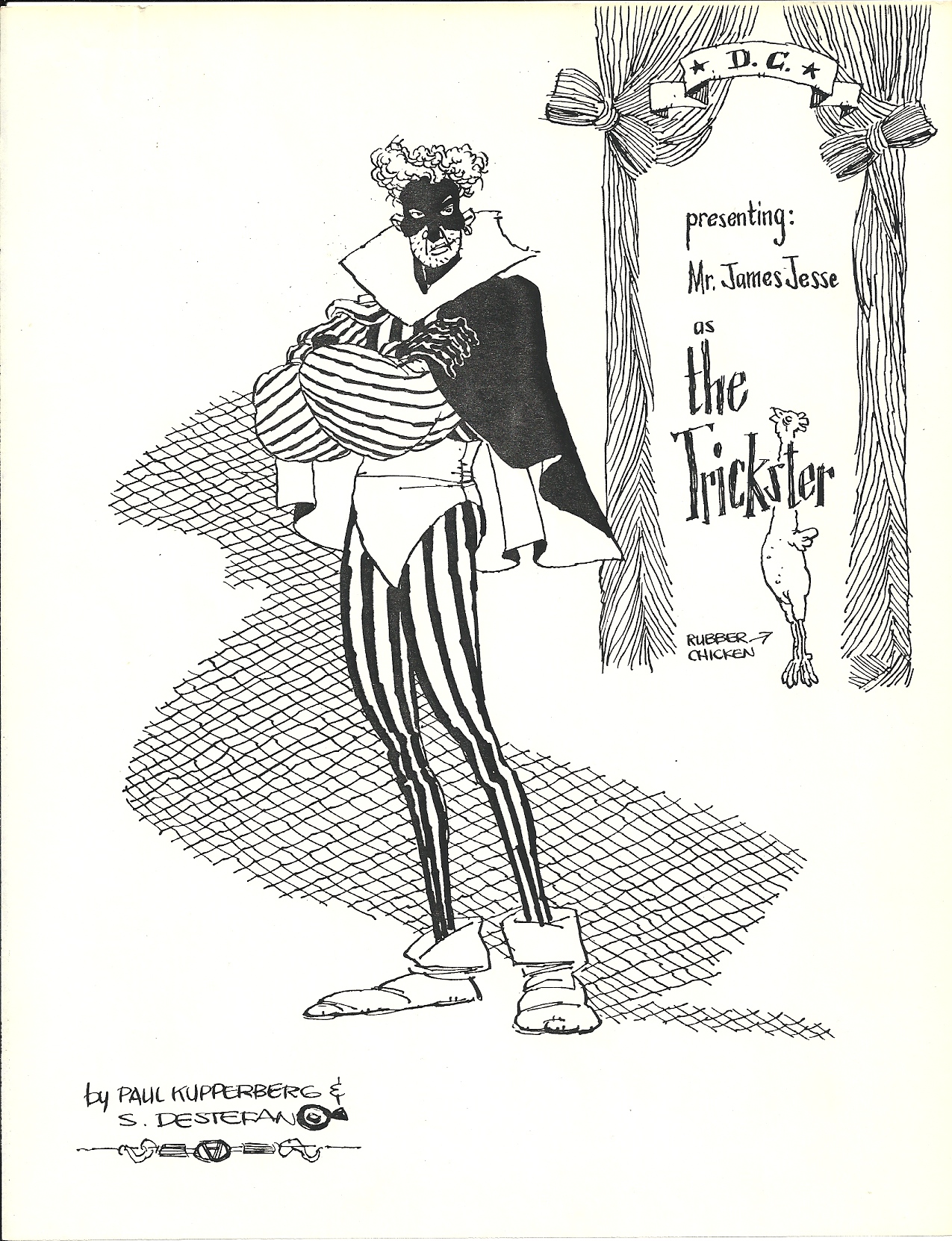
The Trickster (c) DC entertainment

Back in 1989, DC Comics had procedures for getting proposals for new titles through what they called “the pipeline.” I assume they still have procedures; I wouldn’t know, since, with the exception of Karen Berger’s recent and reasoned rejection of a project I proposed to her, I haven’t tried to sell anything to DC in years.

But in 1989, my time on The Doom Patrol had just come to an end and I was seeking a book to replace it on my schedule. Since one couldn’t count on being chosen to replace another writer on an ongoing book, the best way to find work was to create something new. One such proposal was called Bloodhound, which I worked on with Graham Nolan (who had replaced Erik Larsen on the last few issues of my run on Doom Patrol) for editor Bob Greenberger. Bloodhound, as I recall, was pitched and rejected. Oh well. They can’t all be winners, right?

Another proposal, though, was supposed to be a sure bet. An editor (although this, as well as previous and subsequent experience with this person both as a writer and a colleague has proven, the title alone does not validate the position) approached artist Stephen DeStefano (co-creator with Bob Rozakis of the charming ‘Mazing Man, as well as a ton of work ever since, including Ren and Stimpy, the Venture Brothers, and Instant Piano) and myself with the idea of doing a series based on the Flash rogue, the Trickster.

The idea was to bring a humorous and offbeat slant to a character who had been around for almost thirty years and who, let’s face it, wore harlequin shoes and used such weapons as explosive teddy bears in his battles with the Flash. The Trickster series would just take that already existing level of absurdity to the next level, removing him from the world of conventional superheroics, surrounding him with a cast of wacky supporting characters, and letting hilarity ensue.
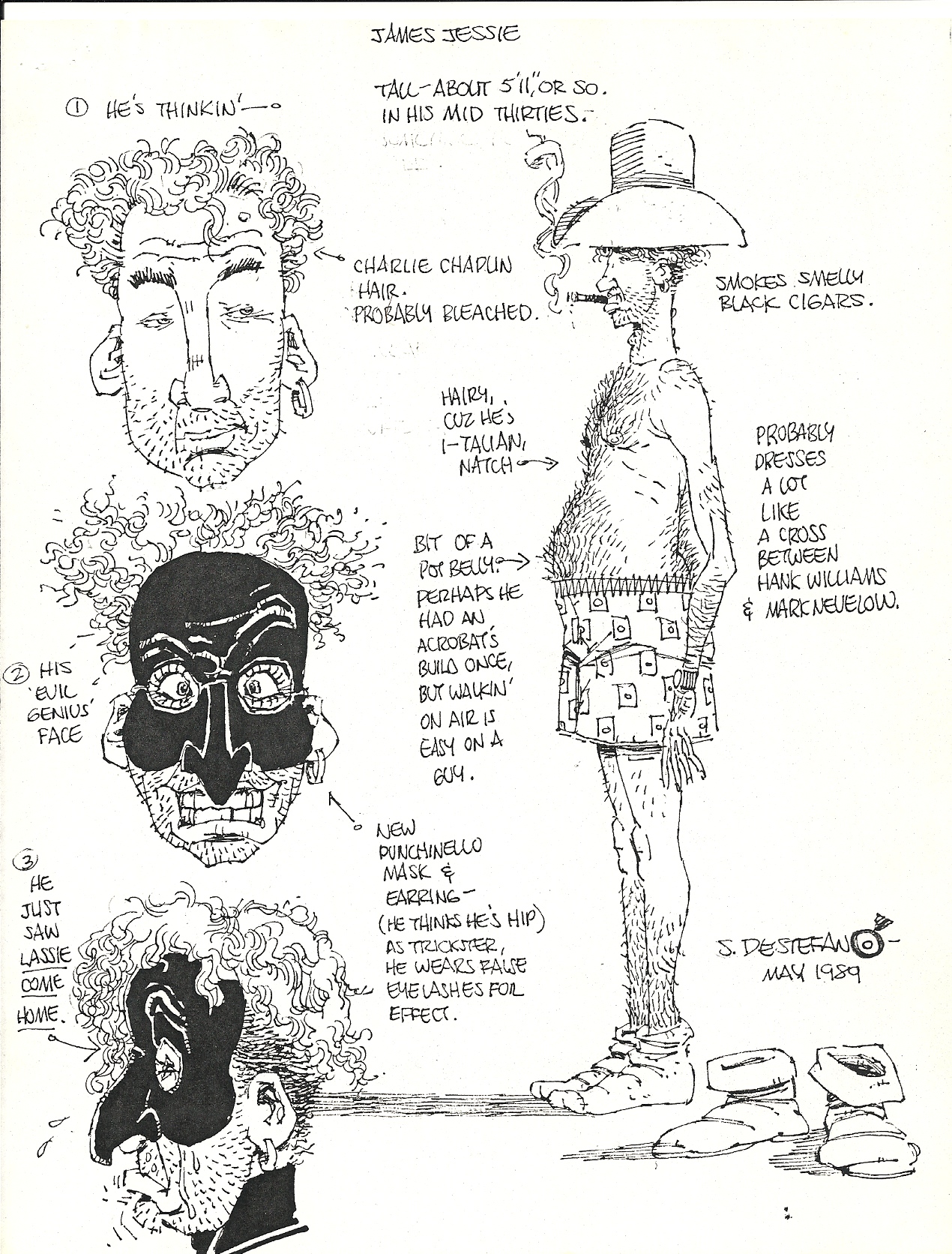
The Trickster (c) DC Entertainment

It was, Stephen and I were assured, a lock. An influential editor telling us to go forth and pitch a project that had his complete support and backing? Why, the proposal was just a formality!

A formality that kept getting kicked back to me by the editor for revisions, rewriting, and rethinking. Most were minor, cosmetic tweaks; I know this because I still have the files for three of the four drafts for comparison. Still, multiple revisions are not uncommon, nor are they any real indication of a proposals’, or a series’, chance of success. My proposal for the 1996 series Takion underwent six editorial revisions before being accepted, evolving from a revival of the Roger Stern/Tom Lyle incarnation of Starman to a wholly new character; for all that, Takion ran just seven issues. On the other hand, I was the editor who submitted the Grant Morrison/Mark Millar proposal for the 1996 series Aztek that was accepted on the strength of its first draft (and which then-group editor Denny O’Neil called “the best proposal” he had ever read); that series lasted ten issues.

But, four revisions later, The Trickster was as dead as the commissioning editor’s current career in comics.

I was told that it had been rejected by Dick Giordano (I forget what his title was at the time–managing editor, editorial director, something like that), who had “problems” with my work. Of course, two years later, when I met with Dick to discuss his “problems” with me I learned that not only had Dick not rejected the proposal, the editor had never even submitted it. Dick apologized for this treatment by one of his staff, then asked me if I would be interested in taking an editorial position that would soon be opening up. I told him indeed I would be…and was subsequently informed by the Trickster editor that it was he who had been responsible for getting me the staff position that Dick had offered me; indeed, he had to fight Dick tooth and nail to get me the gig. The reason for the editor’s behavior, as I later learned from a third party who witnessed the exchange, seemed to have stemmed from an offhanded joke made by a DC executive regarding my output for his office. I find it hard to believe the executive really had issues with the amount of work I was doing; I am, according to the excellent and comprehensive Mike’s Amazing World of DC Comics, currently the 19th most prolific writer (by number of stories published) in DC’s history–twenty years ago, I probably ranked several places higher on the list. Prolificacy doesn’t seem to have been a punishable offense, then or now.*

Anyway…

Very few projects are as fraught with drama as was The Trickster. Like I said, revisions were (and likely remain) a common practice, and it wouldn’t be the first or the last project of mine not to make it beyond the proposal stage. Hell, I’ve got a couple of file folders full of them. But The Trickster was a particular disappointment, both because it would have been a fun book to write and would have meant that I got to work with Stephen on a monthly basis. (We had previously done one story together–“Thud, Thud, Thud in the Mississippi Mud” in Tru Studios’ Trollords #7 in 1986–and would later be teamed up again on the Johnny Bravo story, “Johnny Delivers” in Cartoon Network Cartoon Cartoons #22 in 2003.) As you can see from the character sketches accompanying this post, whatever I might have done with the stories in The Trickster, Stephen would have drawn the living hell out of ‘em!

Of course, ideas don’t ever go to waste. I’ve since recycled many elements from The Trickster proposal into a young adult novel, of which I’ve written about 16,000 words.

Next time: The Trickster proposal of which I’ve been speaking.

*At the number one spot, by the way, is the indefatigable Bob Kanigher, with an astonishing 2,669 stories to his credit, clocking in at over 30,000 pages; the number two man is Gardner Fox, trailing far behind with 1,512 stories, at almost 18,000 pages; I come in with a relatively paltry 489 DC stories.

Tags: , , , , , , ,

Paul Kupperberg on July 24th, 2012

While meandering through the Westport Arts Festival this past Sunday, I walked past one of the artists whose work was on display and for sale just in time to hear him mutter, sotto voce and obviously in response to a question he had just been asked, something that at first made me laugh out loud but, upon further reflection, I realized was actually a pretty sorry commentary on some of the people who make art.

As local arts festivals go, this one was pretty typical. There were a lot of talented people represented, but it consisted for the most part of what I call “sofa art”; flimsy, inoffensive works–seascapes, landscapes, abstracts–with little or nothing to say other than “these colors would coordinate nicely with your sofa.” Most of them are done with enough professional proficiency that the artists have nothing to be embarrassed about, but they provoke nothing besides innocuous pleasure at the choice of palettes. I was able to stroll past almost all the more than one hundreds booths without encountering, more than a couple of times, anything that made me stop and take a second look.

The Friday before, I accompanied a friend to an opening at a gallery in Stamford. It was a photographic installation consisting of oversized negatives juxtaposed and overlapped and projected onto the white walls of the gallery. The negatives were all of New York’s Lower East Side, circa 1950. My first thought was, “Well, I could do this!” And if I could do it, how could it be art? But my friend pointed out two salient facts that made me stop and reconsider: (1) I hadn’t done it, and (2) it was not likely that I ever would have thought to do it.

Art, I’ve always believed, should have intent. Intent doesn’t have to be deliberate; the artist even have to know what the intent is before or during the act of creation, but when it’s done and they’ve stepped back from the work, they–as well as we, the viewer–should be able to find and articulate it. We don’t have to all agree on what it is, but if a piece doesn’t provoke a reaction beyond “those colors would go great with my rug,” we should question its validity to the claim of “art.” In the case of the projected photographic images, closer examination of what was thrown up on the walls by a series of a dozen overhead projectors did in fact lead me to a reaction, if only to get me thinking about what it was I was actually seeing in the overlapping images.

At the same gallery, another artist had opened her studio so those attending the opening could browse her work. She created fluffy, ephemeral images, using paint, fabric, feathers, string, and beads. At first glance, it appeared interesting, but to look at it in any depth revealed it to be little more than gift shop art; the pieces she had printed on expensive papers as greeting cards only underscored this impression. That the artist also took great pains explaining the pieces in detail, pointing out the barely discernable faces and figures in the swirls of color and fabric which she insisted were not painted by her intentionally but appeared because of the “spirit” that moved her hand as she worked, left me with the feeling that this was someone desperate to have something, anything, to say.

I don’t lay any claim to “Art” myself, nor am I trying to tell anybody what I think they should think art is or isn’t; art is entirely a matter of personal taste and just because I think, say, Jackson Pollock’s drips on canvas are a load of hooey doesn’t mean you can’t find them to be the height of artistic expression. As the saying goes, “I may not know about art, but I know what I like.”

I have long described myself as a “retail writer.” I mostly write to order towards specific commercial purpose, from comic books to coloring books to short stories or novels based on licensed properties. But, I’ve also long said that I don’t write for the money even if I do turn in the manuscript for a check. When I’m writing, even a Penguins of Madagascar color and activity book, I really do try and make it a good Penguins of Madagascar color and activity book, the best one I can possibly write.

What did I overhear that Westport artist mutter that lead me down this road?

“My ‘motivation’ is not to have to cash in my 401k,” he said. And looking over his paintings, it showed. I just don’t want anybody to be able to say the same about what I do.

Paul Kupperberg on July 20th, 2012

Several years ago I was at another of the boring parties thrown by some boring neighbors in Stamford, Connecticut, amusing myself with the only interesting person there, a genial and funny drunk named Chris. We always gravitated towards one another at these parties, even though Chris and I couldn’t be farther apart on just about any issue you can name: I’m a liberal, he’s a conservative; I’m an atheist, he’s a practicing Catholic; I believe in social programs for those who can’t take care of themselves, he believes everybody’s responsible for their own welfare. But we got on along just fine on one fundamental level: We both know if you don’t laugh about it all, it’ll just drive you crazy.

Hearing him tweak me about my stand on social issues, another guest, I don’t remember his name–let’s call him Herb, a mid-40s suburban hipster doofus with a shaved head, a beret, and facial hair du jour who drove a Range Rover because he lived “out in the woods,” i.e. more than three turns off a main road, all of them paved–let me know that he too was a liberal, but not one that followed the “party line.” He, for instance, was a gun owner. Back before I knew better than to engage such individuals in reasonable dialog, I asked this one what the fuck he needed a gun for.

Because he lived “out in the woods.” Because he had a wife and children and a home to protect. Because it was his right as an American to own a firearm to protect himself. It said so, right there in the Second Amendment: he has the right to bear arms. I asked him to recite the amendment to me. He said, with some satisfaction, “It says ‘the right of the people to keep and bear arms shall not be infringed.’”

The Second Amendment reads, in its entirety: “A well regulated militia being necessary to the security of a free state, the right of the people to keep and bear arms shall not be infringed.” I told him this. Asked if he was a member of a well-regulated militia as, you know, the entirety of the U.S. military probably wasn’t up to the job and could use his assistance.

Herb told me that while he wasn’t part of a militia, he was well-regulated. He, his wife, and his children had all undergone training in handling firearms. He kept his handguns in a lock box, unloaded, and secured with trigger-guards. He was a responsible firearms owner!

So, I said, if someone breaks into your house in the middle of the night, you’ve first got to get your gun out of the lock box, remove the trigger-guard, and load it before you can use it to defend yourself…and, by the way, it’s statistically more likely you’ll have that weapon taken away from and used against you, your wife, or your kids.

Tell me again what good having a weapon in your house is doing you, Herb…?

In reality, the conversation went on for more than half an hour, which was about half an hour longer than I really cared it to. The truth is, Herb just wanted to own a gun, and he wanted to convince me, an old-school lefty, that he was a responsible gun owner. Like millions of other Americans, it made him feel good to have a gun in his house. It made him feel safe. According to the Violence Policy Center, there are an estimated 192,000,000 firearms in the hands of Americans; 25% of adults own a firearm, with three-quarters of that number owning more than one gun each. Of that number, about 65,000,000 are handguns, most of them probably in lock boxes, unloaded, secured with trigger-guards, and doing their owners no good except to make them feel good.

But there are enough guns that aren’t locked up, secured, or safely hidden away with their bullets kept separately in the sock drawer.

In 1997, there were 89 firearm deaths a day in this country, one every 16 minutes.

In 2007, there were an estimated 17,300 suicides and 12,600 homicides by firearm.

This morning, 12 people who wanted nothing more than to enjoy the midnight viewing of The Dark Knight Rises are dead, more than 50 others wounded, and hundreds others traumatized, the latest victims of just one of those 192,000,000 guns.

We’ll learn soon enough what warped rationale the 24-year old shooter had for this act. We’ll hear endless debate apportioning blame. The fact is, we’ve become a violent society with easy access to weapons, an outdated rationale for allowing just about anyone who wants a gun to own a gun, and hamstrung by dueling ideologies into ever solving the problem.

12 dead. 50 wounded.

Sleep tight, Herb.

In the spirit of my own growing intolerance for shoddy and biased reportage and online bullshit and self-aggrandizement, I’ve decided to start deleting from the roster of my Facebook “friends” those who consistently post blatantly racist (and/or sexist) material.

Glancing at the feed of posts by these friends yesterday, I came across several posts by so-called birthers, questioning the legitimacy of Barrack Obama’s citizenship and, therefore, his presidency with arguments about his birthplace. This “controversy” makes me see red–as in red state; the only thing illegitimate going on is its inclusion in the public debate.

You can argue with birthers until the color of your own skin changes and you’re blue in the face, but trying to inject reality into the argument has proven to be a waste of breath. The releasing of the president’s birth certificate should have been proof enough to make this go away, but that fact that it’s still being raised leads me to believe that birthers just don’t want to believe he’s a citizen and has a right to the job to which he was legally and legitimately elected.

That this argument is mostly accompanied by some variation of the disclaimer “I’m not a racist, but….” shouldn’t be a surprise, nor does it exempt the disclaimee from the taint of racism, no matter how unconscious those motives may be. For all the poundings previous presidents have taken — including the disputed elections of Hayes/Tilden in 1876 and Bush/Gore in 2000 — the hue and cry over their legitimacy to hold the office were never this loud, this sustained, this vicious. Are we supposed to believe that the level of vitriol and effort being heaped upon a president over an issue that has been repeatedly disproved is just coincidental to his being the first African-American to hold the office?

The first instinct is to rebut the birthers, but if proof hasn’t convinced them, reason isn’t going to alter their views either. This faction believes what it wants to believe; trying to engage them in reasonable argument only lends credence to the irrationality that passes for their politic discourse. The magical thinking that allows listeners of Limbaugh and Beck to believe that to repeat a lie enough times makes the lie real is immune to reason.

Look, believe what you want to believe. Vote for who you want to vote. I’ve got a passel of issues with President Obama myself (less than I’ve got with Mitt Romney, but plenty), but mine are based on the things he’s done or failed to do while in office, not on some bogus issue about his place of birth or the color of his skin.

You can’t argue with irrationality so I won’t try. Instead, I’ll just brush them off my wall. Sure, the birthers will still be out there, but I don’t have to listen to them.

Paul Kupperberg on July 14th, 2012

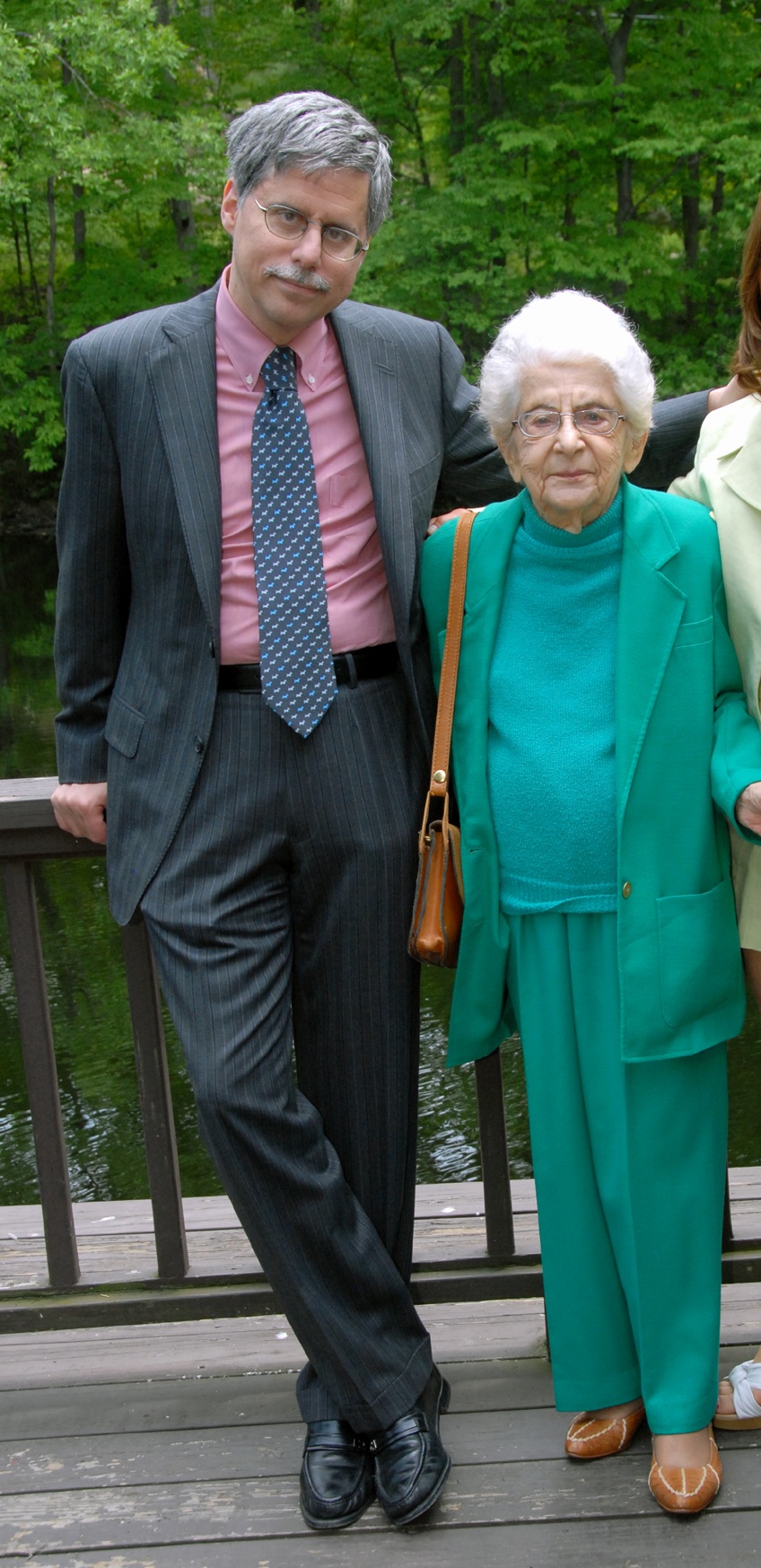
Paul and Hannah Levitz, May 28, 2009

Growing up in the East Flatbush section of Brooklyn, I had two homes. There was the apartment at 254 East 89th Street where I lived with my parents and brothers, and then there was the house at 393 East 58th Street where I spent most of my free time with my friend Paul Levitz.

Paul and I had met at Meyer Levin Junior High School (a.k.a. P.S. 285), through a mutual friend, Steve Gilary. We were the school’s contingent of comic book fans and quickly bonded on our mutual love of comics and collecting. Together, we started publishing fanzines in the late-1960s, crude, forgettable affairs produced on Xerox machines that no one but a few close friends and our parents ever saw. In 1971, we finally found a fannish niche to fill, scraped together a few bucks, and published the first issue of Etcetera, a newszine that eventually became The Comic Reader, marking Paul’s debut as a publisher and leading both of us to careers in the comic book industry.

Between 1968 and 1973, when I wasn’t home or in school, I was likely at Paul’s house. Paul’s parents, Alfred and Hannah, welcomed me (and the rest of that era’s members of fandom who constantly tramped through the place) with open arms. I came to feel like a member of the family and, I like to think, that feeling was reciprocated. In high school, when I was having trouble with Spanish and algebra, Mrs. Levitz would often sit with me at their dining room table (where we also produced our fanzines until we outgrew that space and moved the operation down to the basement apartment) and helped me with my studies. We sat at the same table with Mr. Levitz as he tried to teach us how to play bridge. Neither attempt at tutelage was successful, but they never lost their patience or their good cheer.

Mrs. Levitz was, as Paul’s perpetually slender form will attest, one of the world’s worst cooks. But she fed us toast with butter and grape jelly or happily drove us to pick up a pizza to make sure none of us starved. She wasn’t that good a driver, either, but she was always there to chauffeur Paul and us, his pals, wherever we needed to go.

When I got married to the first former-Mrs. Kupperberg, Mr. and Mrs. Levitz were, of course, on my guest list. As I introduced my bride to them, Mrs. Levitz smiled sweetly and said, “You’re a grown up now, dear. You can call us Alfred and Hannah.”

I didn’t keep in as close touch with them as I should have over the years, but Paul and I did and we used one another as conduits to pass pleasantries to our respective parents.

Several years ago, Paul gave a party at his house to celebrate his father’s birthday. I came with my son, Max, who was almost the same age I had been when Paul and I first met in the late-1960s. When I walked into the room with Max, she took one look at him and her eyes went wide with total wonder and delight. She took my hand and said, “He’s you, dear!” and, for that moment in a kitchen in Chappaqua, it was 1968 and we were back in that little house on East 58th Street in Brooklyn.

But Brooklyn was a long time ago. My father has been gone for nineteen years, Alfred passed away several years back, and I lost my mother just six weeks ago.

Now Hannah is gone too. She was, to the end, a feisty, outspoken little woman with an iron will and an intense love for her family: Paul and her three grandchildren, Nicole, Philip, and Garrett, and, in my heart at least, me, as well.

Tags: ,

As soon as someone I have just met hears that I write comic books (in general) or Archie Comics (in particular), it’s a pretty sure bet that I’ll get one of two reactions from them:

1. A delighted “I used to read them all the time when I was a kid,” or

2. A surprised, “I didn’t know they still publish those!”

Similarly, civilian friends (i.e. people outside the comics business and/or those who haven’t read a comic book since discovering the opposite sex…otherwise known as the majority of the human race) will have the same response to some piece of comics news that makes the popular press–the latest being DC’s “outing” of the Alan Scott Green Lantern. All this proves, of course, is that comics, once available and therefore visible on the racks of tens of thousands of newsstands, drugstores, and candy stores all across the country have simply disappeared from the public consciousness in direct correlation with their dwindling availability anywhere other than comics specialty shops which, after all, civilians do not frequent. Ever!

But while comic books themselves have all but disappeared from view, the comic book sensibility has actually experienced an exponential increase in the mass media consciousness. That sensibility dominates the movies and television not only in product taken directly from comics as the source material (Avengers, Spider-Man, Iron Man, Thor, Captain America, Batman, Men In Black, Walking Dead, etcetera and so forth), but in product whose form and direction are direct swipes of the comic gestalt, such as Full Moon, True Blood, Lost, Heroes, or most anything produced and/or written by the likes of J.J. Abrams, Damon Lindelof, Jeph Loeb, Alfred Gough, Miles Millar, Kevin Smith (sorry, just typing his name makes me throw up a little in my mouth), and similar creators, many of whom make frequent crossings between comics, TV, and films

Simply put, comic books, which once sold in the hundreds of thousands, now sell in the tens of thousand, if they’re lucky. A friend who has spent as much time in this business as have I was horrified to learn that a new title he was working on from one of the larger independent publishers had gotten orders of just over nine thousand copies…and the publisher was pleased with this number. While it’s true that Avengers has earned over $1,000,000,000 in ticket sales, Amazing Spider-Man $150,000,000-ish in its first week, and Dark Knight Rises will likely fall somewhere in between…well, I don’t write blockbuster movies or television shows. Neither do most of my friends and colleagues.

We write and/or draw comic books.

Which brings me to an article published a couple of weeks back (June 27) in the New York Times, “Super-Dreams of an Alternate World Order, ‘The Amazing Spider-Man’ and the Modern Comic Book Movie,” in which Times movie critics Manohla Dargis and A.O. Scott engage in a dialogue about the current domination of the superhero movie.

Dargis points out the almost evolutionary inevitability of comics acceptance and alliance with film:There was a time when motion pictures were considered disreputable too, bad for the moral and psychological health of not just (vulnerable) children but also (weak) women. Just like movies, comic books have undergone cycles of popularity, denunciation and legitimization that reflect larger shifts in mass and popular culture. Wertham’s anti-comic message was one facet in the high culture versus popular culture debates, one that was also expressed by a series of essays Edmund Wilson wrote, beginning in 1944, for The New Yorker, the first being “Why Do People Read Detective Stories?” He was focusing on a popular genre, which he characterized as a waste of time but also, amusingly, did read himself. ‘Friends, we represent a minority, but Literature is on our side,’ Wilson wrote. ‘There is no need to bore ourselves with this rubbish.’”

It’s Scott’s response, however, that is the crux of the biscuit: “But the kind of condescending dismissal practiced by Wilson and the cultural panic expressed by Wertham exist nowadays almost entirely as straw men. A critic who voices skepticism about a comic book movie—or any other expensive, large-scale, boy-targeted entertainment—is likely to be called out for snobbery or priggishness, to be accused of clinging to snobbish, irrelevant standards and trying to spoil everyone else’s fun.

What the defensive fans fail or refuse to grasp is that they have won the argument. Far from being an underdog genre defended by a scrappy band of cultural renegades, the superhero spectacle represents a staggering concentration of commercial, corporate power. The ideology supporting this power is a familiar kind of disingenuous populism. The studios are just giving the people what they want! Foolproof evidence can be found in the box office returns (of The Avengers): a billion dollars! Who can argue with that?”

Who indeed?

But I’m left wondering, Mr. Scott: Just what the hell exactly is it that comic books have won?

Paul Kupperberg on July 5th, 2012

Another of the series of columns on writing I did about four years ago for the website ComicsCareer.com…some of the references are dated (my son turned 16 last April and he’s finishing up the engineering and editing phase of the album his band Cheerleader just finished recording) but hopefully the advise isn’t…

Thought: The Enemy of Art?

About eight, nine months ago, my wife, our soon-to-turn 12-year-old son and I went to see Eric Andersen, a 1960s folk singer we like, play at a small club in a neighboring town. Andersen is one of these guys who travels by himself, playing small clubs and bars here in the States (he’s a much bigger name in certain parts of Europe but likes to come home and perform for the old hippies every year or so) and accessible during intermission and after the show to sell you some CDs, sign stuff, or just talk. We’ve been to enough of his shows that he recognizes us as regulars. This was the first time we brought the kid, who is a musician himself (a drummer, studying for about four years now).

After the show, we went up to say hello. Our son told Andersen that he was also a musician, had a band (they’ve played publicly several times, the last for a local arts & jazz fair as one of the opening acts for a major rock musician, his first paying gig), and asked if he had any advice for performing. Andersen took our son aside and spoke to him for a few minutes privately. After we’d said our good-byes and left we asked what the singer had told him. This is, boiled down to its essence, what he said:

Don’t think. Thought is the enemy of art. And forget about the audience. You’re not playing for them, you’re playing for yourself. Make yourself happy and they’ll be happy too.

That’s pretty profound advice to lay on a 12-year-old newbie, but I’m glad he did it, and I’m glad the kid’s got enough on the ball to understand what the singer was saying; not that you have disdain for the audience, but that you have respect for the music first and that will come through to the audience. I’ve been telling the kid that his entire life, from the moment he could pick up a crayon and started to worry or get frustrated about coloring outside the lines or using the wrong color for Spider-Man’s costume.

There are no rules in art. There is no right or wrong.

He asked me, several years back, why he had to learn all these rules of grammar. He was never going to need to know how to diagram a sentence in real life. Besides, I’m a professional writer and I can’t articulate half the rules of grammar, plus, I break the rules all the time when I write. True, I agreed, but at one time I did know them and could diagram a sentence and, to this very day, though I may not be able to name the parts of speech (a dangling whatthewhosis?), I know when something is wrong and I can fix it. And, besides that, I said:

Yes, I break the rules because there are no rules in art. And, before you start breaking the rules for artistic or any other reasons, you first have to know what the rules are.

I pointed out to him that as a musician, he first had to learn how to read music, then play it by the metronome and by the book before he started to learn jazz and how to improvise. It reminds me of the legendary comic book artist Alex Toth, known for his (brilliantly!) minimalist style, who said:

I spent the first half of my career learning what to put into a picture and the second half what to leave out.

That’s art: Learn it, then turn your back on it and make your own way. Just take the step. Don’t think about it.

Doesn’t sound possible. Writing—I’ll use writing as my example because that is, after all, what I do—is a thought process, putting words on paper in a certain order to achieve a specific narrative or emotional effect. Inform your reader of the locale or the time period, describe a character or setting, evoke fear or sadness, make them horny, whatever. You need to think about that before you jump in and start writing. This stuff doesn’t just happen by itself.

Well…it does and it doesn’t. Sure, you sit down and say, okay, in this scene, I want to achieve this thing that either moves the plot forward or reveals something about your characters, or both. In my recently completed mystery novel (a 1950s period story), I have one scene intended to convey new clues to the police detective; he’s talking to a waitress and short order cook in a diner and, while they drop the requisite information and plot points under his questioning, the scene took on a life of its own and became a set piece more about the character’s love of pie (he eats 3 or 4 pieces during the interview) and his integrity (he won’t take the pie as a freebie and insists on paying because he intends to come back often for the pie and wants to be a welcome visitor instead of a crooked cop on the take).

If had thought about doing a character bit like that, it would have come off as clunky and unconvincing, but by just letting it flow from the process of writing the information I needed into the story, it turned into the one chapter that two out of the four people who have read/are reading it have mentioned.

The real heart of your story comes out in those moments, the unplanned character bits, the spur of the moment inspiration that turns a minor character into a major player…another thing that happened in my mystery. Having elements of pastiche to it, I included a deceased real-life person who I got to know, thirty-five years later than the period in which the book is set, intending to use him in one scene, just as a tip of the hat to a man for whom I cared very much. But art knows no reason and he wound up coming back in later on in the book and, in fact, ends being a sort of Dr. Watson to my detective’s Sherlock Holmes. Didn’t plan that, never would have planned that, but it happened and, without thinking, I went with the flow.

Another example: in a Justice Society of America novel I wrote a few years back, the heroes are all down and about to bite the big one at the hands of the bad guys. The POV character for the book, Mister Terrific, a one-time Olympic athlete, flashes back to his only competitive defeat, a loss by like 2/10th of a second because he allowed himself to be distracted by how his competitor was running his race. It’s maybe 800, 1000 words out of 85,000, but that little flashback, the frustration of not only reliving that moment but of repeating it now when the stakes weren’t a silver medal instead of the gold, but his and his comrades lives as well as the lives of countless innocents, is one of four or five in the book that stand out to me as what these characters are about, not just events that push the story forward (although they do that, too).*

Plotting is a mechanical structure: One comic book writer friend of mine creates elaborate charts of story direction, individual character arcs, introduction of subplots, how long they played out, secondary and tertiary subplots and how they evolved to become major subplots and then the main plots. He can, on the down and dirty, connect the Legos-level of sheer mechanical plotting, wipe the floor with me. My plotting in comics, even ones I wrote over two, three, or four year stretches, was always ad hoc, based on some broad outline that I, sort of, knew where it was headed. Unless I changed my mind and went somewhere else because my free-form plotting allowed me the room to do that. With his plotting, you start pulling on one thread and the whole sweater unraveled.

I’m not bound by the specs of the plot-machine he builds for himself. He has said he envies my ability to write that way, more from the gut and less from the head. The gut is where the passion and the juice come from. The head is where rational thought lies. You want about 25% of the latter and 75% of the former in your work. Know where you’re going, understand the mode of transportation you’ve chosen to take you there, but don’t be bound by some route you’ve laid out on the map before you even left the garage. Take detours, visit interesting roadside attractions, cut across land marked with “No Trespassing” signs, leave the blacktop and explore some dirt roads, and stop every now and then for a couple or four slices of pie at that diner you pass along the way.

Just do it, but whatever else…don’t think!

+ + +

*The excerpt from JSA: Ragnarok follows below; it was finished in July of 2005 and due to various and sundry legal and technical difficulties–including the fact that the DC Universe this was written about no longer exists–I seriously doubt it will ever be published:

The 400 meter was the last event of the first day of the decathlon and Michael Holt felt nothing but good about his chances. The 400 was his event. He had already taken the 100 meter, the long jump, the shot put, and high jump, breaking one personal best and three Olympic records in the doing. He was well ahead in points and the odds-on favorite to take the gold. The whole stadium seemed to be on his side as he took his place at the starting line.

The closest thing he had to competition was the Kenyan, a whippet thin young man with densely corded muscles and deadly serious expression, currently in second place. He had gone over to shake the other man’s hand and wish him luck before the race, but instead of being a gentleman about it, the Kenyan had instead given him only the most perfunctory of handshakes and then turned his back on Michael.

Well.

If that didn’t call for some serious butt kicking, Michael didn’t know what did. He glanced over at his competitor, but the other man had his eyes fixed on the tape, 400 meters, just a shade under 361 feet down the track. The Kenyan was giving away nothing. He had to know he was up against a superior athlete. Any other year, he would have been a cinch for the gold medal. Just his luck to qualify the same year as the one competitor in the world who outclassed him.

Michael took his position, steadying his breathing. Out of the corner of his eye, he watched the Kenyan. The Kenyan ignored him. He only had eyes for the finish line. Too bad Michael’s back was about to block his view.

The starting gun barked and the runners pushed off.

Michael Holt sailed into an easy lead, legs and arms pumping in perfect rhythm, breathing in through his nose, out through his mouth. Every bit of technique he had ever learned  and had trained into himself so deeply that it was as natural as the beating of his heart came into play. He wasn’t just running, he was flying, fractions of seconds ticking off in his head with the accuracy of a Swiss timepiece. The world record in the 400 belonged to Michael Johnson at 43.18 seconds. Michael’s best in competition was 43.32. The Kenyan’s was 43.55.

He needed to shave only .14 second to tie, .15 to beat it.

And teach the Kenyan a lesson.

He allowed himself a glance at the Kenyan’s lane to his left. He saw the African was matching him, stride for stride. There was nobody between them. It was down to just them. The damned Kenyan was running the race of his life.

And the spectators knew it. Suddenly, the cheers were no longer for Michael Holt but for the Kenyan.

And then Michael stumbled, not much, just a half-step, nothing anyone but another runner would even notice, but enough to cost him less than a tenth of a second. Less than the blink of an eye.

But enough to lose him the race and cost him the world record.

The Kenyan broke the tape at 43.21.

Michael was right behind him at 43.26.

The stadium went wild. And just before he took his victory lap, the Kenyan turned his head and caught Michael’s glaring eyes, giving him an almost apologetic half-smile and a minute shrug.

Michael Holt went on to win the remaining five events the following day, giving him nine out of the ten and setting a still-unbroken Olympic record for the decathlon. Nine out of ten. The Olympic gold. But what he remembered most about his victory was that .05 of a second loss, all because he got cocky and allowed himself to be distracted by something else, taking his eye off the prize, off the finish line where it belonged.

Losing your focus. That’ll kill you every time.

Paul Kupperberg on June 29th, 2012

I’ve been getting paid to write stuff for over 35 years now and, while there are those who would claim I’ve been taking the money under false pretenses (myself included on more than one occasion), I have managed to pick up a few things about writing during that time, which I tried to sum up for a series of columns which originally ran about four years ago on the website ComicsCareer.com–hence some of the slightly dated references and examples. Now, you may say my points are kind’a obvious, but trying to read a lot of what’s coming out of Corporate Comics nowadays, maybe it’s time somebody stated the obvious…

What are you writing? A novel, a short story, a TV or film script? Whatever it is, you need one thing before you can get started:

A story.

What’s it about? Not “Boy meets girl. Boy loses girls. Boy wins girl back.” That’s the plot, the mechanical “getting everybody from A to Z” part of writing. The story is “Boy finds deep emotional attachment with girl, who reminds him of his deceased wife. Boy loses girl, who thinks he’s just another loser with a sick fixation. Boy wins back girl with the realization-won-through-trial that life goes on and a living love’s more precious than a memory.

Not much of a plot, but the difference should be obvious.

Should  be, but, even among professionals, it’s not always so obvious: I read an interview with the editor-in-chief of a great Metropolitan comic book company discussing the genesis of their annual company-wide-Change-The-Universe(-Again) “events.” He said he and his team of top tier writers (it doesn’t matter which company or writers; either of the Titanic Two could lay claim to this) set out to tell this universe changing story, yet they spent a week unable to find a way to approach the story that worked.

Then…epiphany!

They realized, after this long, hard creative struggle that what they needed to do was tell the story from the points of view of the characters being affected. Once they had that, he said, the rest of the story just flowed. (From the results, I’d say oozed or upchucked, but who am I to argue with success?)

That brilliant conclusion, what most of us call Writing 101, took the man setting the creative direction and his hand-chosen, best-selling, top name talent writers a week to arrive at. What should have been their first thought was their 1,001th.

Please don’t do as they do. Always remember that, like Soylent Green, “Story is People.” It starts with a character, throws said character into a situation with emotional and/or physical consequences with other characters while yet other characters still are involved in peripheral events which should at some point logically dovetail with the main story, either physically or thematically, leading to an outcome that resolves the situation through the character’s own emotional resolution. In other words, the story has to MEAN something to your characters if it’s going to mean anything to your readers.

John Steinbeck famously said that drama is the human heart in conflict with itself. Even if your story involves swords and dragons, or cowboys and rustlers, medieval knights or deep space explorers, your characters need to undergo the same types of emotional struggles your readers face every day of their lives. That’s why the concept of the flawed hero is so appealing: On the one hand, he can have great powers and perform miraculous rescues and feats while, on the other hand, he’s a total loser in love or can’t hold down a job. In comic books, Stan Lee’s genius had nothing to do with his choice of superpowers for his heroes, but for making them all so wonderfully flawed. Spider-Man is a stud in his leotards, but as Peter Parker, he couldn’t get laid to save his life; Reed Richards was the brilliant leader of the Fantastic Four, an emotional brick wall of a character , except when it comes to family and loyalty. Don’t even get me started on the complexities of Sub-Mariner, Doctor Doom and Black Panther. Sure, Stan was playing with pseudo-Shakespearean themes dressed up in tights, but the stuff endures for the same reason Shakespeare does; its continued resonance with each new generation of readers. (Yes, I know; talk to me in 400 years and see if they’re still talking about Stan’s work.)

And, in truth, going back to reread some of that stuff is painful. Stan was obviously floundering (sorry, no; really!) with Sub-Mariner during the early years, not knowing how to play the strip, but he eventually found his handle and, by the time he started handing books off to Roy Thomas and those who came after to write, the character was set. Subsequent generations of writers have since left their marks (and damage), but the Namor of 1965 is the distinct ancestor of whoever it is running around the Marvel books today.

And knowing that a character like Namor has been around as long as he has, it should be easy enough for a professional writer to identity the qualities that make him Namor and write a story about that character. But they don’t. Because writers today believe it is their job to take over a book and make their mark on a character, even if that mark is contrary to, even betrays everything that’s come before. A recent issue of ALL-STAR BATMAN AND ROBIN THE BOY WONDER featuring bad words not hidden behind black bars supposed to disguise them misses the point when a printing error is blamed for the aggravation these words being visible caused

The actual point is that those words—not even hidden behind black bars that really are black—have no place in a Batman and Robin comic book. Not even the suggestion of that language. I’m not saying you can’t use those words in print—I’ve used them and will again, so knock yourself out! But there’s a place for everything and everything in its place and the place for foul language is not in a comic book featuring a character familiar to every three year old in the country. That Batman, the one who lives in a world where that language is used, isn’t the Batman. It’s Frank Miller’s Batman and it’s wrong. You never want parents being shocked and asking the question, “Is that the same Batman that’s on little Timmy’s Underoos?” because if the answer is yes, the response is that Batman’s no longer appropriate for little Timmy, not even as a pattern on his undies. And, surprise, surprise, Batman should be bigger than the people who want to mess with it.

The long-term value and concept of BATMAN is of far greater value than the short-term self-indulgent needs of Frank Miller or any other writer who wants to mess with it. No matter how influential a talent, the proper response by the editor (or the Publisher, if the editor doesn’t have the authority to deny the sundry 800-pound gorillas anything) should have been: “This is Batman. It is corporate policy to forbid that language or these situations in connection with him.” DC’s and Warner’s interest in Batman is far greater than anyone’s worth as a freelancer.

Why am I ragging on Frank Miller? I’m not. I’m ragging on DC. It’s Frank’s job to try and push the envelope and (it seems to me), his delight to piss off  the readers. I wish him continued success in both endeavors, but the character should always come first. Always. Things like this erode a character, slowly but surely; look how Batman’s gone from the campy “Pow! Zap! Bam!” 1960s incarnation to this new, over-the-top psychotic on a mission version. Neither of them is right; the truth, as usual, lies somewhere in the middle. But you need to find that truth and be able to understand the character. They say a journey of a thousand miles starts with a single step, but if that single step is out a third story window, you’re not going to get very far. A misstep in your initial, basic understanding of the people you’re writing will have pretty much the same effect. And even if you don’t look down, you’re still going to fall.

Because if you don’t get the character right, how the hell are you supposed to know what he’ll do when he starts to make his way through your story?

Paul Kupperberg on June 25th, 2012

I’ve finally had it. I just can’t take it anymore. Effective immediately, there’s some online comics columnists I’m deleting from my bookmark and reading lists.

It’s not that I don’t agree with their points and positions; in many cases, we’re actually on the same page on matters creative, social, and political. What I have a problem with is their takes on history and their grips on reality.

Once upon a time, having a column meant writing for a print publication. Becoming a columnist meant that an editor or publisher thought you had something to say and the chops to say it. And it meant there was someone there to reality check what you were saying.

Nowadays, all that having a column requires is an internet connection (to which I offer myself as Exhibit A in support).

Of course, everyone’s entitled to their opinions…no, strike that: Everyone’s entitled to their informed opinions. Oh, you can have any opinion you want. Man and dinosaur coexisted on an Earth that’s only 6000 years old? The 1969 moon landing was an elaborate hoax? One race is inferior or superior to another? Someone else’s sexuality is anybody’s business but their own? You go, girl! Science says you’re wrong, but the Constitution says nobody can stop you from saying it anyway. I myself hold a lot of opinions that fall outside of the mainstream and if I want to be able to express my thoughts freely, I’ve got to extend that same right to you.

But as entitled as we are to our own opinions and beliefs, we ain’t none of us entitled to our own facts.

Facts are called facts because they’re, y’know…factual. They are true independent of anybody’s opinions or beliefs. You can believe wet is dry or up is down all you want, but the believing doesn’t make it so.

All too many of these columnists regularly want us to believe that the Pacific Ocean is just a big pile of sand. I’m not talking about their opinions on the current output of modern mainstream comics either; there are plenty of people who sincerely like what Corporate Comics offers for sale these days. I don’t, but I can easily agree to disagree there. Taste is a personal thing; I’ve tried to raise my son not to wrinkle his nose in disgust because someone likes something he doesn’t. In the case of taste, there are no facts, just individual preferences.

What I’m talking about are the manipulations of the facts, those indisputable bits of reality on which personal taste or opinion have no bearing. Some of them have been and/or still linger around the fringe of the business, and everything they write involves claiming credit for some part of whatever it is they’re writing about. A recent entry by one on the current state of comics made casual reference to a catchphrase which, oh by the way, the columnist coined; forget that it’s been in common usage far longer than their time in the industry. Another spends the entirety of his/her columns spouting the most blatant self-promotion that I’ve yet to see backed up any actual product or production. Yet another was present at every major intersection in the post-Silver Age comics industry and was, it seems, instrumental in changing the course of history at every turn.

Whatever the person, place, or thing mentioned, they discovered him/her/it or are somehow responsible for its creation, popularity, or success. There’s one who starts every sentence with, “Did I ever tell you about the time when I…(fill in the blank)?” DC Comics VP Bob Wayne gained a whole new slew of respect from me on one such occasion when he interrupted that opening line by asking, “Is this the story where you’re the hero?”

I’ve been in the comic book business since 1975 and was in the room–or least the neighborhood–when a lot of the events related for personal glory in these columns were taking place. In many cases, I know the people who actually made the decisions or set the policies for which these guys now take credit. In some instances, the actual decision-makers have died, leaving the field clear for historic revisionism; in others, the policy-makers would never think to pound their chests and brag about their accomplishments. Believe it or not, at the time they did what they did, it was because it was either the right thing to do for the industry or the talent, or was just plain old good business.

Yes, we all write our own stories (I’m writing mine right now) and the tendency to make ourselves the hero is always there; I’ve done it myself, I’m sure…hell, aren’t I the high-minded seeker of truth in this story? But in a year when I’m constantly being bombarded by political messages from both parties saying they’re unfailingly right and the other guys unfailingly wrong, I’m tired of having to deal with the same sort of factually-challenged self-aggrandizement when I’m reading about comic books.

+ + +

What online columns and sites do I read? So as not to end on a total downer, here are a few of my favorite things:

My old pal Tony Isabella provides an entertaining look into comic books old and new, along with some brutally honest insights into his personal life in his daily Bloggy Thing. It doesn’t hurt that Tony’s been quite generous in his reviews of my own humble creative efforts, but that’s just icing on the cake. Speaking of pals who don’t fail to entertain, Rob Kelly takes on all things King of the Seven Seas in his Aquaman Shrine (and an assortment of other interesting comics blogs which you can click through to from there). I also recommend the blogs and/or websites of Bob Greenberger, Bob RozakisMark Evanier, and Todd Klein, as well as Mark Waid’s site, where he’s breaking some new ground in self-publishing and online comics.

For news, you can’t beat Heidi MacDonald’s The Beat, Rich Johnston’s Bleeding Cool News, and Comic Book Resources, while for snarky mockery of comic strips, I head on over to The Comics Curmudgeon. And when I’m hankering for a dose of good old-fashioned mimeographed and ditto’ed fanzine goodness, I make a beeline for Chain Letters For Disturbed Children.

And, because Danny Fingeroth demanded it: Don’t Believe Everything You Read, Part I!


Tags: , , , , , , , , , , , , , , , , ,

Paul Kupperberg on June 19th, 2012

I cried the day Julie Schwartz died. It was February 8, 2004, a Sunday, and Paul Levitz called me that morning to deliver the news. My then wife and I had family coming over later in the day for a visit, but I spent that Sunday in numb shock over the loss of that dear, dear man. Julie wasn’t just an editor and a friend, he was that crusty, curmudgeonly old Jewish grandfather I never knew. Long before I ever met him, he had given me vast chunks of  childhood memories that set me on the path to the career that would eventually allow us to meet, to work together, and, most importantly, for us to become friends.

Today would have been Julie’s 97th birthday.

Here are two pieces I wrote about Julie Schwartz, the first appearing in an issue of Comics Buyers Guide commemorating his 60th Anniversary (!) as an editor at DC Comics, the second for a DC Comics tribute following his death.

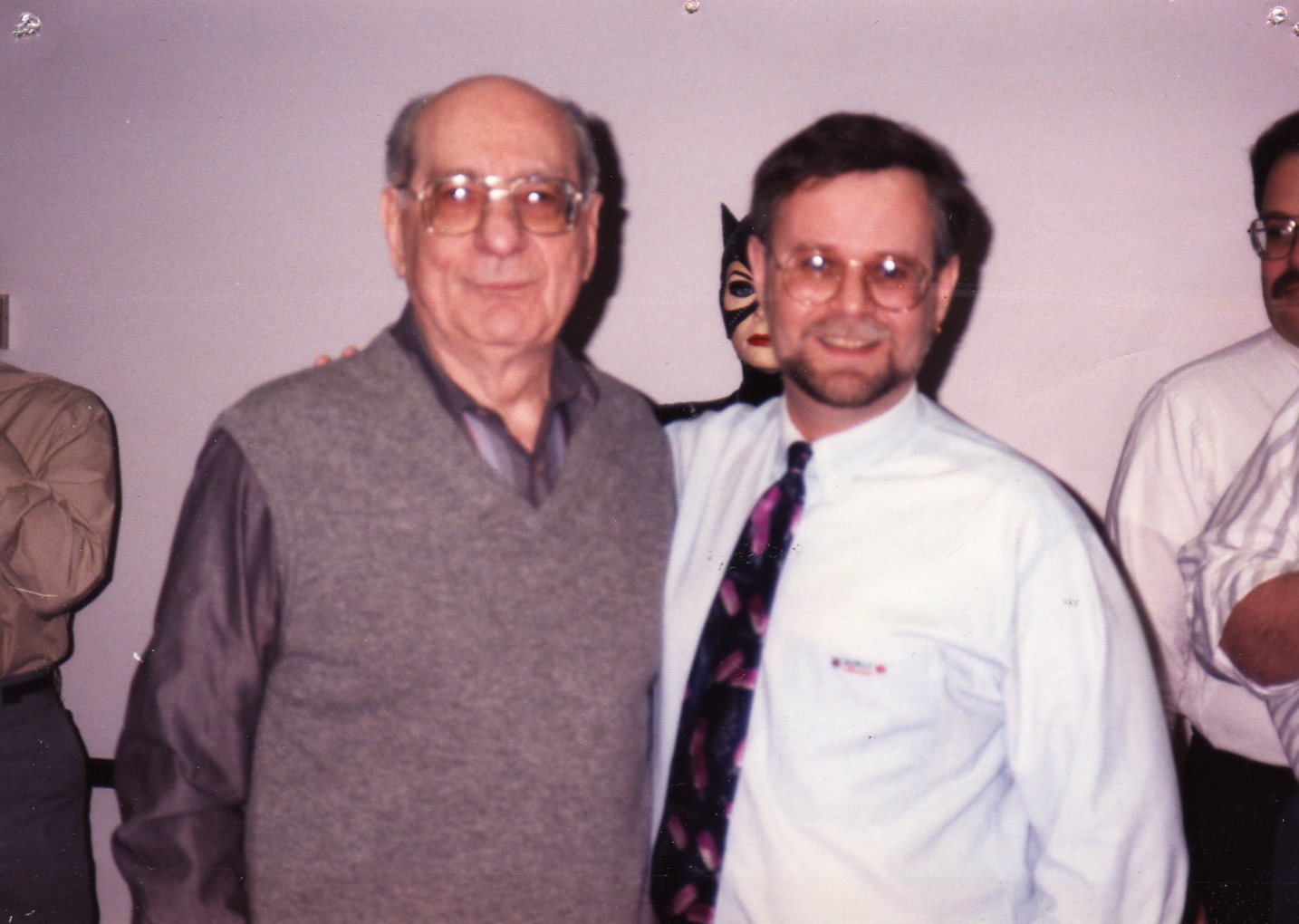
Julie & Me, at an early-1990s DC Comics birthday party for the maestro

Like every comics fan of a certain age, I was raised on the books edited by Julie Schwartz. While the Batman and Robin of 1963 were fighting aliens and giant robots, while Superman was engaging in battles of wit against mobsters in suits, heroes in the Schwartz stable of books (including THE FLASH, GREEN LANTERN, THE ATOM, JUSTICE LEAGUE, and Adam Strange in MYSTERY IN SPACE) were facing off against criminals and menaces worthy of their great powers and abilities. You could, as far as I was concerned, keep your Marvel Comics with their purple prose and soap opera conceits; Schwartz’s guys had been displaying their fair share of personal problems and angst years before Fantastic Four #1 hit the stands. (In fact, as legend has it, it was Marvel’s publisher learning of the sales success of the Schwartz helmed JUSTICE LEAGUE OF AMERICA that was the impetus for the creation of the Fantastic Four. No Schwartz, no F.F.—and, perhaps, no Marvel. Who knows?)

For as long as I can remember, Julie Schwartz was the Editor in comics. When Batman was struggling to survive on the newsstands of the early-1960’s, the character was handed to Schwartz for a major retooling. The result was the “new look” Batman. Gone were the robots and aliens. Batman the detective—the character as he was created to be—was back. Next stop for Batman? The Batman TV show that revived the character’s popularity and gave comic books in general a much needed shot in the arm. Julie did that.

Julie pulled off that level of creative magic so many times in his editorial career—his second career by the way, begun in 1943; his first was as a literary agent for the top names in science fiction of the 1930’s and 40’s—that it was probably just business-as-usual for him. Not for the fans, though. For us it was always a matter of waiting to see what he would do next.

I started writing for DC Comics in 1975. I honestly don’t remember what the first thing was that I wrote for Julie, but it must have been around 1980 or 1981 that he first asked me to pitch him some Superman stories, after I had a fair number of stories under my belt. What I do remember is how nervous I was heading into the Schwartz’s Den that first time. Julie was a certified legend. I was a humble newcomer. He was gruff Perry White, I was bumbling Jimmy Olsen. Editor of legends like Alfred Bester and Gardner Fox and John Broome. I was a kid who had written a bunch of stuff for HOUSE OF MYSTERY and WEIRD WAR TALES. Julie was…well, Julie Schwartz!

I had a bunch of ideas to throw his way, but I barely had time to stammer my way through the first one before Julie jumped in, tossing out idea after idea. Just bits and pieces off the top of his head, any one of which would make for a fine story in its own right. For once in my life, I shut my big fat mouth, listened, took notes, and learned.

Evidently Julie saw something in my execution of his ideas and let me actually pitch my own stories. Before long, I was writing not only Superman, but SUPERBOY, SUPERGIRL, and DC COMICS PRESENTS for him. Pretty soon we were friends and, eventually, I even stopped being afraid of him. But one thing that hasn’t changed and never will is this:

I never actually felt as though I had made it for real as a comic book writer until the day I sold my first story to Julie Schwartz, the best damned editor in the history of this business.

+ + +

It’s taken a while to absorb the reality, to go from our weekly visits and having just written to CBG commemorating his 60th anniversary at DC to saying good-bye. Growing up reading the comics coming out of his editorial office, I feel like I’ve known Julie Schwartz my whole life, even if our relationship didn’t begin until around 1980. It started out as strictly professional—I was way too intimidated by this living legend with the impatient bark and growl in his voice to even think about anything else—but developed over the years into something more. All it took was discovering that this gruff guy behind the editor’s desk was all bark and no bite. He was, in fact, a pussycat, and once he “adopted” you, you were family and family, as I learned, meant more to Julie than anything else in the world.

Most Thursdays since his retirement, I’d wander up to the 6th floor and drop in on him in his office. We’d chat, we’d gossip, he’d tell stories, I’d listen. Every week, without fail and with a big smile, he’d growl “How’s Maxie?” referring to my 7-year old son Max, who Julie had met once, about four years earlier at a convention. And when the visit was done, he’d send me on my way with an “Awright, you’re dismissed,” and I’d head on back to work with a “Later, Schwartz!” I already miss those Thursdays. I miss Julie not sharing the world with us any longer.

Julie, as everyone who knew him will tell you, loved to tell stories. One of those stories concerned a middle school class that came through DC one day on a tour. After he had waved hello to the kids and made small talk, the class moved on. Except for one boy, who lingered in his office door. Julie told him to hurry along or he’d miss the rest of the tour, but the kid wanted to ask a question.

“You’re Julie Schwartz, editor of The Flash, right?”

Julie admitted that he was.

“So that means you’ve got Flash’s Cosmic Treadmill in your closet, right?” the boy asked hopefully, referring to a recent story in which Julie had appeared as his Earth-Prime self meeting the Earth-One Flash, who built the time-travelling Treadmill in order to return to his own world.

Julie explained that that had just been fiction, that the Cosmic Treadmill was an imaginary device in a make-believe story. He couldn’t understand why the little boy looked so crushed by this news, so Julie asked.

“Because,” the boy said, “my dad died last year and I wanted to use the Cosmic Treadmill to go back and tell him I love him.”

It sure would be nice to have that Treadmill right about now.

Later, Schwartz.

Tags: , , , , , , , , ,