Sometime around 1994, I worked with DC Comics editor Dan Thorsland on a proposal to revive the Roger Stern/Tom Lyle Starman (Will Payton) (1988-1992). Having myself been the final editor of that title (I was handed it to run out its time, with little hope of saving it from cancellation), I was more than passingly familiar with the character and his fate. In case you don’t remember, Starman “died” fighting Eclipso (whose then ongoing series I was also handed to run out…the sad fate of the newest editor on staff) during the 1992 DC company-wide crossover event, Eclipso: The Darkness Within miniseries, leaving him literally drifting in the (cosmic) winds.
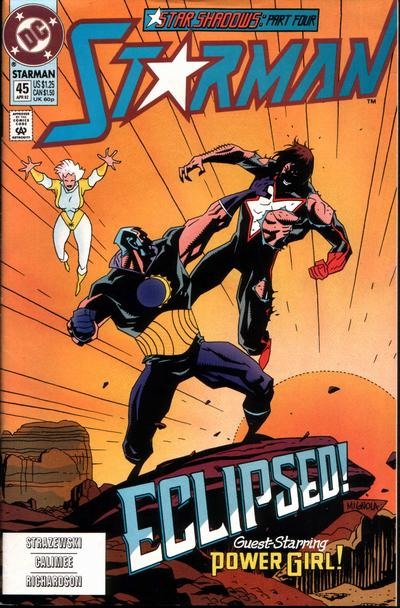
Unbeknownst to me and Dan, over in editor Archie Goodwin’s office, a very different (and eventually award-winning) version of Starman was in development with writer James Robinson and artist Tony Harris (Starman, 1994-2001). It only became beknownst when we fed our Starman proposal into the pipeline for review by the senior editors (Archie Goodwin, Denny O’Neil, and Mike Carlin); our Starman was bounced like a Spalding.
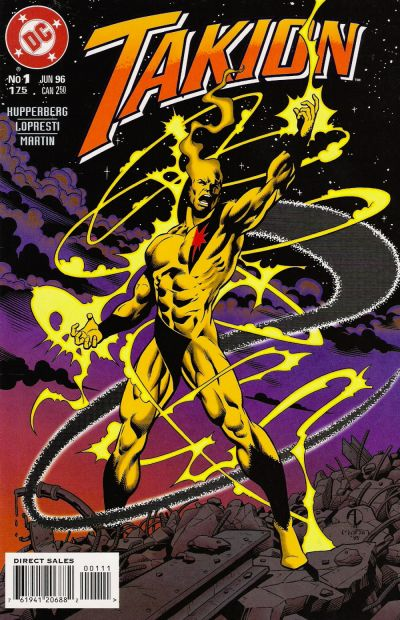
Instead of just chalking it up to experience and sticking the proposal in a drawer, Dan suggested we salvage what we could from it and use that as a foundation to create an entirely new character. This we did and, after a bunch of talking (usually over shabu-shabu at a Japanese restaurant near the DC offices) and a few drafts, “Will Payton…Starman” became “Josh Saunders…Takion, co-created with artist Aaron Lopresti.
Takion lasted all of seven issues (1996). Oh well.
The Saga of Starman proposal is below for your reading pleasure.
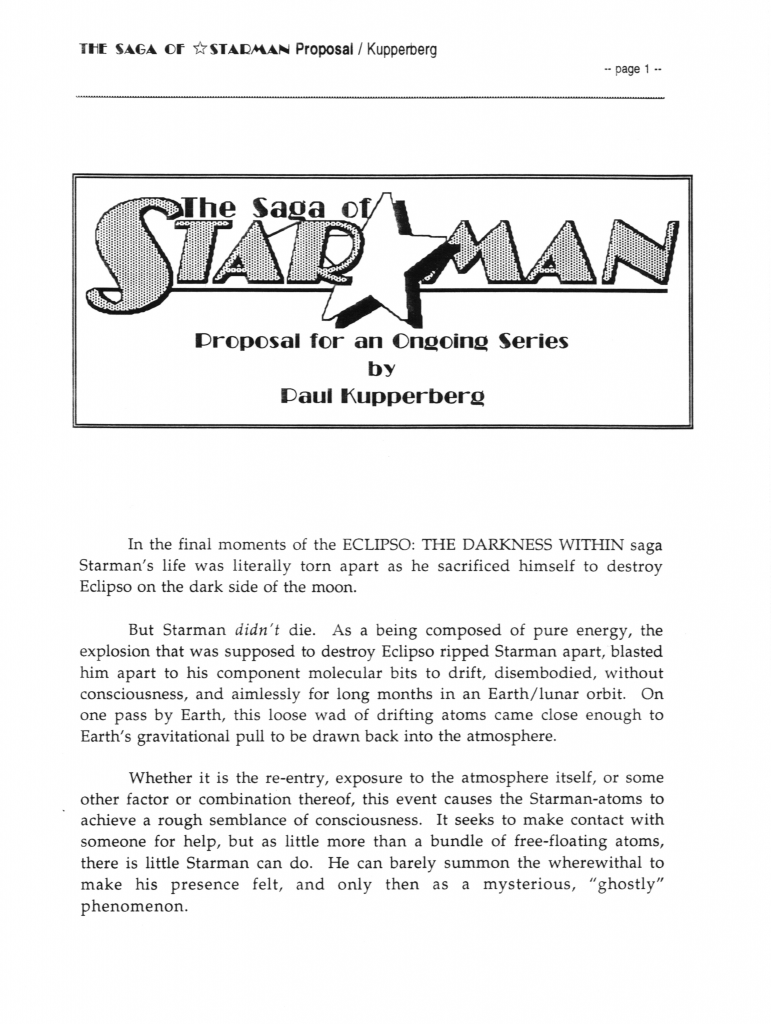
The Saga of Starman Proposal for an Ongoing Series
In the final moments of the ECLIPSO: THE DARKNESS WITHIN saga Starman’s life was literally torn apart as he sacrificed himself to destroy Eclipso on the dark side of the moon.
But Starman didn’t die. As a being composed of pure energy, the explosion that was supposed to destroy Eclipso ripped Starman apart, blasted him to his component molecular bits to drift, disembodied, without consciousness, and aimlessly for long months in an Earth/lunar orbit. On one pass by Earth, this loose wad of drifting atoms came close enough to Earth’s gravitational pull to be drawn back into the atmosphere.
Whether it is the re-entry, exposure to the atmosphere itself, or some other factor or combination thereof, this event causes the Starman-atoms to achieve a rough semblance of consciousness. It seeks to make contact with someone for help, but as little more than a bundle of free-floating atoms, there is little Starman can do. He can barely summon the wherewithal to make his presence felt, and only then as a mysterious, “ghostly” phenomenon.
(A possible crossover stunt to precede the launch of a new STARMAN title: a series of unexplained encounters that hit different heroes in their books in the course of their normal activities. It need be nothing major, something as small as a one or two panel “feeling” that they’re being watched or that there’s someone there as the disembodied Starman attempts to make contact.)
Finally, unable to draw any attention to his plight, Starman allows himself to drift away from Earth. Once out in space, Will’s disembodied atoms are caught by the solar winds and blown off into deep space, out of the solar system.
Out of the galaxy.
Time passes, with the Starman-consciousness drifting aimlessly through space, aware of its surroundings, learning what makes the cosmos tick, and how he, as a being of pure energy, fits into the cosmic scheme of things. Eventually, an event occurs which enables Starman to coalesce back into a solid — if not entirely human — form: his scattered atoms are sucked into a wormhole, condensed, and spit out the other end, in a galaxy far, far away.
As a being of pure energy, he doesn’t need to take human form — he doesn’t really need to take any solid form. But out of habit and because it’s familiar, he takes on a form resembling his human identity, Will Payton. Starman is far from Earth. He could find his way back, of course—as an energy being, we will learn that he possesses the ability to tap into the universal energy flow—but he chooses not to. Instead, he decides to leave Earth and the teeming humanity of which he used to be a part, behind. It’s not because he’s entirely lost his humanity, rather it’s because he’s experienced so much in his time as pure energy. Having had almost three decades being one, he knows all he needs to know about being a human, and now that he’s moved to a new stage in his existence, he wants to learn all he can about the universe he inhabits and that has so much to offer one with his power.
Thus begins Starman’s “rebirth” as a star-spanning cosmic adventurer and hero. The first six issues of the new series will establish him in this more powerful incarnation, explore his powers, look at what makes him tick as he’s redefined in this new form. Starman’s “death” was, literally, a senses-shattering experience; his experience as a disembodied consciousness unable to reform itself messed with his mind. Maybe there’s a certain amount of madness to him in this new, more powerful and not-quite-human form. Maybe it’s just that his actions and motivations have changed and are no longer quite human and recognizable to us.
Either way, Starman is different now. He’ll eventually come to grips with his powers and situation and, when a menace of cosmic proportions forces his return “home” to Earth, he will see again what it was that he was, what of that former existence he still possesses, and be somewhat healed by the experience. No longer human, but certainly sympathetic to humanity; not a man, but most definitely fond of the mankind that he was born into. He may no longer be human, but he was one long enough that humanity means something to him. All it takes is exposure to his friends and family to remind him of this.
Maybe he intended to deal with the menace threatening the planet and then leave again, but once he sees his home, once his mother and sister embrace him in relief that he’s alive after they so long believed him dead, he sees he hadn’t really lost his humanity; he’s merely misplaced it in the rush and confusion of his major transformation and life altering experiences.
The new SAGA OF STARMAN will established Starman as a star-spanning, cosmic hero, no longer bound to Earth by physical necessity, but held there by emotional ties. Starman/Will Payton maintains contact with Earth and his family and friends because he wants to, because for all his newfound powers and abilities and the change that made him so much more than human, he is, at the bottom of things, very much tied to his roots. Just because he’s no longer a human being doesn’t mean he no longer needs human contact; his intellect, his emotional base, is from his having been born and raised Will Payton, human. No matter what his physical being has become, his heart and soul are still very much human. He’ll just need time to relearn/ realize/remember that.
The new Starman is different, focused. He no longer needs to “learn” about being a hero. Even before the change, he’d been at the hero game long enough to know what he was doing and this latest experience confirms his experience and abilities. Starman is an accomplished hero now, no longer fighting piddly little villains. THE SAGA OF STARMAN is the story of a bigger, more powerful super-hero (probably one of the top five most powerful in the DC Universe) who handles big, overwhelmingly powerful threats equal to his power.
By tearing Starman literally to pieces and rebuilding him from the physical and emotional ground up, he becomes an all-new character with a new outlook and approach to his adventures, but one grounded in the familiar. There’s no more of the goody-goody, hesitant wuss he was up to the DARKNESS WITHIN. He’s big, he’s powerful, he’s kickin’ butt and taking names later. He means business, although that’s not to say he’s become a “dark” Starman; he’s just not the same uncertain clown he was through his first series.
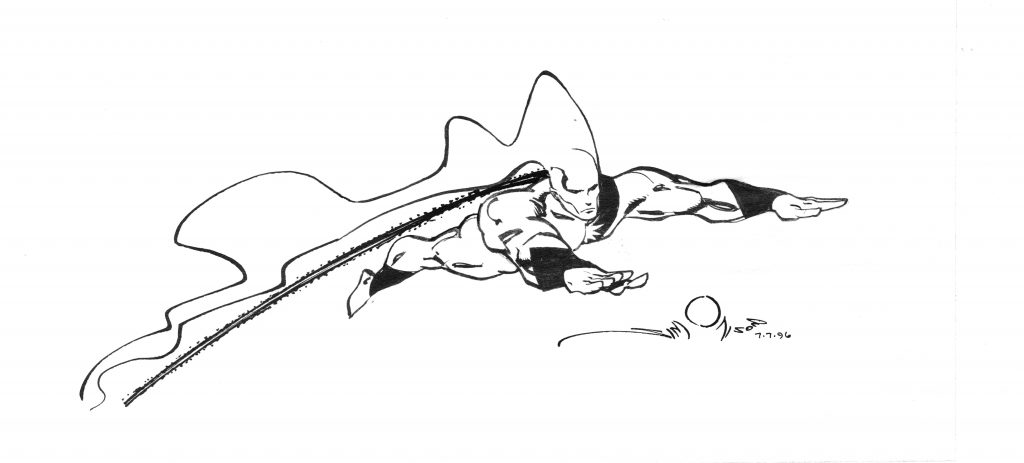
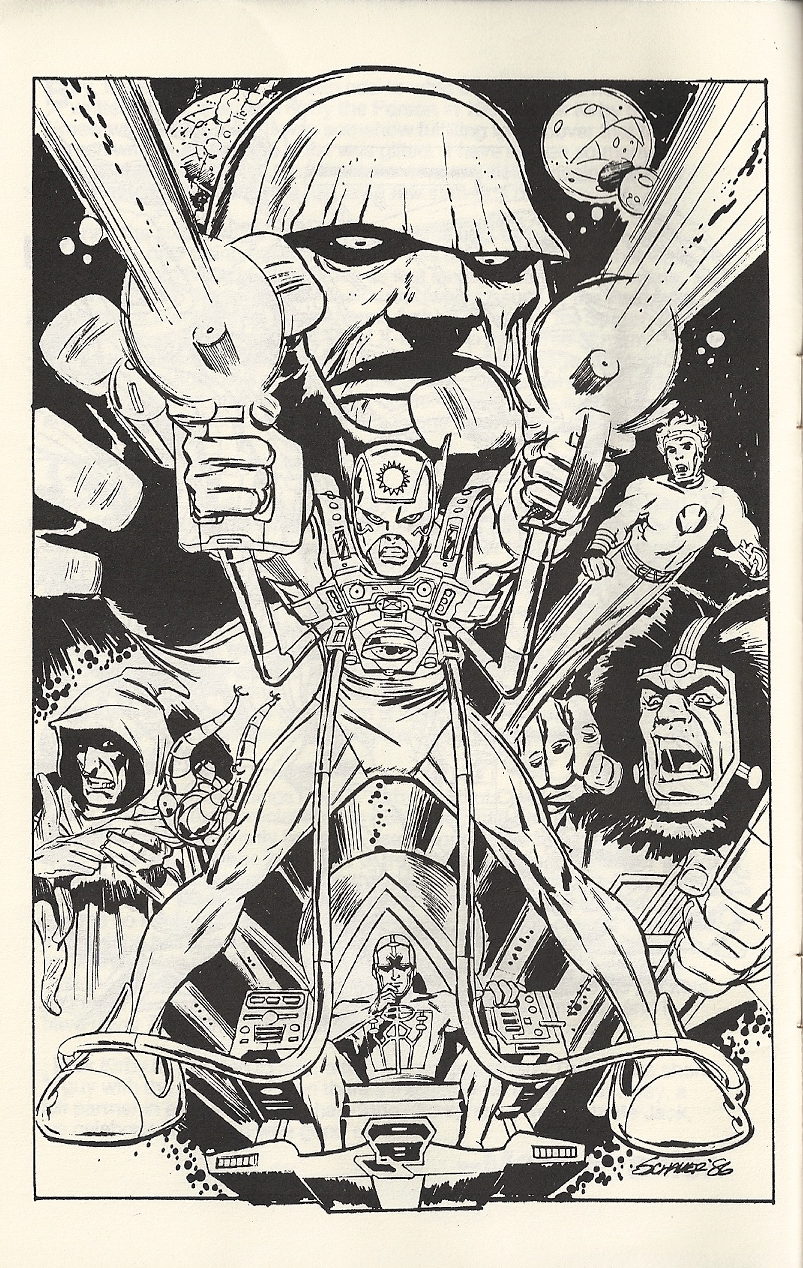
The new Starman’s costume (a constantly shifting starfield against a black background) isn’t actually a costume but a physical manifestation of his internal powers. He can hide the starfield whenever he chooses — part of the chameleon ability he’s had all along, but which he now more readily and easily controls—which he does when he “becomes” Will Payton. He keeps his alter ego, less because of any need for a secret identity but because it enables him to more easily move among, and relate to, people.
The initial story arc details what THE SAGA OF STARMAN #1 happened to Starman after THE DARKNESS WITHIN #2, how he came to be this new, more powerful incarnation, follows his first cosmic adventures, and culminates in his return to Earth to combat the menace threatening the planet and rediscover his “lost” humanity.
The first story arc will also explore the extent and limits of his redefined powers. He’s no longer a wishy-washy type. His is the power of the universe, one with the various forces of the universe, a conduit for the cosmic flow. There’s no uncertainty or hesitation in such a character. He’s powerful and he knows it!
Since ECLIPSO: THE DARKNESS WITHIN #2 shipped in late Summer, 1992, that gives us a minimum of a year, a year and a half between that and a relaunch, more than enough time to put some distance between the market and the previous STARMAN series. Second, it allows time to build up the character in the minds of the readership through references to Starman’s heroism in other titles, as well as through the aforementioned attempted-contact stunt. Since no one believes anybody ever really dies, we can play off that in other DC Universe titles, tease the reader with his eventual “rebirth.”
There may even be a time travel angle that can be played with that could have the new (and unidentified) Starman popping up in stories before a relaunch; then the time travel gimmick can be explored and explained in the new Starman title, months later. There are any number of ways we can play it, lots of ways we can excite interest in a relaunched STARMAN.
The End
Tags: Aaron Lopresti, Archie Goodwin, comic book series proposal, Dan Thorsland, DC Comics, Denny O'Neil, Eclipso, Eclipso: The Darkness Within, Gary Martin, James Robinson, Josh Saunders, Mike Carlin, Mike Mignola, Roger Stern, Starman, Takion, Tom Lyle, Tony Harris, Will Payton







Recent Comments